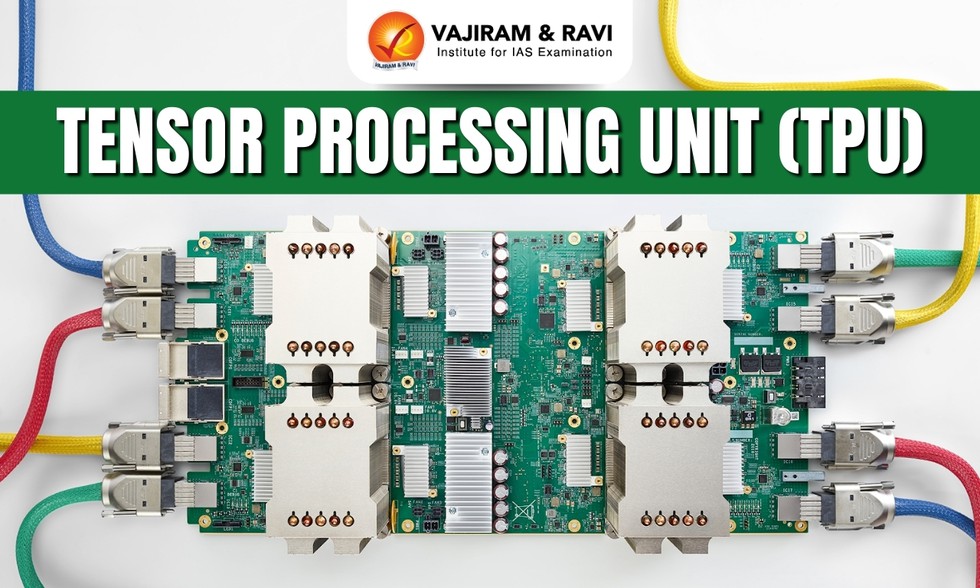
About Tensor Processing Unit (TPU):
- A TPU is a specialized chip designed to accelerate AI and Machine Learning (ML) tasks.
- Unlike traditional Computer Processors Units (CPUs) or Graphics Processing Units (GPUs), TPUs are specifically built to handle the complex calculations required for deep learning models.
- TPUs were developed by Google to improve the performance of their AI applications, such as Google Search, Google Translate, and Google Photos.
- Since then, TPUs have become a key component in AI infrastructure and are widely used in data centers and cloud computing.
How Do TPUs Work?
- AI models rely on a type of mathematical operation called tensor computation.
- A tensor is a multi-dimensional array of numbers, similar to a table of data.
- Deep learning models use these tensors to process large amounts of information and make predictions.
- TPUs are optimized for tensor computations, allowing them to process large datasets much faster than CPUs or GPUs.
- They achieve this through:
- Massive parallelism: TPUs can perform many calculations at once, making them highly efficient.
- Low power consumption: Compared to GPUs, TPUs use less energy while delivering high performance.
- Specialized circuits: TPUs have circuits specifically designed for AI workloads, reducing the need for unnecessary computations.
- While CPUs are great for general tasks and GPUs are an excellent choice for gaming and AI, TPUs are specifically designed to make AI models work faster and more efficiently.