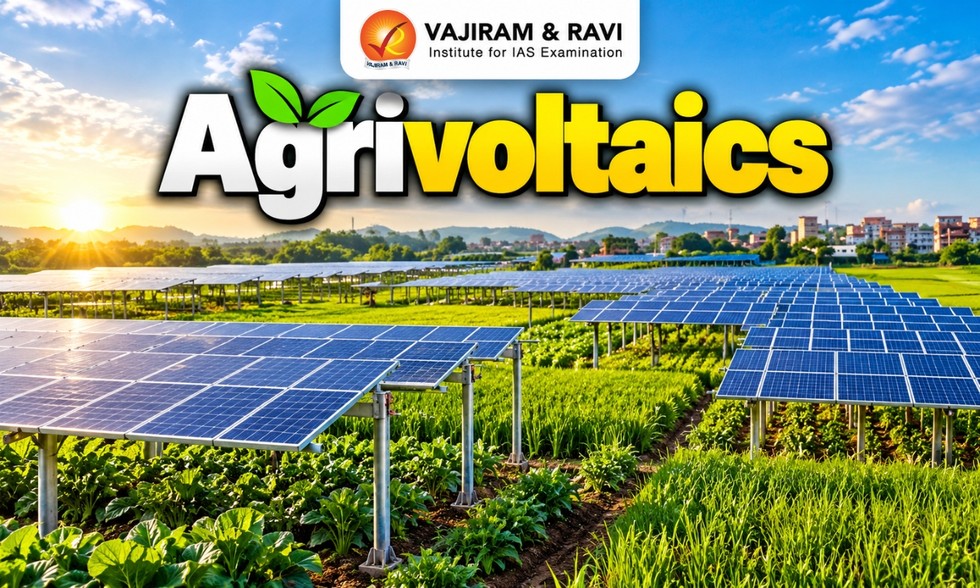
Operationalising just 10% of the agricultural land deemed suitable for agrivoltaics in India could generate enough electricity to meet the country’s projected power demand for 2050, Union Minister for New and Renewable Energy (MNRE) said recently.
About Agrivoltaics:
Agrivoltaics, also known as Agri-Photovoltaics (AgriPV), agrisolar, or dual-use solar, is the practice of utilizing the same land for both farming and solar power generation.
This combination helps address two pressing issues: clean energy production and sustainable agriculture.
The idea of agrivoltaics has been around since the 1980s. After the turn of the millennium, the concept of agrivoltaics was put into practice and researched in pilot plants, first in Japan, then in Germany and France.
However, it is only in recent years that the implementation of this concept of agrivoltaics has gained momentum.
Agrivoltaics designs vary depending on crop type, geography, and climatic conditions:
Elevated systems: Solar panels are mounted several metres above the ground, allowing normal farming below.
Row-based systems: Panels are placed between crop rows to reduce shading impact.
Vertical systems: Upright panels capture sunlight from both sides, suitable for certain crops.
Greenhouse-integrated systems: Panels are incorporated into greenhouse structures to regulate light and temperature.
Agrivoltaic systems can create unique microenvironments that benefit both energy generation and crop growth:
Improved Water Efficiency: The shade from solar panels reduces evaporation, helping soil retain moisture for longer periods. Studies indicate water savings of up to 30% in agrivoltaic setups.
Temperature Regulation: Partial shade from panels helps maintain optimal temperatures for certain crops, particularly during intense summer heat.
Enhanced Plant Growth: Many crops, especially shade-tolerant varieties, show improved yields when grown under solar panels due to reduced heat stress and better water retention.
Agrivoltaics Status in India:
Agrivoltaics in India is currently at a nascent and pilot-based stage, with nearly 50 installations across the country experimenting with different crop–panel combinations and assessing their economic viability.
The MNRE estimates that an extra 630 GWp of solar power could be produced by putting solar panels on just 1% of India's agricultural land.
Dear Student,
You have still not entered your mailing address. Please enter the address where all the study materials will be sent to you. (If applicable).