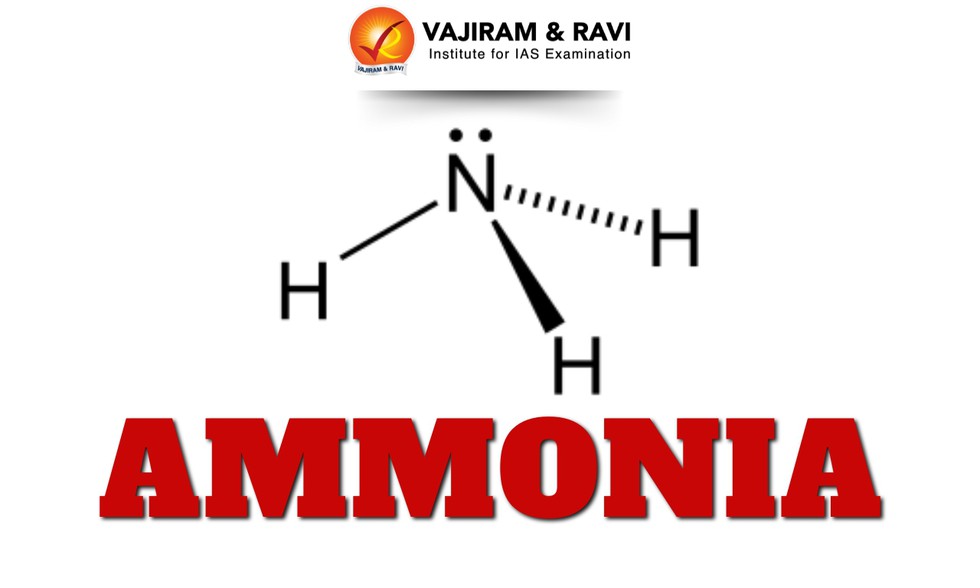
Officials explained that ammonia spikes in the Yamuna are a chronic winter issue, generally occurring between 15 and 22 times a year.
About Ammonia:
It is a colorless, pungent gas composed of nitrogen and hydrogen with the formula NH3.
It is the simplest stable compound of these elements and serves as a starting material for the production of many commercially important nitrogen compounds.
It exists naturally in humans and in the environment.
In the environment, ammonia is part of the nitrogen cycle and is produced in soil from bacterial processes.
Ammonia is also produced naturally from decomposition of organic matter, including plants and animals.
Industrial production: Manufactured mainly by the Haber–Bosch process (from nitrogen and hydrogen).
Ammonia gas can be dissolved in water. This kind of ammonia is called liquid ammonia or aqueous ammonia. Once exposed to open air, liquid ammonia quickly turns into a gas.
Uses:
The major use of ammonia is as a fertilizer.
Ammonia is a basic building block for ammonium nitrate fertilizer, which releases nitrogen, an essential nutrient for growing plants.
About 90 percent of ammonia produced worldwide is used in fertilizer.
Additional uses include as a refrigerant, stabilizer, neutralizer, and purifier — particularly in food transport and water treatment applications.
It can also be used in the manufacture of plastics, explosives, fabrics, dyes, and pharmaceuticals.
Exposure to high levels of ammonia in air may be irritating to a person’s skin, eyes, throat, and lungs and cause coughing and burns.
To prevent the release of toxic fumes, ammonia should not be mixed with other chemicals (especially chlorine bleach).
Dear Student,
You have still not entered your mailing address. Please enter the address where all the study materials will be sent to you. (If applicable).