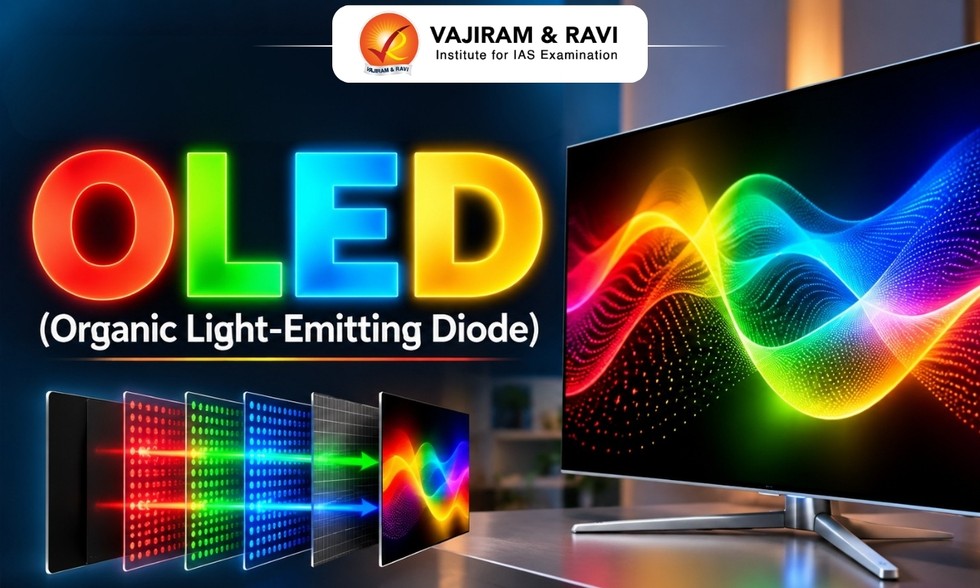
About OLED (Organic Light-Emitting Diode):
- It refers to a class of light-emitting devices where the emissive layer is composed of carbon-based organic molecules that glow when excited by an electric current.
- The OLED structure consists of a multilayer array of thin organic films sandwiched between two electrodes, at least one of which is transparent, allowing light emission. When electrical current is applied, a bright light is emitted.
- OLEDs differ from both traditional LEDs (inorganic diodes that emit light at specific points) and LCDs (which rely on liquid crystals and a backlight).
- Instead, OLEDs are self-emissive surfaces which means every pixel generates its own light.
- OLED displays provide the best image quality, and they can also be made transparent, flexible, foldable, and even rollable and stretchable.
- An OLED display have the following advantages over an LCD display:
- Improved image quality: Better contrast, higher brightness, fuller viewing angle, a wider color range, and much faster refresh rates.
- Lower power consumption.
- Simpler design that enables ultra-thin, flexible, foldable, and transparent displays
- Better durability: OLEDs are very durable and can operate in a broader temperature range.
- Advanced OLED configurations include PHOLED (Phosphorescent OLED) variants, which use phosphorescent phosphors to increase light efficiency, and WOLED (White OLED), used in lighting technology to generate white light with a wide colour spectrum.