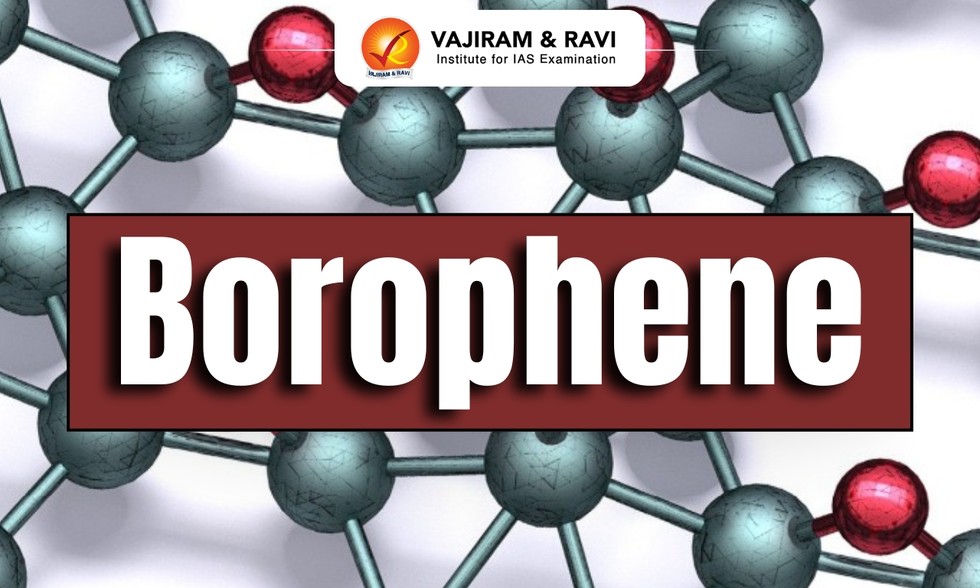
About Borophene:
- It is an allotrope of boron.
- It is composed of a single-atom-thick sheet of boron atoms arranged in a two-dimensional (2D) lattice.
- Unlike graphene, which consists of carbon atoms in a perfect hexagonal structure, borophene is highly polymorphic — meaning its atomic structure can vary depending on the synthesis conditions, leading to multiple possible configurations.
- First predicted by theory in the mid-1990s, different borophene structures were experimentally confirmed in 2015.
- Properties:
- It is known for its ultra-light weight, flexibility, and exceptional strength.
- It has excellent properties, including thermal and electrical conductivity, high capacitance, metallic nature, etc.
- Its electrical and mechanical properties vary with direction, offering tunable features for specialized applications.
- It is highly reactive, allowing strong interaction with other atoms or molecules, which is valuable in catalysis, energy storage, and sensor t
- Due to these outstanding properties, borophene is mainly used in a range of applications in the fields of thin-layer electronics, optoelectronics, capacitors, and biosensors.
Why Are Recent Findings Important?
- Friction and wear are major causes of energy loss and equipment failure in industries worldwide.
- Developing advanced lubricants that can effectively minimize these losses is therefore a key scientific and technological challenge.
- While castor oil is an attractive renewable and biodegradable lubricant, its performance can be further enhanced using suitable additives.
- The recent study found that adding just 0.1 percent borophene by weight to castor oil reduced friction by around 42 percent compared to pure castor oil, while also improving wear resistance and load-bearing capacity.
- The researchers found that borophene disperses uniformly in castor oil without requiring chemical modification.
- During operation, it forms a durable protective layer, known as a tribofilm, comprising iron oxides, carbon-based compounds, and boron-containing compounds.
- This layer reduces shear stress, protects contact surfaces, and minimises wear.
- This research has the potential to transform the lubrication industry by advancing renewable energy systems, marine applications, green lubrication technologies, and sustainable manufacturing.