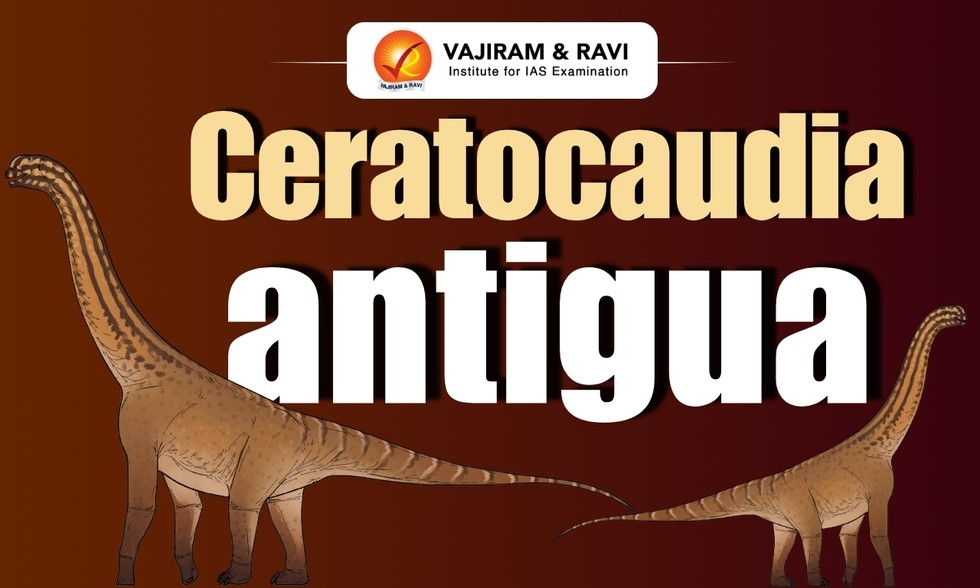
About Ceratocaudia antigua:
- It is a new species of long-necked dinosaur.
- It was discovered following excavations in the Kaladongar Formation of the Kachchh Basin in the Kutch district of Gujarat.
- Living roughly 170 to 180 million years ago during the Jurassic period, this diminutive giant reaches only about seven meters in length, significantly smaller than its more famous 20-meter-long relatives like Brachiosaurus.
- Ceratocaudia is distinguished by several physical traits that set it apart from its closest relatives.
- The most striking feature is a curved, horn-like crest atop its front tailbones.
- It also possessed a unique notch on its neck vertebrae and specific shapes in its lower leg bones, the tibia and fibula, which have not been seen in other sauropods.
- Furthermore, its tail vertebrae show a rare transition from flat-ended joints to "ball-and-socket" joints near the tip, a feature usually reserved for much later dinosaur species.
- The name Ceratocaudia antiqua reflects these physical and historical traits.
- The genus name is derived from the Greek words ‘cerato’ (meaning horn) and ‘caud’ (meaning tail), referring to the unique spike on its vertebrae.
- The species name, ‘antiqua’, is Latin for "old" or "ancient," highlighting that this is one of the earliest known macronarian dinosaurs, a group of long-necked giants characterised by their large, boxy skulls and wide nostrils.
- Ceratocaudia now stands as the earliest diagnosable member of its lineage in India and one of the oldest in the world .