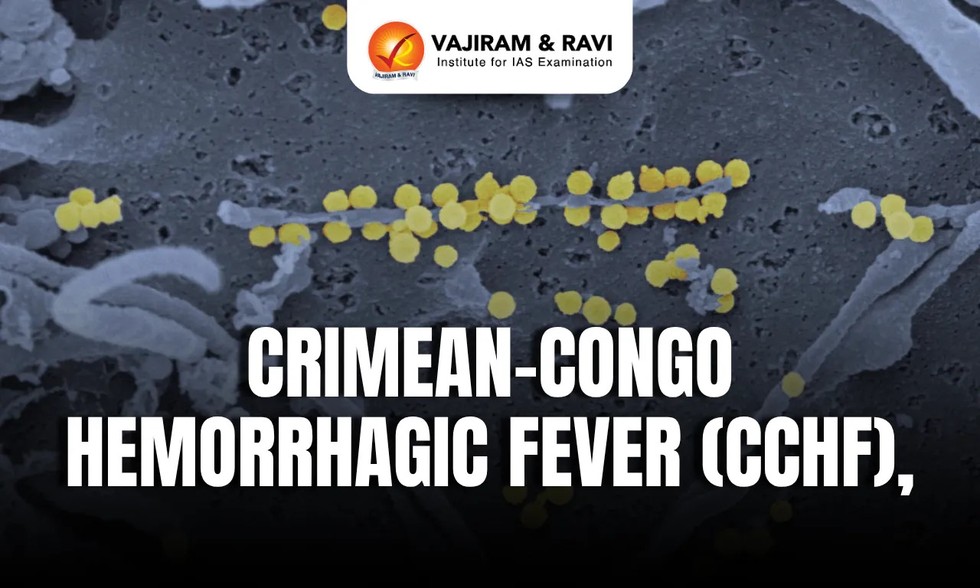
About Crimean-Congo Hemorrhagic Fever (CCHF):
- It is an important zoonotic disease caused by a tick-borne virus (Nairovirus) belonging to the family Bunyaviridae.
- The CCHF virus causes severe viral haemorrhagic fever outbreaks, with a case fatality rate of 10–40%.
- Distribution:
- The disease was first characterized in 1944 in the Crimea.
- In 1969, the same pathogen was identified as the cause of a similar disease in the Democratic Republic of the Congo, leading to the combined name used today.
- CCHF commonly spreads in (is endemic to) Africa, Asia, the Middle East, and parts of Europe.
- Its distribution closely mirrors that of Hyalomma ticks, the primary vectors responsible for transmitting the virus.
- Transmission:
- It is transmitted by bites from infected ticks or by direct contact with blood or tissues of infected ticks, people, and livestock.
- The ticks can also be hosted by migratory birds.
- People working in livestock industries, slaughterhouses, and veterinary services are considered among the highest-risk groups for infection.
- Treatment:
- There is no specific treatment or cure for CCHF.
- Supportive care includes fluid balance, giving oxygen, managing blood pressure, and treating other infections.
- An antiviral called Ribavirin has shown some benefits in treating CCHF patients.