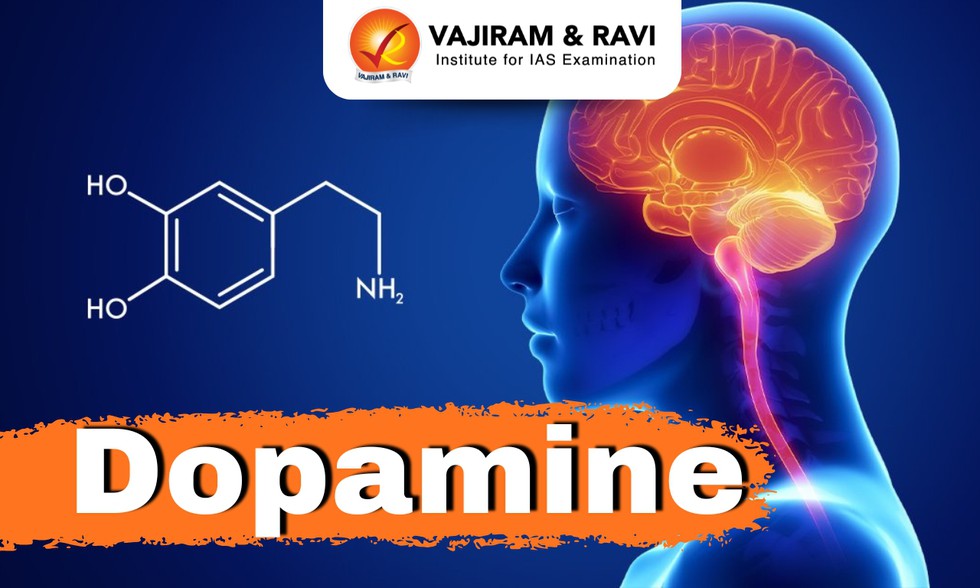
Researchers recently showed for the first time that dopamine dysfunction in the entorhinal cortex, a critical memory-related brain region, contributes directly to impaired memory formation.
About Dopamine:
Dopamine is a hormone and a type of neurotransmitter, or chemical messenger, made in your brain.
Your nervous system uses it to send messages between nerve cells. These messages also travel between your brain and the rest of your body.
This unique neurotransmitter affects your body, brain, and behavior.
Dopamine is the chemical that mediates pleasure in the brain.
It is released when your brain is expecting a reward.
When you come to associate a certain activity with pleasure, mere anticipation may be enough to raise dopamine levels.
It's a big part of our unique human ability to think and plan. It helps us focus, work towards goals, and find things interesting.
Dopamine also plays a role in these functions:
learning and attention
mood
movement
heart rate
kidney function
blood vessel function
sleep
pain processing
lactation
High or low dopamine levels are associated with diseases including Parkinson’s disease, restless legs syndrome, and attention deficit hyperactivity disorder (ADHD).
Dopamine is also made in other parts of your body, where it acts as a hormone.
Dopamine acts as a hormone to help:
relax or tighten your blood vessels when needed
control your salt levels and urine production
control how much insulin you make
slow down some parts of your digestion
Dopamine is found in humans as well as animals, including both vertebrates and invertebrates.
Dear Student,
You have still not entered your mailing address. Please enter the address where all the study materials will be sent to you. (If applicable).