Normal Climatic Conditions:
- In "neutral" conditions, surface water in the Pacific Ocean is cooler in the east and warmer in the west.
- The "trade winds" tend to blow east-to-west, taking warm water from South America towards Asia.
- To replace that warm water, cold water rises from the depths — a process called upwelling.
What is El Niño-Southern Oscillation (ENSO)?
- El Niño and La Niña are two opposing climate patterns that break normal climatic conditions.
- Scientists call these phenomena the El Niño-Southern Oscillation (ENSO) cycle.
- El Niño and La Niña can both have global impacts on weather, wildfires, ecosystems, and economies.
- Generally, El Niño occurs more frequently than La Niña.
What is El Nino?
- El Niño is a climate pattern that describes the unusual warming of surface waters in the eastern tropical Pacific Ocean.
- El Niño is the “warm phase” of the ENSO.
- During El Niño, surface temperatures in the equatorial Pacific rise, and trade winds — east-west winds that blow near the Equator — weaken.
- They falter and change direction to turn into westerlies, bringing warm water from the western Pacific towards the Americas.
- The phenomena of upwelling is reduced under El Niño.
- Warm waters also carry tropical species towards colder areas, disrupting multiple ecosystems.
- Since the Pacific covers almost one-third of the earth, changes in its temperature and subsequent alteration of wind patterns disrupt global weather patterns.
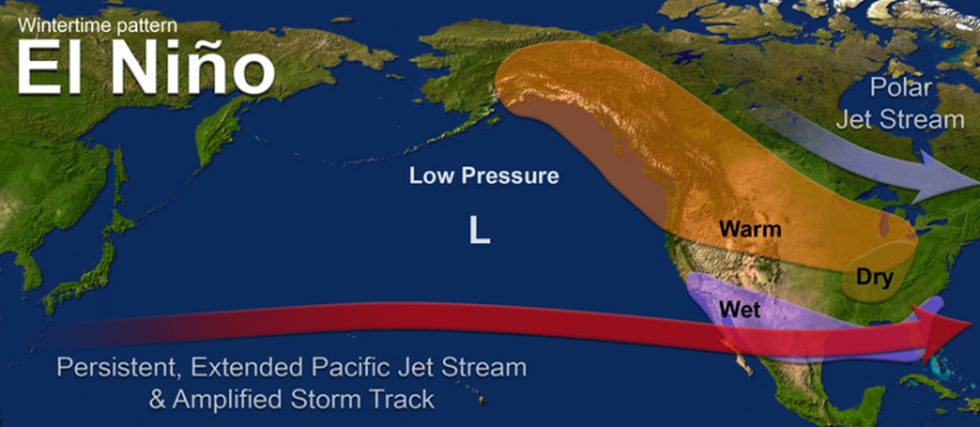
- El Niño causes dry, warm winters in the Northern U.S. and Canada and increases the risk of flooding in the U.S. gulf coast and south-eastern U.S.
- It also brings drought to Indonesia and Australia.
What is La Nina?
- La Niña, the “cool phase” of ENSO, sees cooler than average sea surface temperature (SST) in the equatorial Pacific region.
- Trade winds are stronger than usual, pushing warmer water towards Asia.
- On the American west coast, upwelling increases, bringing nutrient-rich water to the surface.
- Pacific cold waters close to the Americas push jet streams — narrow bands of strong winds in the upper atmosphere — northwards.
- Impacts:
- This leads to drier conditions in the Southern U.S., and heavy rainfall in Canada.
- La Niña has also been associated with heavy floods in Australia.
Impact on India’s monsoons:
- In India, El Niño causes weak rainfall and more heat, while La Niña intensifies rainfall across South Asia, particularly in India’s northwest and Bangladesh during the monsoon.