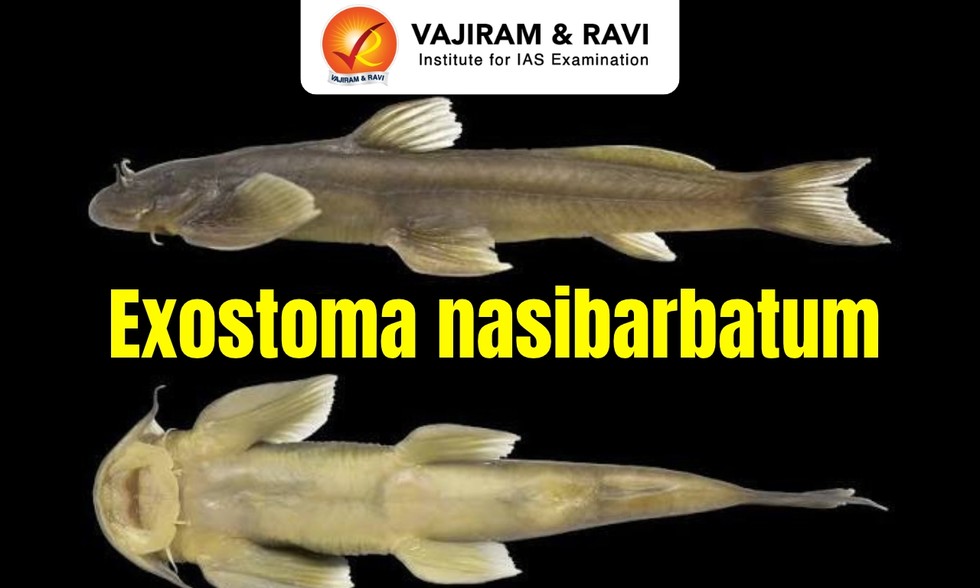
About Exostoma nasibarbatum:
- It is a new species of catfish.
- It was discovered in Manipur, during a survey of the Bupal stream, a tributary of the Dujang River in the Chindwin river system along the Myanmar border.
- It inhabits fast-flowing, turbulent streams characterised by boulders and rocky substrates.
- The species has several morphological adaptations that enable it to survive in fast-flowing waters.
- These include a strongly flattened head and body, enlarged paired fins with adhesive striae, and flattened maxillary barbels that aid attachment to rocky substrates.
- The species has been named nasibarbatum in reference to its prominent nasal barbel, which extends beyond the posterior margin of the orbit.
- The name combines the Latin words nasus, meaning nose, and barba, meaning beard, referring to the elongated, tactile sensory organ located near the nostril.
- It belongs to the genus Exostoma.
- Exostoma is a genus of sisorid catfishes native to Asia.
- Sisorid catfishes are freshwater catfishes belonging to the family Sisoridae, under the order Siluriformes.
- 23 valid species are currently recognised within the genus, distributed across major river systems in Southeast Asia and the Indian subcontinent.
- Of these, seven are considered valid species in the Chindwin-Irrawaddy drainage.