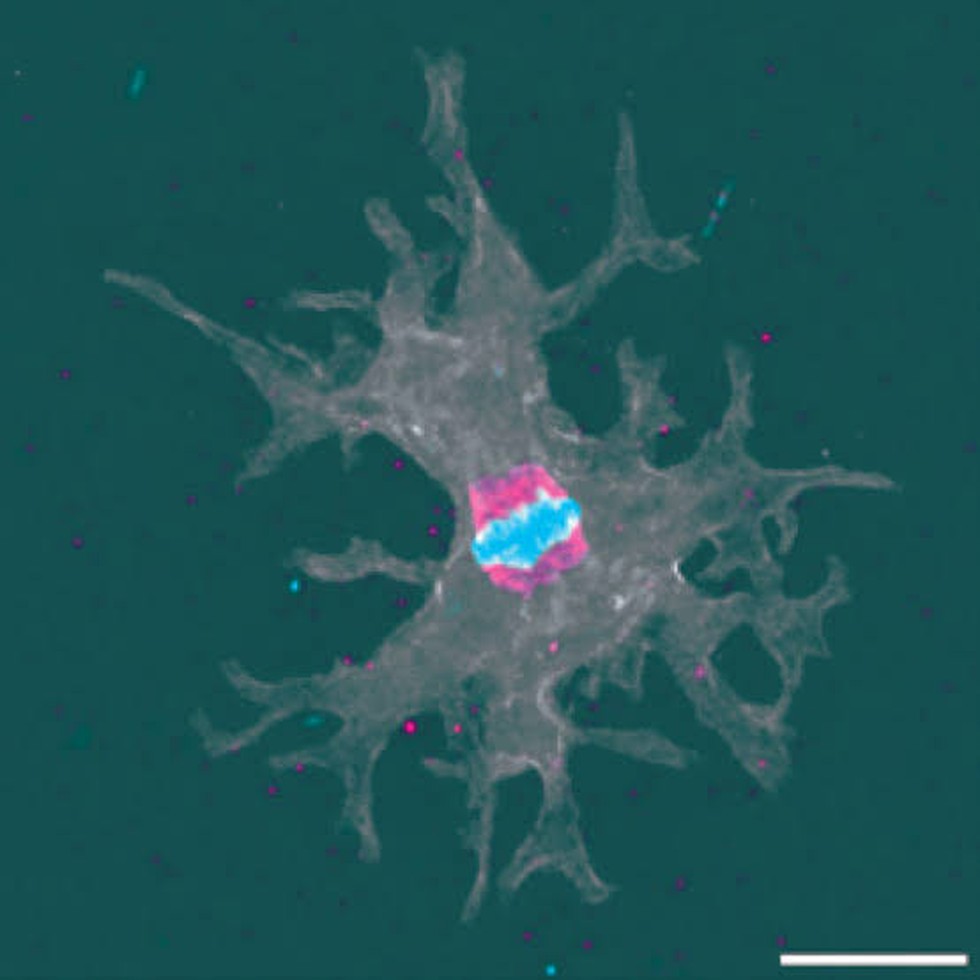
About Incendiamoeba cascadensis:
- It is a new species of amoeba.
- It was discovered in the geothermal streams of Lassen Volcanic National Park, California, United States.
- The name Incendiamoeba cascadensis translates to “fire amoeba from the Cascade mountain range”.
- It can reproduce at temperatures reaching 145°F (63°C), breaking the record for the most heat-tolerant eukaryote.
- While some thermophilic bacteria and archaea have been found to grow at temperatures exceeding 100°C, the limit for eukaryotic survival has been estimated at 60°C based on previous sampling.
- Archaea and bacteria have different cellular organization from eukaryotes.
- Eukaryotic organisms, including animals, plants, fungi, amoebae, and many other microorganisms, contain a nucleus and other specialized cellular structures.
- cascadensis divides through mitosis, the process in which one eukaryotic cell produces two daughter cells.
- It can remain mobile at around 147°F (64°C) and recover after brief exposure to temperatures of approximately 158°F (70°C), although it does not reproduce normally at that temperature.
- It had an elongated, worm-like form and a compact, amoeboid shape with pseudopodia.
- How does the amoeba survive extreme heat?
- Extreme heat can damage proteins and destabilise cell membranes.
- The findings suggest that the organism has adaptations that help protect its proteins and membranes.
- It can also change its shape and movement patterns in response to rising temperatures.
- At higher temperatures, the amoeba forms a protective structure that helps it withstand short periods of extreme heat.
- However, scientists have not yet identified the precise mechanisms responsible for its heat tolerance.