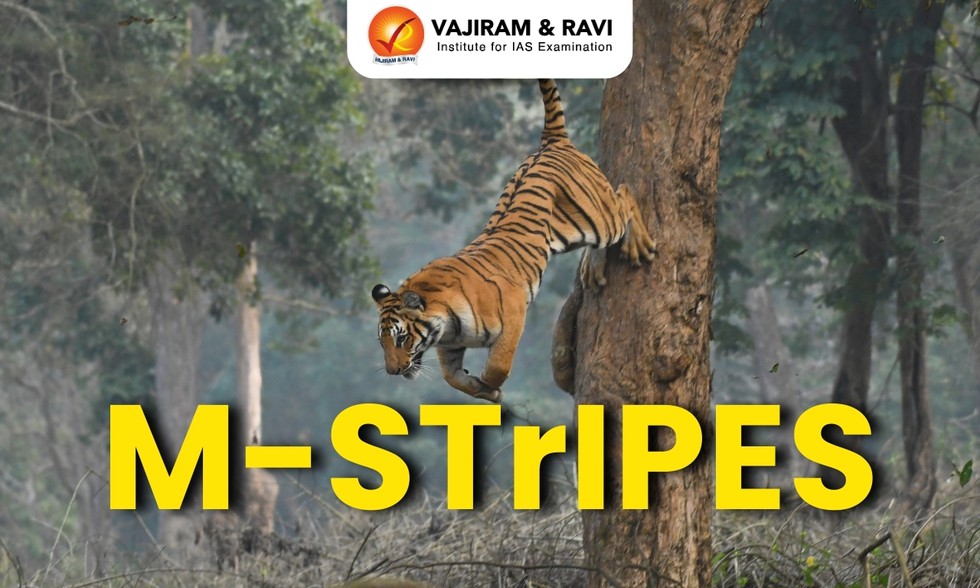
About M-STrIPES:
- The MSTrIPES (Monitoring System for Tigers: Intensive Protection and Ecological Status) is a software-based monitoring system created to assist patrol and protect tiger habitats.
- It was launched by the National Tiger Conservation Authority (NTCA) along with the Wildlife Institute of India in 2010.
- It is designed to assist wildlife protection, monitoring, and management of Protected Areas.
- The programme consists of two parts: an analytical engine with a central desktop software and an online analysis tool, and an Android-based mobile application that records field observations and tracks using real-time GPS.
- It uses Global Positioning System (GPS), General Packet Radio Services (GPRS), and remote sensing,
- to collect information from the field
- create a database using modern Information Technology (IT)-based tools
- analyze the information using GIS and statistical tools
- to provide inferences that allow tiger reserve managers to better manage their wildlife resources.
- Under MSTrIPES protocols, forest guards are expected to patrol their beats and record their tracks using a GPS, in addition to recording observations in site-specific data sheets.
- Beat is the smallest unit of forest administration in India since British time and usually one forest guard is assigned for one beat.
Key Facts about Anamalai Tiger Reserve:
- It is located in the Anamalai Hills.
- It lies south of the Palakkad gap in the Southern Western Ghats.
- It is surrounded by the Parambikulum Tiger Reserve on the east, Chinnar Wildlife Sanctuary, and Eravikulum National Park on the southwestern side.
- It is inhabited by six indigenous communities,, Kadar, Muduvar, Malasar, Malai malasar, Eravalar, and Pulayar.
- Vegetation:
- It supports diverse habitat types, viz. Wet evergreen forests, semi-evergreen forests, moist deciduous, dry deciduous, dry thorn, and shola forests.
- Other unique habitats like montane grasslands, savannah, and marshy grasslands are also present.
- Flora: The reserve is rich in wild relatives of cultivated species like mango, jackfruit, wild plantain, ginger (Zingiber officinale), turmeric, pepper (Piper longum), cardamom, etc.
- Fauna: The important wild animals of the reserve include: Tiger, Asiatic elephant, Sambar, Spotted deer, Barking deer, Jackal, Leopard, Jungle cat, etc.