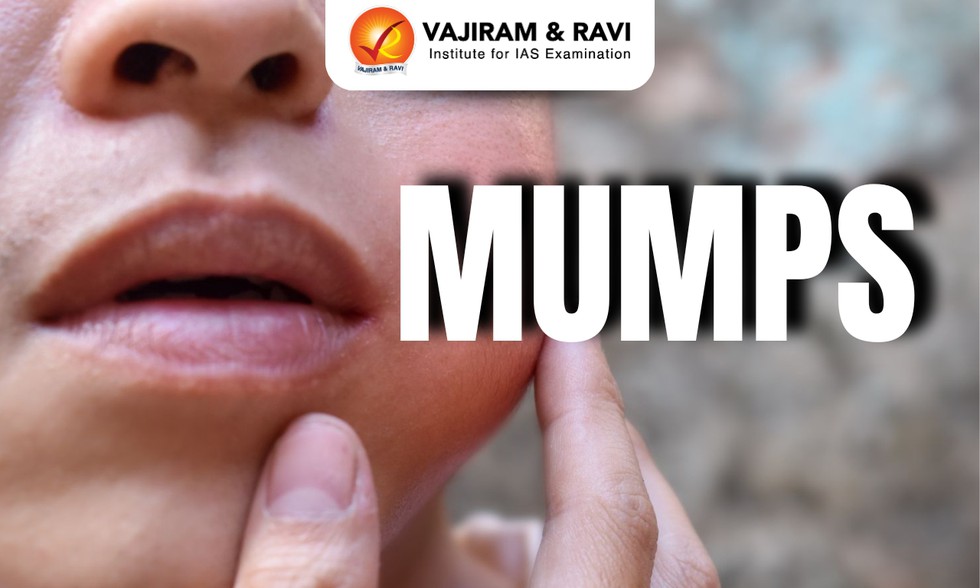
Health officials in Maryland, United States recently issued an alert after confirming an uptick in mumps cases.
About Mumps:
It is a contagious disease caused by the mumps virus, which belongs to a group of viruses known as paramyxoviruses.
It can cause painful swelling in parotid salivary glands (parotitis).
Transmission:
Humans are the only known host for the mumps virus, which is spread from person to person by drops of moisture from the nose and mouth, such as through sneezing.
It is also spread through direct contact with items that have infected saliva on them.
Mumps occurs worldwide and usually affects children and young adults.
Incubation period: Typically 16 to 18 days; ranging from 12 to 25 days.
Symptoms:
Face pain
Fever
Headache
Sore throat
Loss of appetite
Swelling of the parotid glands (the largest salivary glands, located between the ear and the jaw)
Swelling of the temples or jaw (temporomandibular area)
Normally mumps is a mild, self-limiting disease and disappears without sequelae.
However, complications may occur, such as encephalitis or sensorineural deafness.
Orchitis (a painful inflammation of the testes) occurs in 20% of young adult males who develop mumps.
Treatment: There is no specific treatment for mumps. The various symptoms may be relieved with medicines.
Prevention:
Vaccination is the main preventive measure against mumps.
MMR immunization (vaccine) protects against measles, mumps, and rubella.
Dear Student,
You have still not entered your mailing address. Please enter the address where all the study materials will be sent to you. (If applicable).