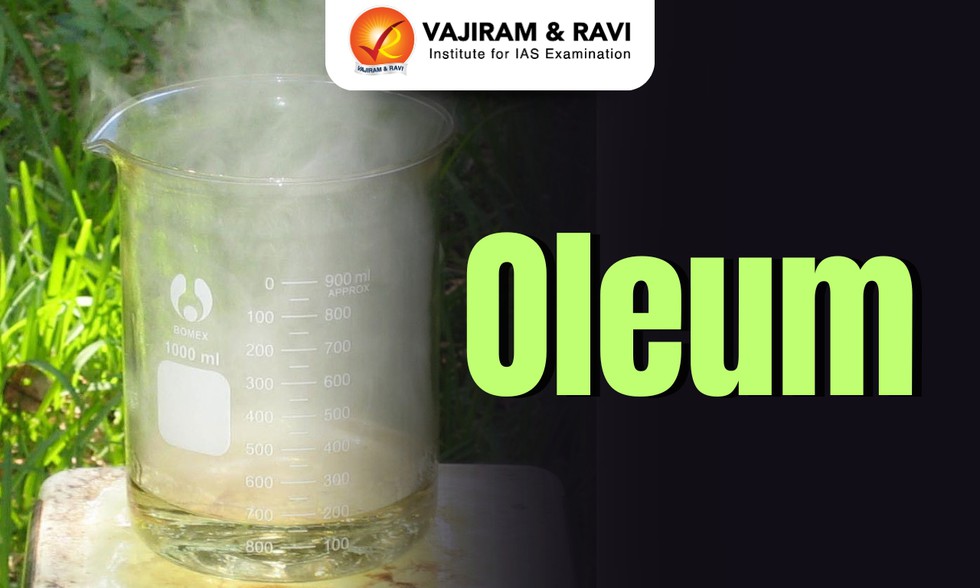
A major leak of hazardous oleum gas at a chemical unit in Maharashtra's Palghar district recently led to the evacuation of over 2,600 people.
About Oleum:
Oleum is a powerful chemical solution composed of sulfur trioxide (SO₃) dissolved in sulfuric acid (H₂SO₄).
Though oleum and sulfuric acid are closely related, they differ significantly in composition and reactivity.
Sulfuric acid (H₂SO₄) is a powerful acid in its own right, but oleum is even more reactive due to the additional dissolved SO₃.
The Contact Process is the primary industrial method for producing sulfuric acid, and by extension, oleum.
Oleum is available in different concentrations, with the SO₃ content varying to suit industrial needs.
It’s often referred to as “fuming sulfuric acid” due to its tendency to releaseSO₃ fumes upon exposure to air.
In terms of appearance, oleum ranges from colorless to pale yellow, with an oily consistency.
Applications:
Oleum's high reactivity makes it a vital component for producing highly concentrated sulfuric acid and in synthesizing crucial chemicals like explosives, dyes, and pharmaceuticals.
Oleum’s high viscosity contributes to its “oily” appearance and influences its handling requirements in industrial applications.
It is also an efficient dehydrating agent and can strip water from organic compounds, which is essential in certain industrial reactions.
Is Oleum Dangerous?
It is highly corrosive, meaning it can burn and damage skin, eyes, and other materials very quickly.
Because it releases toxic fumes, it can also be harmful if inhaled.
Dear Student,
You have still not entered your mailing address. Please enter the address where all the study materials will be sent to you. (If applicable).