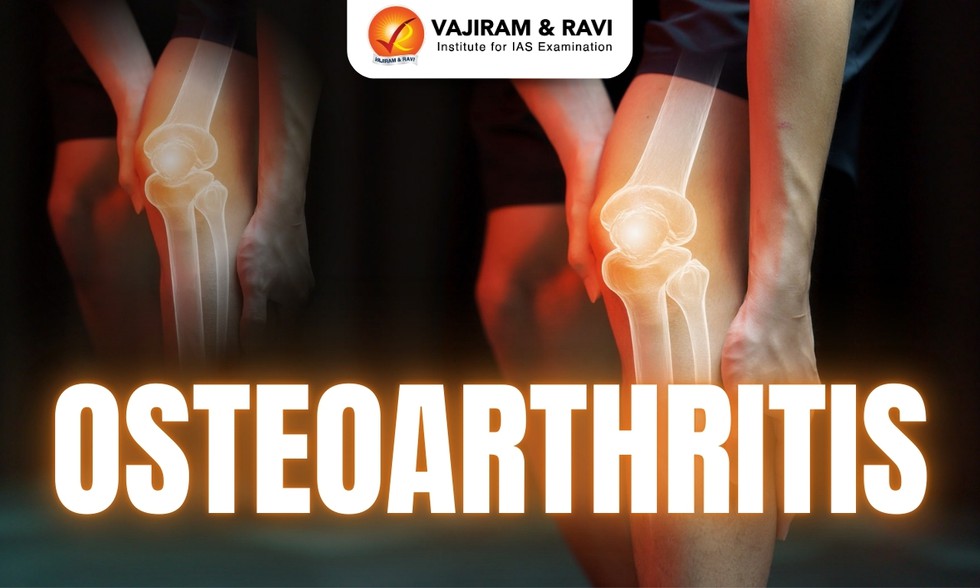
In a promising breakthrough, scientists at Stanford University recently identified a key protein called 15-PGDH linked to cartilage loss during aging, offering hope for new treatments for osteoarthritis.
About Osteoarthritis:
Arthritis is a general term that means inflammation of the joints.
Osteoarthritis (OA), commonly known as wear-and-tear arthritis, is the most common type of arthritis.
What Causes OA?
It is associated with a breakdown of cartilage in joints.
Cartilage is a firm, rubbery material that covers the ends of bones in normal joints.
Its main function is to reduce friction in the joints and serve as a "shock absorber.
The shock-absorbing quality of normal cartilage comes from its ability to change shape when compressed (flattened or pressed together).
Osteoarthritis causes the cartilage in a joint to become stiff and lose its elasticity, making it more susceptible to damage.
Over time, the cartilage may wear away in some areas, greatly decreasing its ability to act as a shock absorber.
As the cartilage deteriorates, tendons and ligaments stretch, causing pain.
If the condition worsens, the bones could rub against each other.
It commonly occurs in the weight-bearing joints of the hips, knees, and spine.
It also affects the fingers, thumbs, neck, and large toe.
It usually does not affect other joints unless previous injury, excessive stress, or an underlying disorder of cartilage is involved.
It is more likely to develop as people age. But it can affect much younger people, too, especially those who have had a prior joint injury.
Symptoms: Symptoms of osteoarthritis most often develop gradually and include:
Joint aching and soreness, especially with movement
Pain after overuse or after long periods of inactivity
Stiffness after periods of rest
Bony enlargements in the middle and end joints of the fingers (which may or may not be painful)
Joint swelling
Treatment:
Although there is no cure for osteoarthritis, there are many treatment options available to help manage pain and keep people active.
As a last resort, a damaged joint may be surgically fused or replaced with one made of a combination of metal, plastic, and/or ceramic.
Dear Student,
You have still not entered your mailing address. Please enter the address where all the study materials will be sent to you. (If applicable).