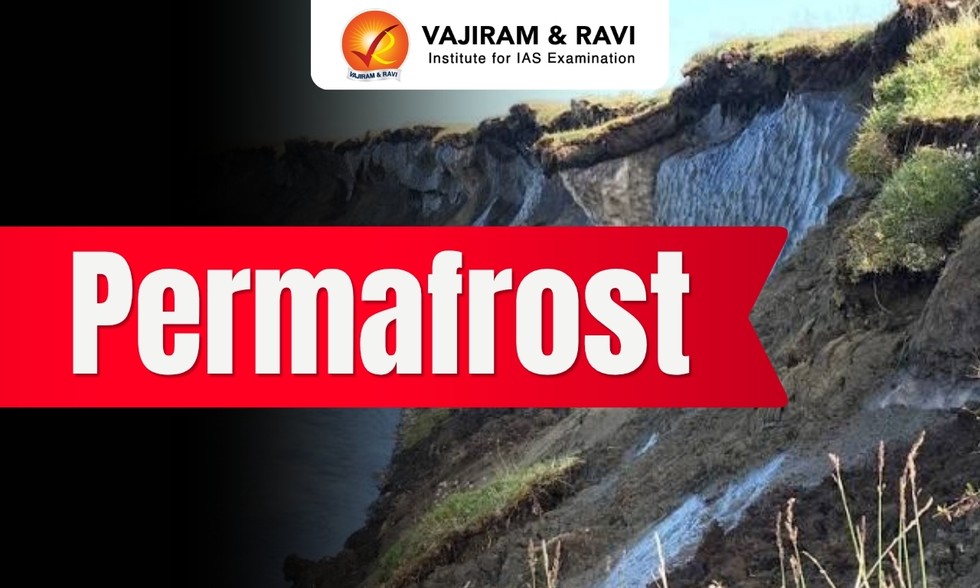
Alaska’s thawing permafrost is releasing acid and metals that turn rivers orange, changing water chemistry for dozens of miles.
About Permafrost:
Permafrost is any ground that remains completely frozen—32°F (0°C) or colder—for at least two years straight.
While two years is the minimum for permafrost consideration, some regions have had frozen ground for hundreds of thousands of years.
Where are they found?
These permanently frozen grounds are most common in regions with high mountains and in Earth’s higher latitudes—near the North and South Poles.
It can be found on land and below the ocean floor.
Its thickness can range from one meter to more than 1,000 meters, covering entire regions, such as the Arctic tundra, or a single, isolated spot, such as a mountain top of alpine permafrost.
Permafrost covers large regions of the Earth. Almost a quarter of the land area in the Northern Hemisphere has permafrost underneath.
It occurs in 85 percent of Alaska and 55 percent of Russia and Canada, and covers probably all of Antarctica.
What Is Permafrost Made Of?
Permafrost is made of a combination of soil, rocks, and sand that are held together by ice.
The soil and ice in permafrost stay frozen all year long.
Although the ground is frozen, permafrost regions can be snow-free in summer.
Near the surface, permafrost soils also contain large quantities of organic carbon—a material leftover from dead plants that couldn’t decompose, or rot away due to the cold.
Lower permafrost layers contain soils made mostly of minerals.
Permafrost loss, also known as permafrost thaw, is the progressive loss of ground ice in permafrost, usually due to input of heat.
A layer of soil on top of permafrost does not stay frozen all year. This layer, called the active layer, thaws during the warm summer months and freezes again in the fall.
In colder regions, the ground rarely thaws—even in the summer. There, the active layer is very thin—only 4 to 6 inches (10 to 15 centimeters).
A thawing permafrost layer can lead to severe impacts on people and the environment.
When permafrost melts, it raises water levels in Earth's oceans.
Melting permafrost and warming global temperatures have a positive feedback loop.
Organic matter currently frozen in the permafrost will start to decompose when the ground thaws, resulting in the emission of methane and carbon dioxide into the atmosphere.
As ice-filled permafrost thaws, it can turn into a muddy slurry that cannot support the weight of the soil and vegetation above it.
Infrastructure such as roads, buildings, and pipes could be damaged as permafrost thaws.
Melting permafrost also releases heavy metals, such as mercury, and other toxins.
As it melts, the contaminated permafrost can pollute water sources for local people.
It is even possible that thawing permafrost may release dormant, disease-causing microbes that are harmful to animals and humans.
Dear Student,
You have still not entered your mailing address. Please enter the address where all the study materials will be sent to you. (If applicable).