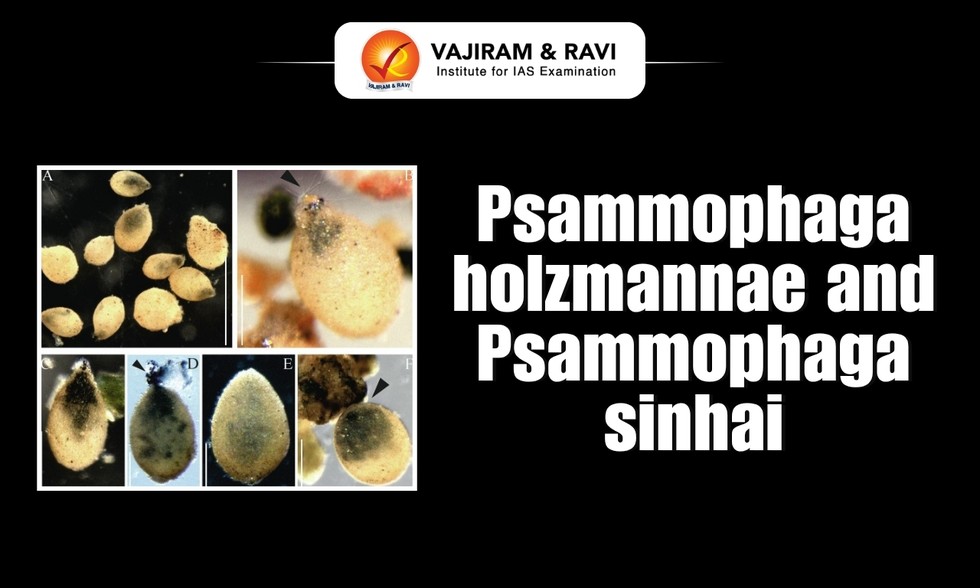
About Psammophaga holzmannae and Psammophaga sinhai:
- They are two new species of microscopic marine organisms that selectively pick up and swallow specific mineral grains from the seafloor.
- They were found at Rajapuri Creek in Raigad district along Maharashtra’s Konkan coast.
- Psammophaga is a type of foraminifera, a group of microscopic organisms commonly found in oceans.
- The name comes from Greek words meaning 'sand eater'.
- Unlike many foraminifera that have hard, multi-chambered shells, these organisms have just one chamber and a soft wall made mainly of very fine clay particles.
- The most interesting discovery was what the organisms choose to eat.
- Both species selectively take in heavy minerals containing titanium and iron. These include ilmenite and magnetite.
- This is important because these minerals occur only in small amounts in the surrounding sediment.
- How do they do it?
- Psammophaga uses thin, temporary hair-like extensions called granuloreticulopodia.
- These extend from the aperture and help the organism interact with the surrounding sediment.
- Scientists believe these extensions may help the organism detect differences between mineral grains, although the exact mechanism is still not known.