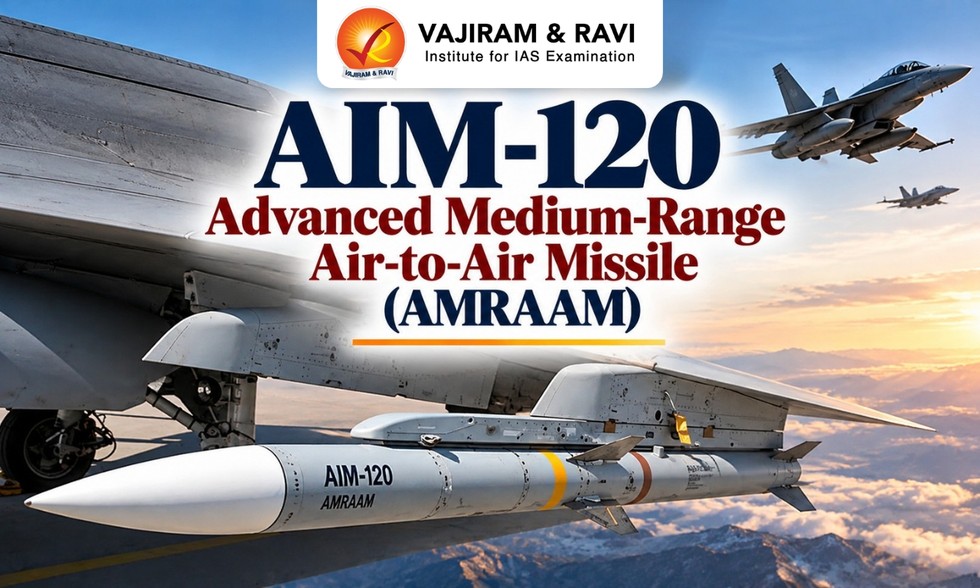
About AIM-120 Advanced Medium-Range Air-to-Air Missile (AMRAAM):
- It is an active, radar-guided, medium-range, supersonic air-to-air missile.
- It is among the most widely used beyond-visual-range (BVR) air combat weapons in the world.
- Developed in the US in the late 1970s and 1980s, it became operational in 1991 with the US Air Force, replacing older radar-guided missiles.
- The AIM-120 is currently employed by over 35 countries, including key S. allies in NATO, the Asia-Pacific region, and the Middle East.
- Notable users include the United States, United Kingdom, Japan, Australia, and several NATO member countries.
- From American F-15s, F-16s, and F-35s to European aircraft like the Typhoon and Gripen, it is installed on a wide variety of fighter jets.
- The missile's primary role is to achieve air superiority by engaging and destroying enemy fighters, bombers, and cruise missiles from beyond visual range.
- Features:
- The missile features four cropped delta wings for lift and four control fins at the rear for steering.
- It is powered by a solid-fuel rocket motor capable of propelling it to speeds exceeding Mach 4.
- The missile can be launched in all weather, day or night.
- It has a range exceeding 160 kilometers under optimal launch conditions.
- It has a blast fragmentation warhead detonated by a proximity fuse.
- It utilizes a sophisticated guidance system that includes inertial guidance for the mid-course phase and terminal active radar homing for the final approach to the target.
- The missile also supports optional mid-course update data links, which enhance its accuracy by refining its trajectory during flight.
- This guidance system provides "fire-and-forget" capability, allowing the launching aircraft to disengage and focus on other threats.
- AMRAAM-ER (Extended Range):
- It is a ground-launched variant with extended range and altitude
- It is intended for use in ground-based air defense systems like the NASAMS (National Advanced Surface-to-Air Missile System).