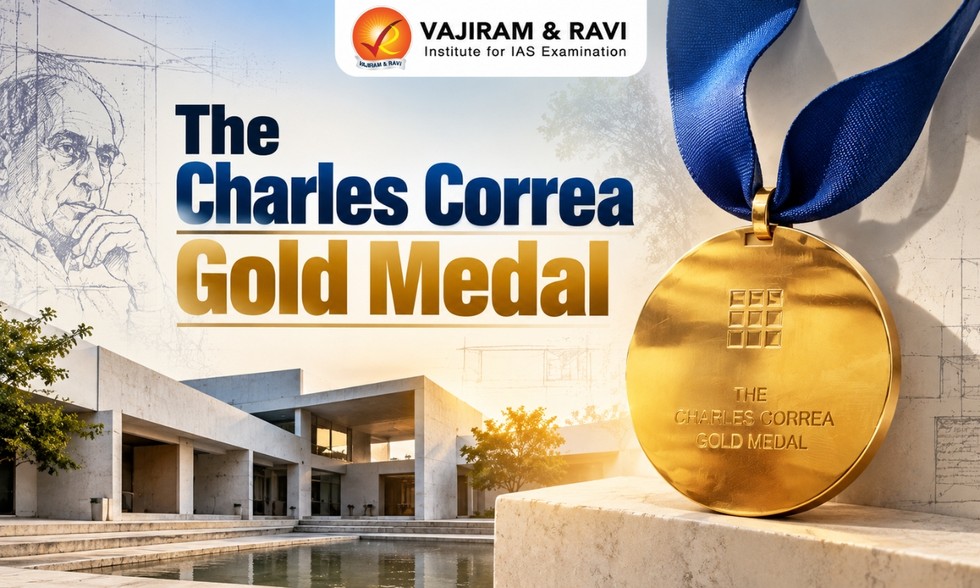
About Charles Correa Gold Medal:
- It is an annual award initiated in 1998 by the Indian architect and urbanist Charles Correa.
- The medal recognises quality and talent among young students of architecture for their undergraduate thesis project in a first professional degree course.
- The Charles Correa Foundation (CCF) administers the Gold Medal annually.
- Eligibility: Final-year students pursuing undergraduate professional degree at eligible Indian architecture colleges.
- Selection:
- Participating colleges nominate one student’s individual thesis project.
- The student must be the sole author of the project. Group work is not permitted.
- A jury of eminent architects reviews the submissions and identifies an outstanding student who will be awarded the Medal.
- The applicant college of architecture must be located in India and approved by the Council of Architecture (COA).
- Initially the award was open only to Mumbai and Goa architecture colleges, but from 2022 forward, CCF invites all colleges across India.
- From 2025 to 2027, the medal focuses on thesis projects that address ‘Equitability through Design’.
Who was Charles Correa?
- He was a renowned Indian architect and urban planner.
- He was credited with the creation of modern architecture in post-Independence India.
- Understanding the needs of the urban poor, Correa used traditional methods and materials to plan the urban designs.
- In the majority of his designs, he applied for the 'open-to-sky' concept.
- His major projects include the Mahatma Gandhi Memorial at the Sabarmati Ashram, National Crafts Museum in New Delhi, Bharat Bhavan in Bhopal, Jawahar Kala Kendra in Jaipur, and the British Council in Delhi.
- He was one of the chief architects of Navi Mumbai.
- His work also includes projects in townships and public housing projects in Delhi, Mumbai, Ahmedabad, Bengaluru (Bangalore), and other cities in India.
- In 1984 he founded the Urban Design Research Institute in Mumbai, and a year later he became Chairman of the National Commission for Urbanisation.
- Awards and Recognitions:
- He was awarded the second highest civilian honour, the Padma Shri in 1972 and the Padma Vibhushan in 2006.
- He was also honoured with the 1984 Royal Gold Medal by the Royal Institute of British Architects (RIBA).
- He was acclaimed as “India’s greatest architect” by RIBA when it mounted an exhibition on him in 2013.