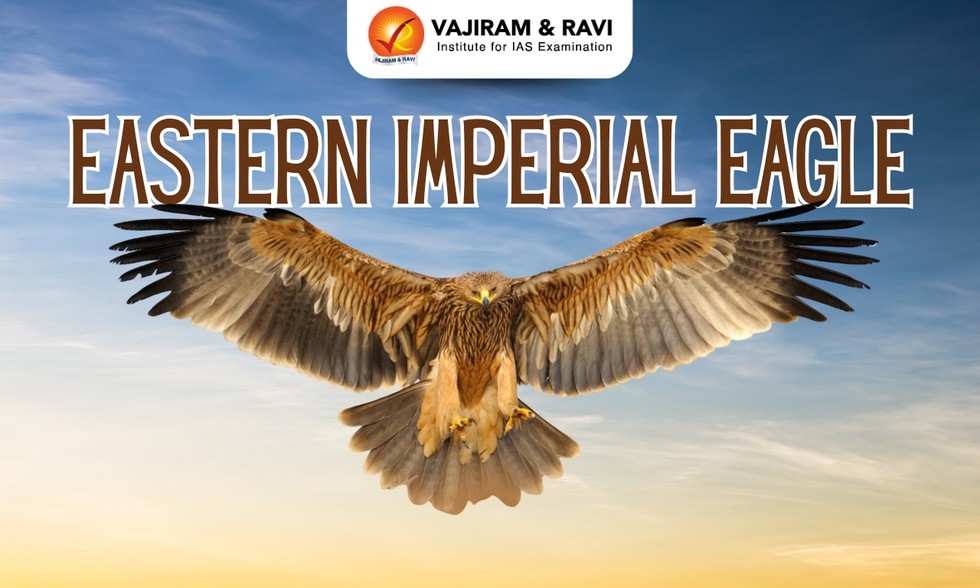
About Eastern Imperial Eagle:
- It is a large bird of prey.
- Scientific Name: Aquila heliaca
- Distribution:
- It breeds in southeastern Europe and extensively through West and Central Asia.
- Most populations are migratory and winter in northeastern Africa, the Middle East and South and East Asia.
- Like all eagles, the eastern imperial eagle is a member of the family Accipitridae. Furthermore, its well feathered legs mark it as a member of the subfamily Aquilinae.
- Features:
- The species displays reverse sexual dimorphism, as do most birds of prey, in which males are usually smaller than the females.
- Conservation Status:
- IUCN Red List: Vulnerable
Mudumalai Tiger Reserve (MTR):
- It is located in the Nilgiris District of Tamil Nadu, at the tri-junction of three states, viz., Karnataka, Kerala, and Tamil Nadu.
- It lies on the northeastern and northwestern slopes of the Nilgiri hills, which is a part of the Western Ghats.
- It is part of the Nilgiris Biosphere Reserve, the first biosphere reserve in India.
- The name Mudumalai means ”the ancient hill range”.
- Habitat: A variety of habitats ranging from tropical evergreen forest, moist deciduous forest, moist teak forest, dry teak forest, secondary grasslands, and swamps are found here.
- River: The Moyar River runs through the reserve.
- The Oscar-winning ‘Elephant Whisperers’ was filmed at the Theppakadu Elephant Camp, located inside the Mudumalai Tiger Reserve.
- Flora:
- It has tall grasses, commonly referred to as “Elephant Grass”, bamboo of the giant variety, and valuable timber species like teak, rosewood, etc.
- It has wild relatives of cultivated plants,, wild rice, ginger, turmeric, cinnamon, etc.
- The habitat also has swampy areas (Vayals) and grasslands.
- Fauna:
- The faunal assemblage includes: elephant, gaur, sambar, four-horned antelope, spotted deer, barking deer, blackbuck, wild pig, mouse deer, and predators like tigers, leopards, and wild dogs.