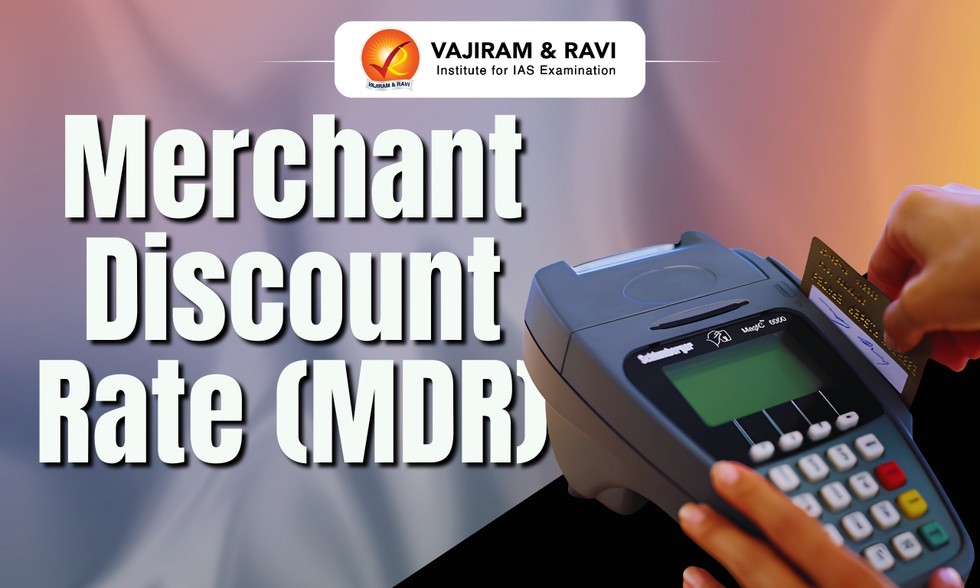
About Merchant Discount Rate (MDR):
- It is the fee charged to a merchant for accepting a digital payment.
- When a customer pays a business digitally, multiple parties may be involved in completing that transaction.
- Depending on the payment mode, these may include the merchant, payment gateway or payment aggregator, acquiring bank, issuing bank, card network or payment network, and other payment infrastructure participants.
- MDR is part of the commercial structure that supports this payment acceptance chain.
- For a merchant, MDR is best understood as a cost of accepting a particular type of payment.
- When a customer makes a payment, the merchant usually receives the transaction amount after deduction of MDR.
- The MDR fees cover a variety of costs, including:
- Payment processor fee: These fees are charged by payment processors (companies that handle transactions between merchants and banks like Razorpay) for their services.
- Interchange fee: These are fees charged by card issuers (banks) to merchants for processing transactions.
- Assessment fee: These are fees charged by card networks (like Visa, RuPay and Mastercard) to merchants for using their payment processing services.
- Markup fee: These are fees that are divided among the different entities involved in the transaction.
- Additional fees: Some payment processors may charge additional fees for services like fraud prevention, chargeback handling, and customer support.
- MDR is not a single fixed rate that applies to every business or every payment.
- It may apply differently across cards, net banking, wallets, UPI, EMI, BNPL, QR, and other payment modes, depending on the provider and the applicable arrangement.
- The MDR typically comes in the form of a percentage of the transaction amount. It is typically between 1% and 3%.
- Merchants must consider these fees as part of managing their business costs and setting their prices.
- MDR charges are automatically deducted from the merchant’s account at the time of settling the transaction batch.
MDR on UPI:
- When UPI was launched in 2016, MDR was applicable.
- But in January 2020, the government removed MDR on UPI and RuPay debit cards to push mass adoption of digital payments.
- But zero MDR also meant banks, the National Payments Corporation of India (NPCI) and fintech startups got nothing from the transaction.
- The government has compensated the industry through subsidies.
Recent Changes Introduced in the Taxation and Other Laws (Amendment) Bill, 2026:
- It empowers the government to levy an MDR on select electronic payment modes, with a potential MDR of 0.25 percent to 0.4 percent on business-directed UPI transactions.
- The finance ministry said consumers will face no transaction charges and that all person-to-person (P2P) transfers will continue to be free.
- The government says it will apply only to a limited set of merchant transactions above a certain value threshold, at a nominal rate, which will be far lower than existing debit or credit card MDRs.
- Small merchants and person-to-merchant payments below that threshold are expected to remain free, to protect the digital-payments push among small businesses.