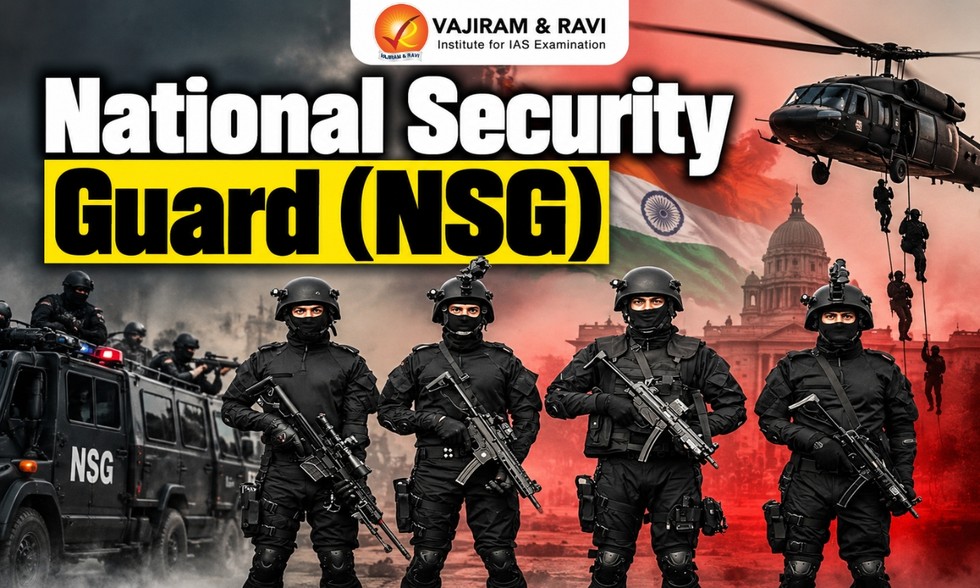
About National Security Guard (NSG):
- It is India’s premier counter-terror force, specially trained and equipped to respond to serious acts of terrorism and other exceptional security situations.
- The NSG members are also known as Black Cats because of the black drill cotton coveralls and balaclavas, or helmets, they wear.
- Establishment:
- It was raised in 1984, following Operation Blue Star and the assassination of Indira Gandhi.
- It was established under the National Security Guard Act of 1986.
- The Act places it under the administrative control of the Union Ministry of Home Affairs (MHA), which exercises operational tasking.
- The NSG was modelled on the pattern of the Special Air Service of the UK and GSG-9 of Germany.
- The NSG’s specific goals include:
- Neutralization of terrorist threats
- Handling hijacking situations in the air and on land.
- Bomb disposal (search, detection, and neutralisation of IEDs).
- PBI (Post Blast Investigation)
- Hostage Rescue
- VIP Security
- Motto: Sarvatra Sarvottama Suraksa.
- Headquarters: New Delhi
- Director General (DG):
- The head of the NSG, designated as Director General (DG), is selected by the Home Ministry.
- All the selected DGs have been officers from the Indian Police Service (IPS).
- It is designed to be employed as a specialised counter-terrorism force “only in exceptional situations,” not to take over “functions of the State Police Forces or other paramilitary forces.”
- The teams of NSG work on a basic philosophy of swift and speedy strike and immediate withdrawal from the theatre of action.
- NSG deployments are usually not made public, with most of its operations remaining classified.
- Structurally, the NSG is a two-tier composite force.
- The Special Action Group (SAG) is the offensive assault component, manned entirely by personnel on deputation from the Indian Army, and constitutes roughly half the force.
- The Special Ranger Group (SRG) is drawn on deputation from the Central Armed Police Forces (CRPF, BSF, ITBP, CISF) and the state police, and performs perimeter, support, VIP protection, and logistics roles.
- This dual sourcing is a deliberate design feature: it keeps the cutting-edge assault capability under Army-trained discipline while retaining a police-culture interface for civilian-environment operations.
- The force also fields specialised wings for bomb disposal, electronic countermeasures, and explosive detection and runs the National Bomb Data Centre (NBDC).
- The NBDC collects, collates, analyses, and evaluates all terrorist bombing activities and disseminates relevant information to concerned law enforcement agencies.