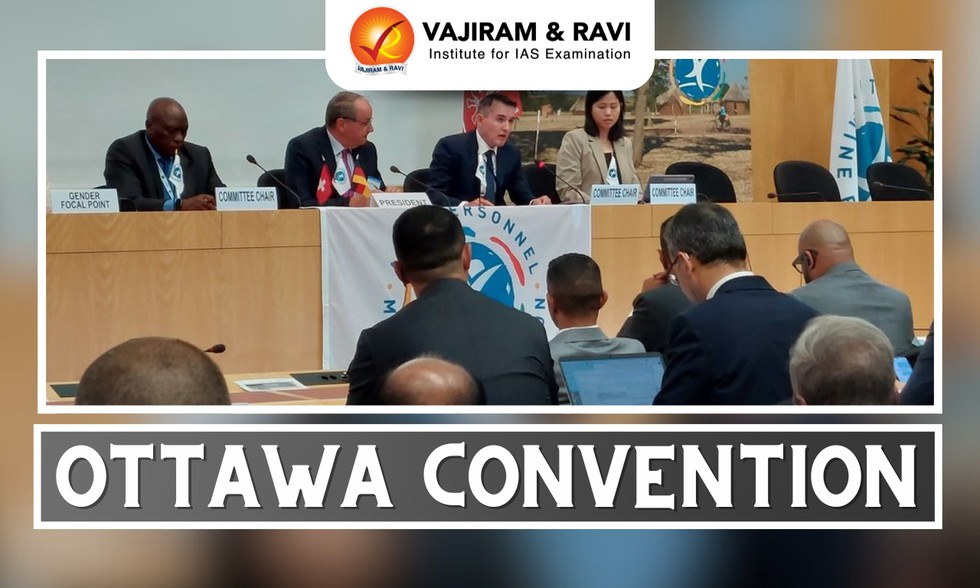
Poland's withdrawal from the Ottawa Convention, as announced by the Prime Minister recently, is a strategic maneuver that allows the country to deploy anti-personnel mines swiftly along its eastern borders if necessary.
About Ottawa Convention:
The Ottawa Convention, also referred to as the "Mine Ban Treaty," prohibits the use, stockpiling, production, and transfer of anti-personnel landmines (APLs).
It requires states-parties to destroy their stockpiled APLs within four years and eliminate all APL holdings, including mines currently planted in the soil, within 10 years.
Countries may request a renewable extension, which can be up to 10 years long, to fulfill their destruction obligations.
States-parties are also required annually to report their total APL stockpiles, the technical characteristics of their APLs, the location of all mined areas, and the status of APL destruction programs.
The convention, which is of unlimited duration and open to all nations, entered into force in 1999.
The Treaty has 164 States Parties, including 34 out of the 50 States that produced mines before 1997, and 33 Signatories.
However, six major countries remain outside the Convention: China, India, Pakistan, Republic of Korea, Russian Federation and United States.
States Party to the Ottawa Treaty commit to:
Never use APLs, nor “develop, produce, otherwise acquire, stockpile, retain, or transfer” them;
Clear mined areas in their territory within 10 years;
In mine-affected countries, conduct mine risk education and ensure that mine survivors, their families, and communities receive comprehensive assistance;
Offer assistance to other States Parties, for example, in providing for survivors or contributing to clearance programs;
Adopt national implementation measures (such as national legislation) in order to ensure that the terms of the treaty are upheld in their territory.
Dear Student,
You have still not entered your mailing address. Please enter the address where all the study materials will be sent to you. (If applicable).