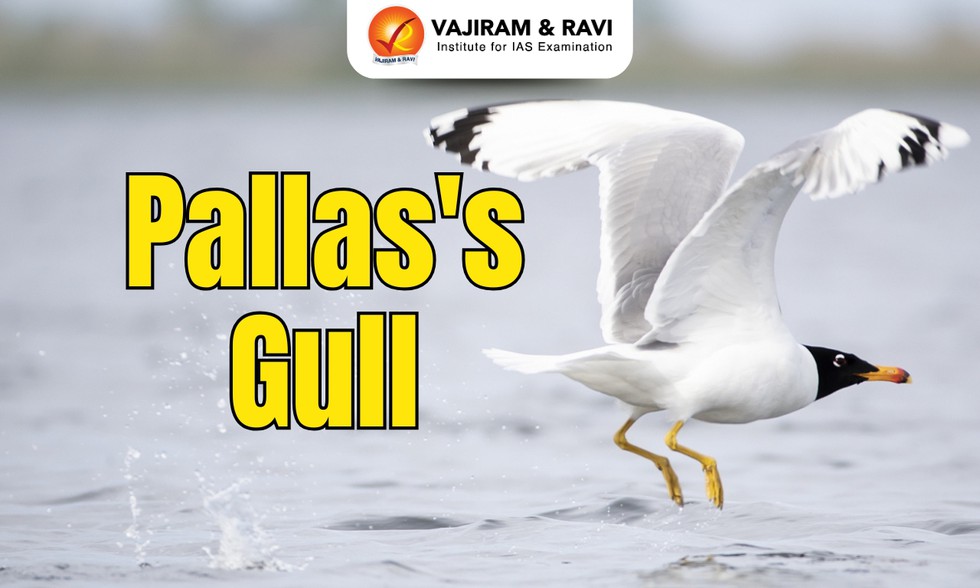
About Pallas's Gull:
- Pallas's Gull, also called the Great Black-headed Gull, is a large bird species.
- It is the world's largest black-headed gull and the third-largest species of gull in the world.
- It belongs to the family Laridae.
- Scientific Name: Ichthyaetus ichthyaetus
- Distribution:
- It breeds in colonies in marshes and islands from southern Russia to Mongolia.
- It is migratory, wintering in the Mediterranean Sea, the Arabian Peninsula, and India.
- Habitat: It prefers wetlands, salt lakes, lagoons, and slow-flowing rivers.
- Features:
- It measures 55–72 cm in length with a 142 to 170 cm wingspan.
- Summer adults are unmistakable, since no other gull of this size has a black hood.
- The adults have grey wings and back, with conspicuous white "mirrors" at the wing tips.
- The legs are yellow, and the bill is orangey-yellow with a red tip.
- In all other plumages, a dark mask through the eye indicates the vestiges of the hood.
- Pallas's Gulls feed on fish, including dead fish. They also prey upon insects, crustaceans, reptiles, other birds, and small mammals.
- Conservation Status:
- IUCN Red List: Least Concern
Key Facts about Udhwa Lake Bird Sanctuary:
- It is located in the Sahebganj district of Jharkhand.
- It is the state's only bird sanctuary.
- It comprises two interconnected wetlands, Pataura Lake and Berhale Lake, which are part of the Ganga River floodplain and surrounded by the Rajmahal Hills.
- It was declared a Ramsar Site in 2025.
- It supports a diverse ecosystem with over 146 species of birds, including endangered ones like the band-tailed fish eagle, lesser adjutant stork, and common pochard.
- It also hosts a variety of aquatic plants, fish, reptiles, and mammals, such as fishing cats and otters.
- The sanctuary is an important habitat within the Central Asian flyway, attracting migratory birds during the winter.