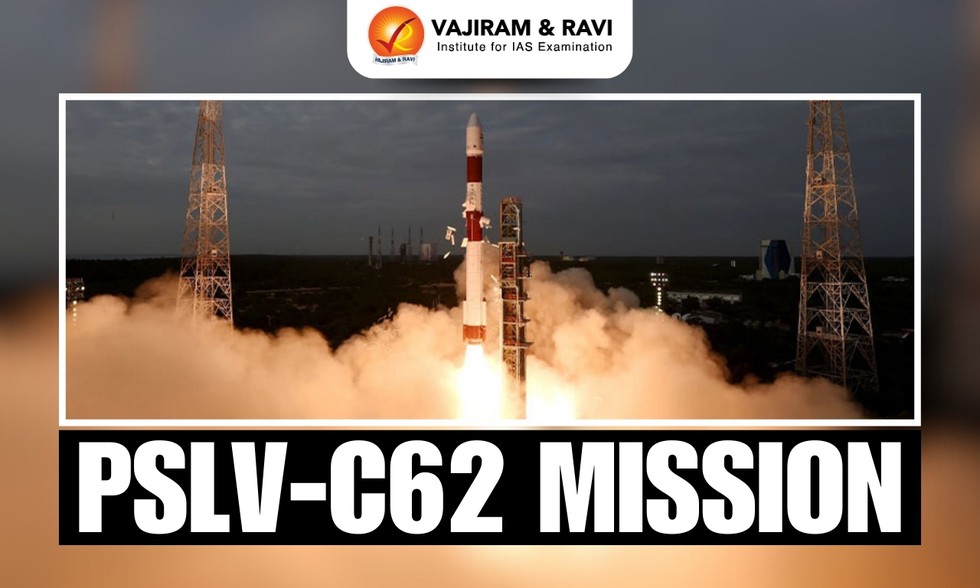
ISRO’s PSLV-C62 rocket is set to lift off from the first launchpad at Sriharikota, marking India’s first space launch of 2026.
About PSLV-C62 Mission:
It is a multi-payload mission of the Indian Space Research Organisation (ISRO) that will carry one primary satellite and 18 secondary payloads into space.
It is ISRO’s first space launch of 2026.
It is scheduled to lift off from Sriharikota.
The mission's primary payload is the earth observation satellite EOS-N1 (codenamed ‘Anvesha’), an hyperspectral imaging satellite developed primarily for the Defence Research and Development Organisation (DRDO) for strategic purposes.
Unlike conventional imaging satellites, hyperspectral satellites can “see” the Earth in hundreds of wavelengths, allowing them to identify materials and objects with far greater precision.
This capability makes EOS-N1 a high-value asset for national security, border surveillance and strategic monitoring.
At the same time, the satellite will also be used for civilian applications such as agriculture planning, urban mapping, mineral detection, and environmental monitoring.
PSLV-C62 will also carry Europe's Kestrel Initial Demonstrator (KID), an experimental mission involving a small re-entry capsule developed in collaboration with a Spanish startup.
The capsule is expected to re-enter Earth’s atmosphere and splash down in the South Pacific Ocean.
Additionally, commercial payloads from startups and research institutions across India, Mauritius, Luxembourg, the UAE, Singapore, Europe, and the United States are manifested for the PSLV-C62 Mission.
Several Indian startups and academic institutions are also flying their satellites.
These include OrbitAID Aerospace’s AayulSAT, CV Raman Global University’s CGUSAT-1, Dhruva Space’s DA-1, Space Kidz India’s SR-2, Assam Don Bosco University’s Lachit-1, Akshath Aerospace’s Solaras-S4, and Dayanand Sagar University’s DSAT-1.
Bengaluru-based OrbitAID Aerospace’s AayulSAT stands out as a historic first.
It is India’s maiden on-orbit satellite refuelling payload.
The mission aims to demonstrate technologies that could extend the operational life of satellites by enabling in-orbit servicing and refuelling.
Such capabilities are seen as crucial for tackling space debris and improving sustainability in Earth’s increasingly crowded orbital environment.
Dear Student,
You have still not entered your mailing address. Please enter the address where all the study materials will be sent to you. (If applicable).