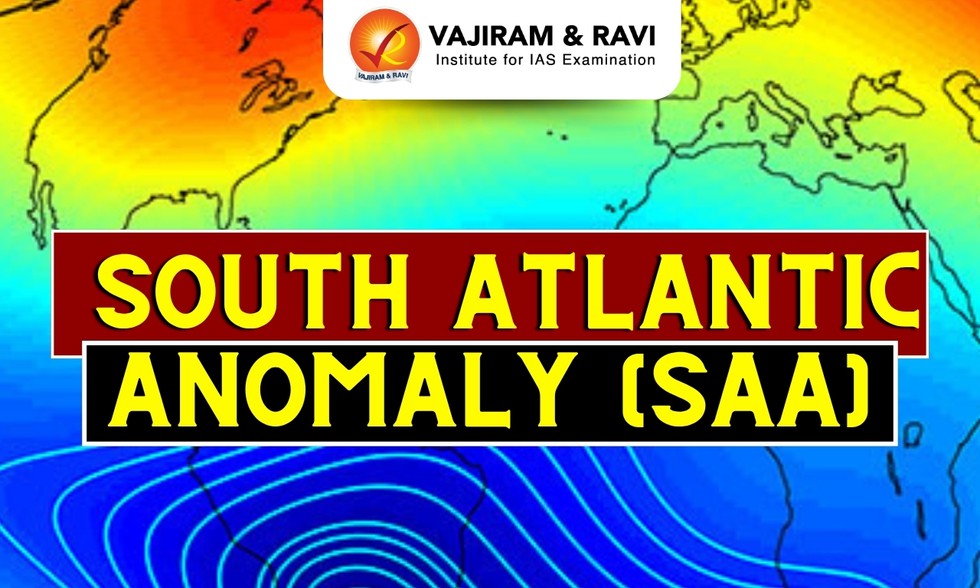
About South Atlantic Anomaly (SAA):
- The South Atlantic Anomaly (SAA), or the "Bermuda Triangle of Space’’, is a dip in the Earth's magnetic field which allows cosmic rays and charged particles to reach lower into the atmosphere.
- It is southeast of South America and southwest of Africa. In this area, the planet’s magnetic field dips down.
- It lies roughly between latitudes 5 and 40 degrees South and between longitudes 0 and 80 degrees West -- the precise strength, shape, and size of the SAA varies with the seasons.
Why Does it Occur?
- Earth’s magnetic field acts like a protective shield around the planet, repelling and trapping charged particles from the Sun.
- SAA exists because the Earth’s inner Van Allen radiation belt comes closest to the planet’s surface, causing an increased flux of energetic particles.
- This leads to the penetration of solar energetic particles deep into Earth’s atmosphere, posing severe problems for airplanes and ships’ positioning systems as well as spacecraft electronic systems.
What are the Van Allen Radiation Belts?
- The Van Allen radiation belt is a zone of energetic charged particles, most of which originate from the solar wind.
- The particles are captured by and held around a planet by that planet’s magnetic field.
- It surrounds Earth, containing a nearly impenetrable barrier that prevents the fastest, most energetic electrons from reaching Earth.
- The outer belt is made up of billions of high-energy particles that originate from the Sun and become trapped in Earth’s magnetic field, an area known as the magnetosphere.
- The inner belt results from interactions of cosmic rays with Earth’s atmosphere.
- The Van Allen belts are most intense over the Equator and are effectively absent above the poles.
- These radiation belts serve both protective and hazardous roles; while they shield Earth from harmful cosmic radiation, they can pose risks to satellites and human space missions, as the particles can interfere with electronic systems.
- They were discovered in 1958 by James A. Van Allen, the American physicist who designed the instruments on board Explorer 1, the first spacecraft launched by the United States.