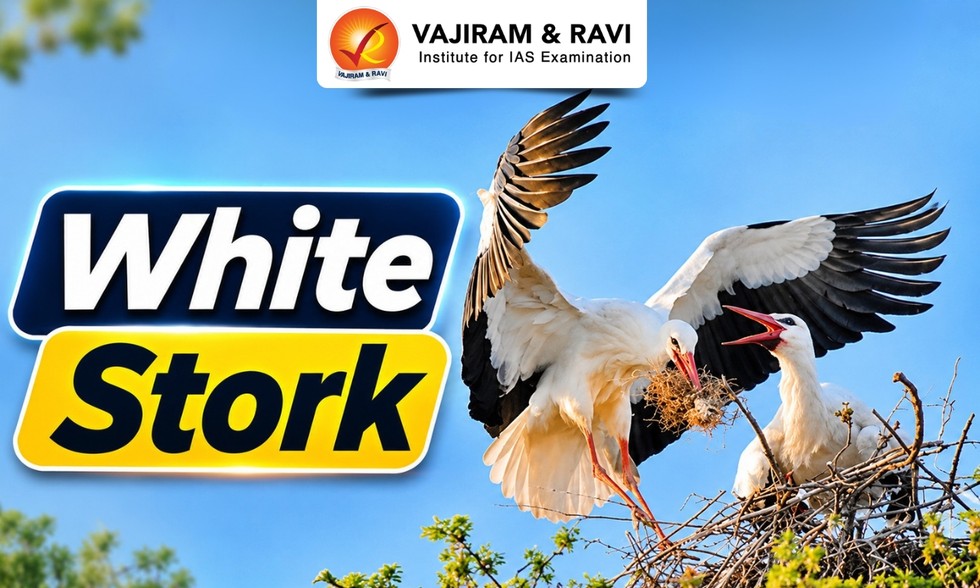
About White Stork:
- It is a large wading bird in the stork family Ciconiidae.
- Scientific Name: Ciconia ciconia
- Habitat and Distribution:
- White storks are found across Europe, Asia Minor, the northern part of Africa, and the Middle East.
- By the winter months, they migrate into tropical regions of Africa, some parts of the Middle East, and the Indian subcontinent.
- They prefer to feed in grassy meadows, agricultural fields, pastures, steppes, savannas, and shallow wetlands, avoiding areas overgrown with tall grass and shrubs.
- They fly with their necks outstretched and legs trailing, utilizing soaring to conserve energy.
- Features:
- When standing, it measures about 95 to 110 centimetres, and it has a wingspan of around 183 to 217 centimetres.
- The sexes are identical in appearance, except that males are larger than females on average.
- The white stork is easily recognisable by its white plumage, its black wing and shoulder feathers, as well as its long red bill (measuring 14-19 centimetres), and its red legs.
- Life span: Up to 40 years.
- Their diet consists mainly of small animals found in shallow water and fields.
- White storks are gregarious and non-territorial
- Conservation Status:
- IUCN Red List: Least Concern
Key Facts about Okhla Bird Sanctuary:
- It is situated at the entrance of Noida in Gautam Budh Nagar District of Uttar Pradesh.
- It is situated at a point where the Yamuna River enters the state of Uttar Pradesh, leaving the territory of Delhi.
- It is roughly 4 sq.km. in size.
- The most prominent feature of the sanctuary is the large lake created by damming the river.
- It is recognised as an Important Bird and Biodiversity Area (IBA) by BirdLife International.