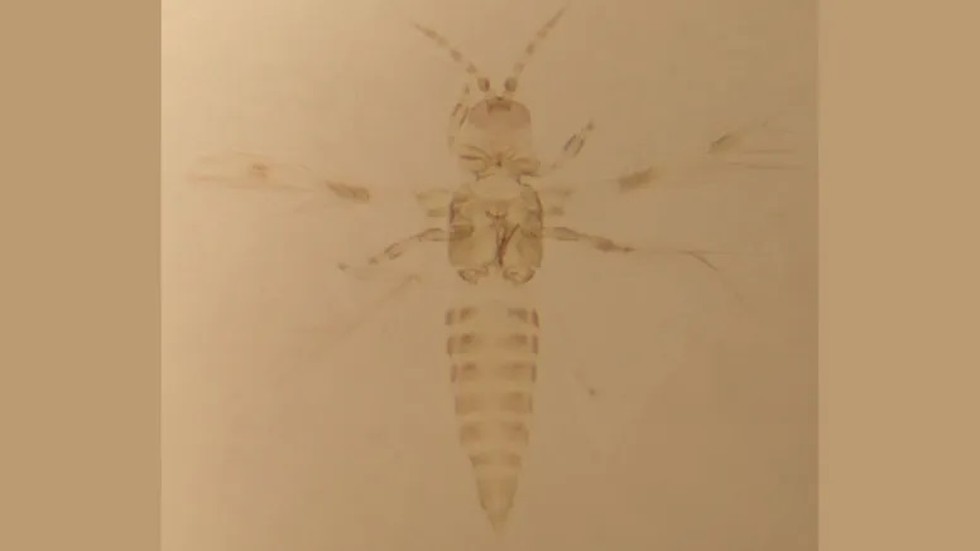
About Trachynotothrips vyaghravahini:
- It is a new species of insect belonging to the group known as thrips.
- It was discovered inside the bright flowers of a tropical plant in the biodiversity-rich Western Ghats of Karnataka.
- It was named vyaghravahini, which is derived from the ancient Sanskrit words 'vyaghra' (meaning tiger) and 'vahini' (meaning flowing river).
- This name is a direct nod to the specific location where the insect was found, Pilikula, which historically was known as a river where wild tigers frequently came to drink water.
- Unlike similar species, the newly discovered species has a uniformly pale midsection without any brown stripes and entirely pale hind legs.
- Furthermore, it lacks the distinct spine-like hairs on the sides of its abdomen and features a different arrangement of microscopic bristles on its lower body compared to its insect cousins.
What are Thrips?
- Thrips are minute, slender-bodied insects less than 1/16 inch to about 3/16 inch in length.
- Adults that range in color from yellow to black and have four long, narrow, fringed wings.
- The young nymphs are smaller, wingless, and range in color from yellow to white.
- Many thrips are plant feeders attacking flowers, leaves, fruit, twigs, or buds.
- Thrips are rarely seen because of their small size.
- The insects feed by puncturing the surface of the plant parts with their single large mandible and slurping the plant juices that seep from the wound.
- Flowers or leaves may develop silvery streaks. Heavily infested leaves appear brownish or silvery, and growing points may become contorted.
- Some species of thrips leave sooty spots of black fecal matter on the leaves.
- Thrips also vector plant diseases.
- A few species are beneficial predators of mites and small insects including other thrips, and some feed on fungal spores.