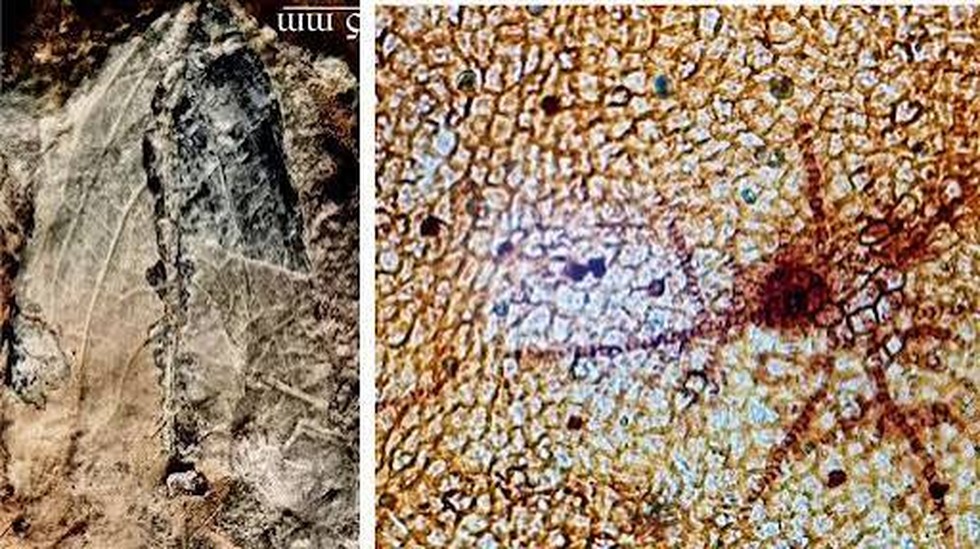
About Vizellopsidites miocenicus:
- It is a new species of ancient, microscopic fungus.
- It was found perfectly preserved on a fossilised plant leaf from up to 12 million years ago in the foothills of the western Himalayas in the Mandi District of Himachal Pradesh.
- Because the delicate fungus was practically invisible to the naked eye, the researchers used a chemical process called maceration.
- It involves bathing the fossil in a series of gentle acids to dissolve the surrounding rock and isolate the leaf's transparent, waxy outer layer.
- When they placed this surviving leaf fragment under a high-powered light microscope, the intricate, dark-brown structures of the ancient fungus were revealed.
- The specific name, miocenicus, directly references the Late Miocene epoch, the geological time period roughly 8 to 12 million years ago when the fungus lived and fossilised.
- It features larger cells and a much looser, net-like arrangement of alternating side branches, which grew in dense mats that primarily branched at the tips.
- It features distinct, circular fruiting bodies, the structures that once released spores, nestled beneath a dark, protective web of cells.
- By comparing the fossil to its modern-day fungal relatives, which grow only in very warm, highly humid tropical environments, the scientists deduced what this region once looked like.
- The presence of V. miocenicus serves as direct evidence that millions of years ago, the terrain of the Himachal Himalaya was not the cooler, mountainous environment we know today, but rather a dense, sweltering, and vibrant tropical forest.