



Why in News?
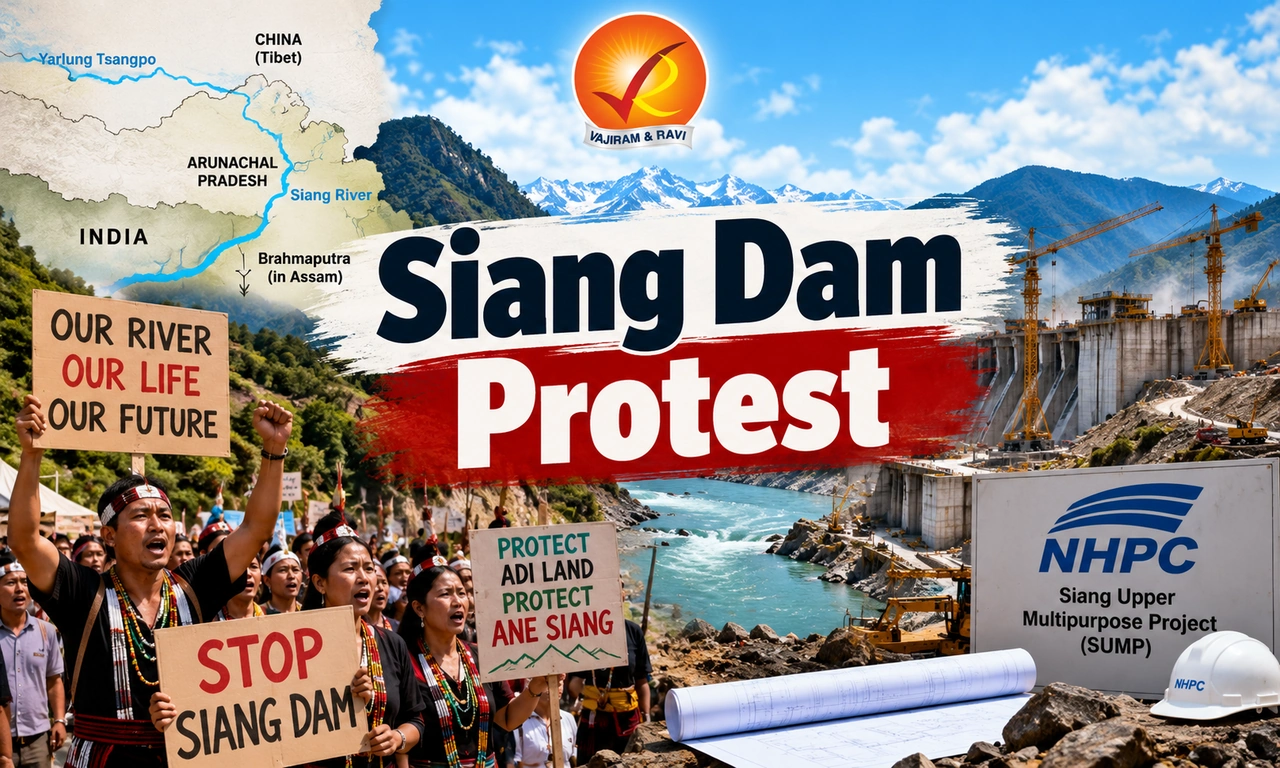
Recently, protests against the proposed 11,200-MW Siang Upper Multipurpose Project (SUMP) in Arunachal Pradesh turned violent, leading to security deployment and restrictions on public gatherings. The unrest has raised questions about public consultation and NHPC Limited's approximately ₹11-crore public relations campaign aimed at building local support for the project.
UPSC Syllabus: GS Paper II – Government Policies, India–China Relations; GS Paper III – Infrastructure, Environment and Disaster Management
About Siang Upper Multipurpose Project (SUMP)
The Siang Upper Multipurpose Project is a proposed large-scale hydropower and water-storage project on the Siang River in Arunachal Pradesh.
- Location: Siang River basin, Arunachal Pradesh.
- Implementing Agency: NHPC Limited, a public sector enterprise under the Ministry of Power.
- Proposed Capacity: Approximately 11,200 megawatts (MW).
- Objectives: Hydroelectric power generation, water storage and flood moderation.
- Strategic Importance: The project is intended to help India manage potential changes in downstream river flows associated with China's hydropower development on the Yarlung Tsangpo River in Tibet.
- Current Status: The project remains at the pre-feasibility survey stage, with its final site and detailed design yet to be determined.


About the Siang River
The Siang River is an important transboundary river forming part of the Brahmaputra river system.
- Origin: The river originates in Tibet, near Mount Kailash, where it is known as the Yarlung Tsangpo.
- Course: It flows eastward through Tibet before taking a sharp bend around Namcha Barwa and entering Arunachal Pradesh as the Siang.
- River System: Downstream, the Siang joins rivers including the Dibang and Lohit to form the Brahmaputra in Assam.
- Significance: The river supports agriculture, fisheries, biodiversity and the traditional livelihoods of indigenous communities.
Why Is the Siang Upper Multipurpose Project Strategically Important?
- India–China Water Security: China's upstream hydropower development on the Yarlung Tsangpo has raised concerns in India about possible changes in downstream water availability and river flows.
- Flood Moderation: The proposed reservoir is intended to help regulate river flows and reduce potential downstream flood risks, subject to its final design and operating conditions.
- Hydropower Generation: The project could contribute to India's electricity supply and renewable energy capacity.
- Strategic Infrastructure: Water-storage infrastructure near the international border is considered important for strengthening India's preparedness against potential upstream water-management decisions.
In December 2024, China approved a major hydropower project on the lower reaches of the Yarlung Tsangpo, increasing the strategic importance of water management in the Brahmaputra basin.
Why Are Local Communities Opposing the Project?
Sections of the indigenous Adi community have opposed the project because of concerns over displacement, environmental damage and the loss of ancestral lands.
- Displacement: The proposed reservoir could submerge villages, agricultural fields and settlements. The Siang Indigenous Farmers' Forum (SIFF) estimates that 27 villages could face submergence, although the final impact has not been established.
- Loss of Livelihoods: Local communities depend on the Siang River and its surrounding land for agriculture, horticulture, livestock grazing and other activities.
- Cultural Significance: The Adi community regards the Siang River as Ane Siang (Mother Siang) and connects its ancestral identity to Abo Tani, a revered ancestral figure.
- Environmental Concerns: Large-scale dam construction could affect forest ecosystems, river biodiversity and sediment flow in the ecologically sensitive Eastern Himalayas.
- Seismic Vulnerability: The Himalayan region is seismically active, requiring careful assessment of earthquake-related and geological risks.
- Public Consultation: Protesters have raised concerns about inadequate engagement with affected communities before surveys and drilling activities.
What Led to the Recent Protests?
The opposition intensified in October 2026 following attempts to advance pre-feasibility surveys and drilling activities.
- Security Deployment: Security personnel were deployed to facilitate preliminary project surveys, leading to protests by local communities.
- Protests and Violence: Demonstrations in Upper Siang and East Siang districts escalated, with incidents of arson, vandalism and clashes with security personnel reported.
- Restrictions: Authorities imposed restrictions on public gatherings under Section 163 of the Bharatiya Nagarik Suraksha Sanhita (BNSS), 2023, in affected areas.
- NHPC's Public Relations Campaign: NHPC awarded a public relations contract worth ₹8.73 crore in July 2025. Its subsequent extension increased the contract value to approximately ₹10.91 crore. The campaign sought to communicate the project's proposed benefits and engage local communities.
- Government Response: Arunachal Pradesh Chief Minister Pema Khandu called for transparency, dialogue and improved communication to address concerns surrounding the project.
The controversy highlights the challenge of balancing strategic infrastructure development with environmental protection, public participation and indigenous community interests.
Way Forward
- Meaningful Public Consultation: Engage affected communities transparently before advancing major project decisions.
- Environmental Assessment: Undertake comprehensive environmental, social and seismic impact assessments, including cumulative impacts on the Siang basin.
- Rehabilitation and Livelihood Protection: Develop appropriate rehabilitation, resettlement and livelihood-restoration measures based on verified impact assessments.
- Transboundary Cooperation: Strengthen hydrological data-sharing and communication mechanisms with China for effective river-basin management.
- Transparent Decision-Making: Ensure public access to relevant project information, assessments and legally required clearance processes.

 Last updated on Oct, 2026
→ UPSC 2027 Notification will be released on 13 January 2027 at upsconline.nic.in.
→ Check Nobel Prize 2026 Winners List here.
→ Check out the latest UPSC Syllabus here.
→ Download UPSC Calendar 2027 PDF Here.
Siang Upper Multipurpose Project FAQs
Q1. What is the Siang Upper Multipurpose Project?+
Q2. Which organisation is responsible for the Siang Upper Multipurpose Project?+
Q3. Why is the Siang Upper Multipurpose Project strategically important?+
Q4. Why are local communities protesting against the Siang dam?+
Q5. What is the relationship between the Siang and Brahmaputra rivers?+
Tags: siang upper multipurpose project