



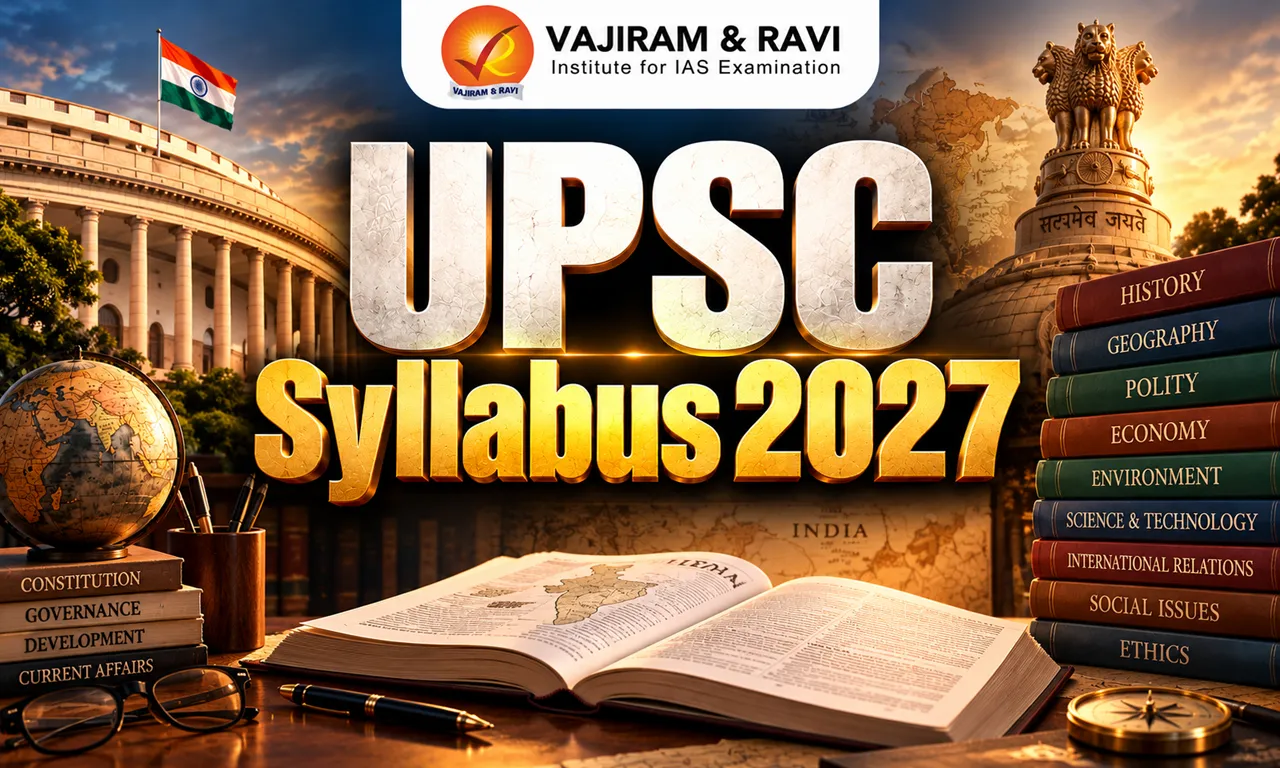
UPSC Syllabus 2027 is officially prescribed by the Union Public Service Commission (UPSC) for the Civil Services Examination. It includes the UPSC Prelims Syllabus 2027 and UPSC Mains Syllabus 2027, covering subjects such as History, Geography, Polity, Economy, Environment, Science & Technology, Ethics, Governance, and Current Affairs. Understanding the latest syllabus and exam pattern is essential for focused preparation and effective time management.
UPSC Syllabus 2027 PDF
Candidates can download the UPSC Syllabus 2027 PDF to get the complete subject-wise syllabus for both the Preliminary and Mains examinations. The PDF helps aspirants understand important topics, paper structure, marking scheme, and the scope of preparation for each stage of the UPSC Civil Services Examination.
UPSC Prelims Exam Pattern 2027
UPSC Prelims Exam Pattern 2027 consists of two objective-type papers: General Studies Paper 1 (GS Paper 1) and General Studies Paper 2 (CSAT). GS Paper 1 determines eligibility for the Mains examination, while CSAT is qualifying in nature and requires a minimum of 33% marks.
| UPSC Prelims Exam Pattern 2027 | |||||
| Paper | Subject | Marks | Questions | Duration | Nature |
|
Paper I |
General Studies (GS Paper 1) |
200 |
100 |
2 Hours |
Merit Ranking |
|
Paper II |
CSAT (GS Paper 2) |
200 |
80 |
2 Hours |
Qualifying (33% Marks Required) |
Note: There is a negative marking of 1/3rd mark for each incorrect answer in both papers.


UPSC Prelims Syllabus 2027
UPSC Prelims Syllabus 2027 consists of two papers: General Studies Paper 1 (GS Paper 1) and Civil Services Aptitude Test (CSAT). The syllabus covers subjects such as History, Geography, Polity, Economy, Environment, Science & Technology, Current Affairs, Comprehension, Logical Reasoning, and Quantitative Aptitude. Understanding the UPSC Prelims Syllabus 2027 is essential for focused preparation and qualifying for the UPSC Mains Examination.
General Studies Paper I (200 marks)
- Current events of National & International importance.
- History of India & Indian National Movement.
- Indian & World Geography – Physical, Social, Economic Geography of India & the World.
- Indian Polity & Governance – Constitution, Political System, Panchayati Raj, Public Policy, Rights Issues, etc.
- Economic & Social Development – Sustainable Development, Poverty, Inclusion, Demographics, Social Sector Initiatives, etc.
- General issues on Environmental ecology, Biodiversity & climate change – that do not require subject specialization.
- General Science.
General Studies Paper II/CSAT (200 marks)
- Comprehension.
- Interpersonal skills including communication skills.
- Logical reasoning & analytical ability.
- Decision making & problem solving.
- General mental ability.
- Basic numeracy (numbers & their relations, orders of magnitude, etc.) (Class X level), Data interpretation (charts, graphs, tables, data sufficiency, etc. – Class X level)
UPSC Mains Exam Pattern 2027
UPSC Mains Exam Pattern 2027 consists of 9 descriptive papers, including Essay, General Studies, Optional Subject, and qualifying language papers. Marks obtained in the Essay, General Studies, and Optional Subject papers (1750 marks) are considered for the final merit ranking, while the language papers are qualifying in nature.
| UPSC Mains Exam Pattern 2027 | |||
| Paper | Subject | Marks | Duration |
|
Paper A |
Indian Language (Qualifying) |
300 |
3 Hours |
|
Paper B |
English (Qualifying) |
300 |
3 Hours |
|
Paper I |
Essay |
250 |
3 Hours |
|
Paper II |
General Studies I |
250 |
3 Hours |
|
Paper III |
General Studies II |
250 |
3 Hours |
|
Paper IV |
General Studies III |
250 |
3 Hours |
|
Paper V |
General Studies IV |
250 |
3 Hours |
|
Paper VI |
Optional Subject Paper I |
250 |
3 Hours |
|
Paper VII |
Optional Subject Paper II |
250 |
3 Hours |
|
Total (Merit Papers) |
Essay + GS + Optional |
1750 |
- |
Note: Candidates who qualify in the UPSC Mains Examination are called for the Personality Test (Interview) carrying 275 marks, making the total marks for final ranking 2025.
UPSC Mains Syllabus 2027
UPSC Mains Syllabus 2027 is designed to assess a candidate’s analytical ability, conceptual clarity, and answer-writing skills. The Mains Examination consists of 9 papers, including an Essay, four General Studies (GS) papers, two Optional Subject papers, and two qualifying language papers. The detailed official syllabus has been discussed below.
UPSC Mains Syllabus 2027 for Qualifying Papers (Indian Languages and English)
(i) comprehension of given passages.
(ii) Precis Writing.
(iii) Usage and Vocabulary.
(iv) Short Essays.
(v) Translation from English to the Indian Language and vice versa.
Note 1: The papers on Indian Languages and English will be of Matriculation or equivalent standard and will be of qualifying nature only. The marks obtained in these papers will not be counted for ranking.
Note 2: The candidates will have to answer the English and Indian Languages papers in English and the respective Indian language (except where translation is involved).
For the Language medium/literature of languages, the scripts to be used by the candidates will be as under:-
| UPSC Mains Subjects for Indian Language (Qualifying Paper) | |
| Language | Script |
|
Assamese |
Assamese |
|
Bengali |
Bengali |
|
Gujarati |
Gujarati |
|
Hindi |
Devanagari |
|
Kannada |
Kannada |
|
Kashmiri |
Persian |
|
Konkani |
Devanagari |
|
Malayalam |
Malayalam |
|
Manipuri |
Bengali / Meitei Mayek |
|
Marathi |
Devanagari |
|
Nepali |
Devanagari |
|
Odia |
Odia |
|
Punjabi |
Gurmukhi |
|
Sanskrit |
Devanagari |
|
Sindhi |
Devanagari / Arabic |
|
Tamil |
Tamil |
|
Telugu |
Telugu |
|
Urdu |
Persian |
|
Bodo |
Devanagari |
|
Dogri |
Devanagari |
|
Maithili |
Devanagari |
|
Santhali |
Devanagari / Olchiki |
UPSC Mains Essay Syllabus
The UPSC Mains Essay Paper, carrying 250 marks, requires candidates to write two essays on topics related to society, governance, economy, philosophy, environment, and contemporary issues. It tests clarity of thought, coherence, originality, and balanced analysis.
Paper-I: Essay: Candidates may be required to write essays on multiple topics. They will be expected to keep closely to the subject of the essay to arrange their ideas in orderly fashion, and to write concisely. Credit will be given for effective and exact expression.
UPSC Mains Syllabus for GS 1 (Paper II)
Paper-II: General Studies-I: Indian Heritage and Culture, History and Geography of the World and Society.
- Indian culture will cover the salient aspects of Art Forms, literature and Architecture from ancient to modern times.
- Modern Indian history from about the middle of the eighteenth century until the present- significant events, personalities, issues.
- The Freedom Struggle — its various stages and important contributors/contributions from different parts of the country.
- Post-independence consolidation and reorganization within the country.
- History of the world will include events from 18th century such as industrial revolution, world wars, redrawal of national boundaries, colonization, decolonization, political philosophies like communism, capitalism, socialism etc.— their forms and effect on the society.
- Salient features of Indian Society, Diversity of India.
- Role of women and women’s organization, population and associated issues, poverty and developmental issues, urbanization, their problems and their remedies.
- Effects of globalization on Indian society.
- Social empowerment, communalism, regionalism & secularism.
- Salient features of world’s physical geography.
- Distribution of key natural resources across the world (including South Asia and the Indian sub-continent); factors responsible for the location of primary, secondary, and tertiary sector industries in various parts of the world (including India).
- Important Geophysical phenomena such as earthquakes, Tsunami, Volcanic activity, cyclone etc., geographical features and their location-changes in critical geographical features (including water-bodies and ice-caps) and in flora and fauna and the effects of such changes.
UPSC Mains Syllabus for GS 2 (Paper III)
Paper-III: General Studies- II: Governance, Constitution, Polity, Social Justice and International relations.
- Indian Constitution—historical underpinnings, evolution, features, amendments, significant provisions and basic structure.
- Functions and responsibilities of the Union and the States, issues and challenges pertaining to the federal structure, devolution of powers and finances up to local levels and challenges therein.
- Separation of powers between various organs dispute redressal mechanisms and institutions.
- Comparison of the Indian constitutional scheme with that of other countries.
- Parliament and State legislatures—structure, functioning, conduct of business, powers & privileges and issues arising out of these.
- Structure, organization and functioning of the Executive and the Judiciary—Ministries and Departments of the Government; pressure groups and formal/informal associations and their role in the Polity.
- Salient features of the Representation of People’s Act.
- Appointment to various Constitutional posts, powers, functions and responsibilities of various Constitutional Bodies.
- Statutory, regulatory and various quasi-judicial bodies.
- Government policies and interventions for development in various sectors and issues arising out of their design and implementation.
- Development processes and the development industry —the role of NGOs, SHGs, various groups and associations, donors, charities, institutional and other stakeholders.
- Welfare schemes for vulnerable sections of the population by the Centre and States and the performance of these schemes; mechanisms, laws, institutions and Bodies constituted for the protection and betterment of these vulnerable sections.
- Issues relating to development and management of Social Sector/Services relating to Health, Education, Human Resources.
- Issues relating to poverty and hunger.
- Important aspects of governance, transparency and accountability, e-governance- applications, models, successes, limitations, and potential; citizens charters, transparency & accountability and institutional and other measures.
- Role of civil services in a democracy.
- India and its neighborhood- relations.
- Bilateral, regional and global groupings and agreements involving India and/or affecting India’s interests.
- Effect of policies and politics of developed and developing countries on India’s interests, Indian diaspora.
- Important International institutions, agencies and fora - their structure, mandate.
UPSC Mains Syllabus for GS 3 (Paper IV)
Paper-IV: General Studies-III: Technology, Economic Development, Bio diversity, Environment, Security and Disaster Management
- Indian Economy and issues relating to planning, mobilization, of resources, growth, development and employment.
- Inclusive growth and issues arising from it.
- Government Budgeting.
- Major crops-cropping patterns in various parts of the country, - different types of irrigation and irrigation systems storage, transport and marketing of agricultural produce and issues and related constraints; e-technology in the aid of farmers.
- Issues related to direct and indirect farm subsidies and minimum support prices; Public Distribution System-objectives, functioning, limitations, revamping; issues of buffer stocks and food security; Technology missions; economics of animal-rearing.
- Food processing and related industries in India- scope’ and significance, location, upstream and downstream requirements, supply chain management.
- Land reforms in India.
- Effects of liberalization on the economy, changes in industrial policy and their effects on industrial growth.
- Infrastructure: Energy, Ports, Roads, Airports, Railways etc.
- Investment models.
- Science and Technology- developments and their applications and effects in everyday life.
- Achievements of Indians in science & technology; indigenization of technology and developing new technology.
- Awareness in the fields of IT, Space, Computers, robotics, Nano-technology, bio-technology and issues relating to intellectual property rights.
- Conservation, environmental pollution and degradation, environmental impact assessment.
- Disaster and disaster management.
- Linkages between development and spread of extremism.
- Role of external state and non-state actors in creating challenges to internal security.
- Challenges to internal security through communication networks, role of media and social networking sites in internal security challenges, basics of cyber security; money-laundering and its prevention.
- Security challenges and their management in border areas - linkages of organized crime with terrorism.
- Various Security forces and agencies and their mandate.
UPSC Mains Syllabus for GS 4 (Paper V)
Paper-V: General Studies- IV: Ethics, Integrity and Aptitude
This paper will include questions to test the candidates’ attitude and approach to issues relating to integrity, probity in public life and his problem solving approach to various issues and conflicts faced by him in dealing with society. Questions may utilise the case study approach to determine these aspects.
The following broad areas will be covered:
- Ethics and Human Interface: Essence, determinants and consequences of Ethics in-human actions; dimensions of ethics; ethics - in private and public relationships. Human Values - lessons from the lives and teachings of great leaders, reformers and administrators; role of family society and educational institutions in inculcating values.
- Attitude: content, structure, function; its influence and relation with thought and behaviour; moral and political attitudes; social influence and persuasion.
- Aptitude and foundational values for Civil Service, integrity, impartiality and non-partisanship, objectivity, dedication to public service, empathy, tolerance and compassion towards the weaker-sections.
- Emotional intelligence-concepts, and their utilities and application in administration and governance.
- Contributions of moral thinkers and philosophers from India and world.
- Public/Civil service values and Ethics in Public administration: Status and problems; ethical concerns and dilemmas in government and private institutions; laws, rules, regulations and conscience as sources of ethical guidance; accountability and ethical governance; strengthening of ethical and moral values in governance; ethical issues in international relations and funding; corporate governance.
- Probity in Governance: Concept of public service; Philosophical basis of governance and probity; Information sharing and transparency in government, Right to Information, Codes of Ethics, Codes of Conduct, Citizen’s Charters, Work culture, Quality of service delivery, Utilization of public funds, challenges of corruption.
- Case Studies on above issues.
UPSC Optional Syllabus 2027
UPSC Optional Syllabus 2027 includes one optional subject chosen by the candidate for the UPSC Mains Examination. The optional subject consists of two papers of 250 marks each, contributing 500 marks to the final merit score. Choosing the right optional subject is crucial, as it can significantly impact a candidate’s overall rank in the Civil Services Examination. Here is the list of UPSC Optional Subjects 2027.
| UPSC Optional Subjects 2027 | ||
|
Agriculture |
Anthropology |
Animal Husbandry & Veterinary Science |
|
Botany |
Chemistry |
Civil Engineering |
|
Commerce & Accountancy |
Economics |
Electrical Engineering |
|
Geography |
Geology |
History |
|
Law |
Management |
Mathematics |
|
Mechanical Engineering |
Medical Science |
Philosophy |
|
Physics |
Political Science & International Relations |
Psychology |
|
Public Administration |
Sociology |
Statistics |
|
Zoology |
Assamese |
Bengali |
|
Bodo |
Dogri |
Gujarati |
|
Hindi |
Kannada |
Kashmiri |
|
Konkani |
Maithili |
Malayalam |
|
Manipuri |
Marathi |
Nepali |
|
Odia |
Punjabi |
Sanskrit |
|
Santhali |
Sindhi |
Tamil |
|
Telugu |
Urdu |
English Literature |
UPSC Interview 2027
UPSC Interview 2027, also known as the Personality Test, is the final stage of the Civil Services Examination conducted by UPSC. Carrying 275 marks, the interview assesses a candidate’s personality, communication skills, leadership qualities, decision-making ability, awareness of current affairs, and suitability for a career in public service. The marks obtained in the UPSC Interview 2027 are added to the Mains score to determine the final merit ranking and selection of candidates for various civil services.
| Other Related Post of UPSC 2027 | |
| UPSC 2027 | UPSC Syllabus |
| IAS Salary | UPSC Age Limit |
| UPSC Exam Pattern | UPSC Calendar |
| UPSC Mains | UPSC CSAT Syllabus |
| UPSC Prelims Syllabus | |

 Last updated on Oct, 2026
→ UPSC 2027 Notification will be released on 13 January 2027 at upsconline.nic.in.
→ Check Nobel Prize 2026 Winners List here.
→ Check out the latest UPSC Syllabus here.
→ Download UPSC Calendar 2027 PDF Here.
UPSC Syllabus 2027 FAQs
Q1. What is the UPSC Syllabus 2027?+
Q2. Has the UPSC Syllabus changed in 2027?+
Q3. How many stages are there in the UPSC Civil Services Exam?+
Q4. What subjects are included in UPSC Prelims GS Paper 1?+
Q5. Is CSAT qualifying in UPSC Prelims?+
Q6. How many papers are there in UPSC Mains?+
Q7. Are Optional Subjects part of the UPSC Mains syllabus?+
Q8. How many General Studies papers are there in Mains?+
Q9. What is covered in UPSC Mains GS Paper I?+
Q10. What topics are included in UPSC Mains GS Paper II?+
Q11. What is the syllabus of UPSC Mains GS Paper III?+
Q12. What is included in UPSC Mains GS Paper IV?+
Q13. Is Current Affairs important for UPSC?+
Q14. Are NCERT books sufficient for UPSC preparation?+
Q15. Is the UPSC Interview syllabus defined?+
Tags: upsc syllabus upsc syllabus 2027 upsc syllabus pdf