



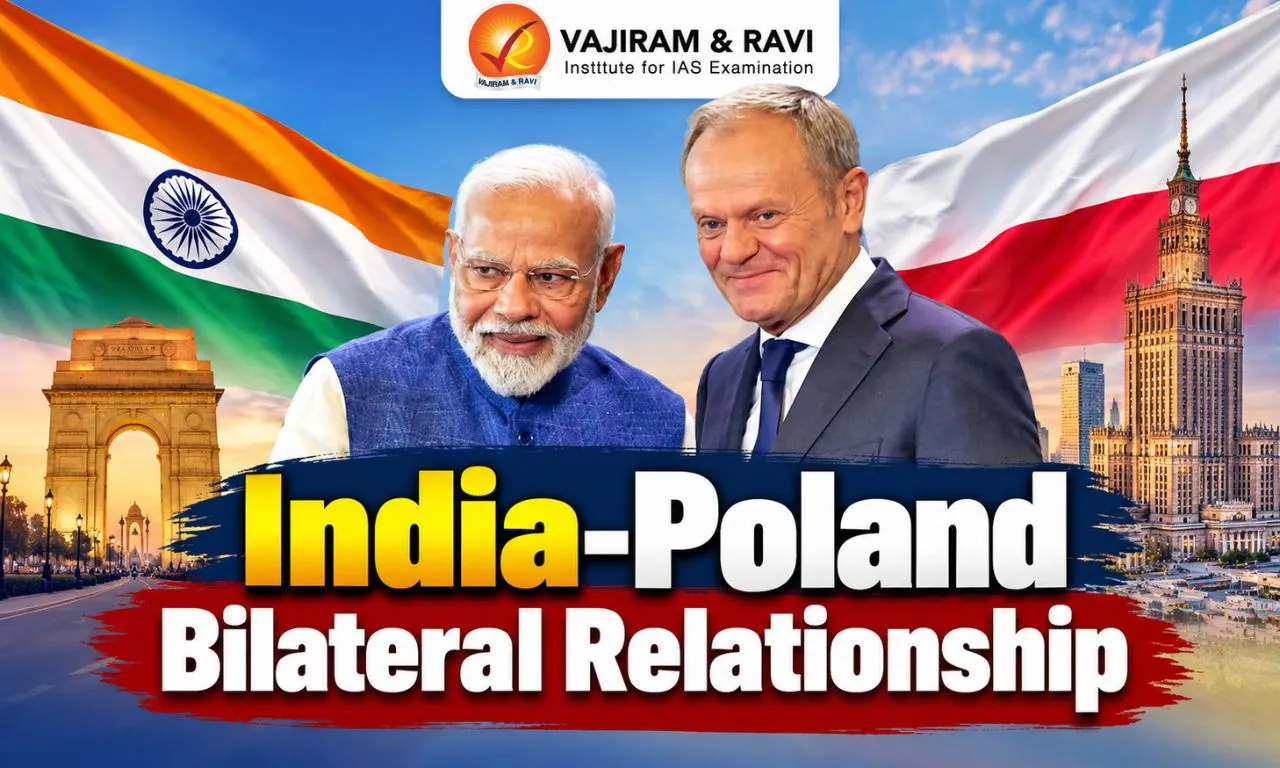
India Poland Relations 2026 are gaining momentum with Polish Prime Minister Donald Tusk’s visit to India from 21 to 23 October 2026, focusing on trade, defence, technology and energy. Building on the Strategic Partnership established in August 2024, bilateral trade reached US$6.36 billion in 2025, while Poland remains an important partner for India in Central and Eastern Europe and the wider EU market.
India Poland Relations: Latest Developments in 2026
Polish Prime Minister Donald Tusk’s visit to India from 21 to 23 October 2026 seeks to advance bilateral cooperation under the Strategic Partnership established in 2024.
Key developments include:
- Bilateral discussions: Prime Minister Narendra Modi and Prime Minister Donald Tusk are scheduled to review bilateral relations and exchange views on regional and international issues.
- Business engagement: India Poland Business Forums are scheduled in New Delhi on 22 October and Bengaluru on 23 October to promote trade and investment.
- Technology cooperation: Tusk’s visit to Bengaluru provides an opportunity to engage with stakeholders in information technology, space and emerging technologies.
- Sectoral cooperation: The visit focuses on expanding cooperation in trade, investment, defence, renewable energy, education and culture.
- India EU engagement: The visit also provides an opportunity to strengthen cooperation within the broader India EU Strategic Partnership.
The broader trade relationship could also benefit from the India EU Free Trade Agreement (FTA), negotiations for which concluded in January 2026. Once the agreement enters into force, it could improve market access for Indian goods and services across the EU, including Poland.
Historical Background of India Poland Relations
India and Poland established diplomatic relations in 1954. Their relationship has evolved alongside political and economic changes in both countries.
- 1950s-1980s: Relations remained friendly, with political exchanges and state-supported trade arrangements. Both countries opposed colonialism, imperialism and racism.
- 1989 onwards: Poland’s transition to democracy and a market economy opened new opportunities for trade and investment.
- 2004: Poland’s accession to the EU strengthened its importance as a potential gateway for Indian businesses seeking to engage with Central and Eastern European markets.
- August 2024: Prime Minister Narendra Modi visited Poland, the first visit by an Indian Prime Minister in 45 years. Both countries established a Strategic Partnership and adopted an Action Plan for 2024-2028.
- 2025-2026: Bilateral engagement continued through institutional consultations and ministerial visits. Poland’s Deputy Prime Minister and Foreign Minister Radosław Sikorski visited India in January 2026, while External Affairs Minister S. Jaishankar visited Poland in September 2026.
The 2024-2028 Action Plan provides a framework for cooperation in political and security affairs, trade and investment, energy, climate, mining, science and technology, transport, cybersecurity and health.


Major Areas of Indian Poland Cooperation
Economic and trade relations form a key pillar of India Poland cooperation, with Poland serving as India’s largest trading and investment partner in Central and Eastern Europe. Bilateral trade has expanded significantly, reaching US$6.36 billion in 2025, with India maintaining a trade surplus.
1. Economic and Trade Relations
Economic cooperation is a major pillar of the relationship. Poland is India’s largest trading and investment partner in Central and Eastern Europe, according to the Indian Embassy’s bilateral brief. Bilateral trade has grown considerably, although India maintains a trade surplus.
|
Indicator |
Details |
|
Bilateral merchandise trade, 2025 |
US$6.36 billion |
|
Indian exports to Poland, 2025 |
US$4.83 billion |
|
Indian imports from Poland, 2025 |
US$1.53 billion |
|
Trade balance |
Surplus for India |
|
Growth in bilateral trade, 2013-2025 |
Approximately 192% |
Major Indian exports to Poland include:
- Textiles and apparel.
- Pharmaceuticals and chemicals.
- Electronic machinery and engineering goods.
- Leather products and vehicles.
- Rubber products and mineral fuels.
Major Indian imports from Poland include:
- Machinery and electrical equipment.
- Base metals and mineral products.
- Precision and medical instruments.
- Rubber products and aerospace-related equipment.
There is scope to diversify trade further, particularly in pharmaceuticals, textiles, engineering, food processing, medical devices and advanced manufacturing. Better market awareness and stronger business links could help companies in both countries access new opportunities.
2. Investment and Business Cooperation
Trade is supported by the presence of companies from both countries. Indian investment in Poland exceeds US$3 billion, while Polish investment in India is estimated at around US$635 million, according to the supplied bilateral brief.
- Indian companies in Poland: Tata Consultancy Services, Infosys, Wipro, HCL Technologies, Zensar Technologies and ArcelorMittal operate in areas such as information technology, manufacturing and steel.
- Polish companies in India: Can-Pack, TZMO, Famur and Ekolog have established operations or business interests in India.
- Institutional mechanism: The Joint Commission on Economic Cooperation (JCEC) provides a platform for reviewing bilateral economic ties and identifying new areas of collaboration.
The seventh session of the JCEC was held in New Delhi on 14 July 2026. Discussions covered digital technologies, mining, renewable energy, green hydrogen, e-mobility, pharmaceuticals, defence, space, agriculture and start-ups.
The next step is to convert these discussions into business partnerships, joint ventures and investment projects, particularly in sectors where the two economies have complementary strengths.
3. Defence and Security Cooperation
Defence cooperation is an important component of India Poland relations, supported by a bilateral defence cooperation memorandum of understanding signed in 2003.
Potential areas of cooperation include:
- Defence manufacturing and industrial partnerships.
- Research, technology exchange and specialised equipment.
- Cybersecurity and protection of critical digital infrastructure.
- Dialogue on European security and international developments.
Poland’s experience in European defence and security frameworks and India’s expanding defence manufacturing capabilities offer scope for practical collaboration. Regular consultations, training and industrial partnerships can help strengthen this area of the Strategic Partnership.
4. Information Technology and Emerging Technologies
Information technology is another important link between the two economies. Indian IT companies operate in Poland and provide services to European clients, while Poland offers a skilled workforce and an established technology sector.
Potential areas of cooperation include:
- Artificial intelligence and emerging technologies.
- Telecommunications, 5G applications and digital infrastructure.
- Cybersecurity and digital public services.
- Space technology, research and commercial applications.
- Start-ups, innovation and joint research.
Business engagement during Tusk’s Bengaluru visit provides an opportunity to build on these existing links and explore further collaboration in technology and innovation.
5. Renewable Energy, Green Hydrogen and Mining
Energy transition and industrial sustainability offer opportunities for both countries to combine their technological and industrial capabilities.
- Renewable energy: Cooperation can support the development and adoption of clean-energy technologies and energy-efficiency solutions.
- Green hydrogen: India’s National Green Hydrogen Mission creates opportunities for collaboration in technology, equipment, industrial applications and supply chains.
- Mining: Poland’s experience in mine closure and land reclamation can support more sustainable mining practices in India.
- Clean coal technologies: Research and technology exchange in areas such as underground coal gasification could support resource utilisation, subject to environmental safeguards.
Cooperation in these sectors can support India’s energy security, industrial modernisation and climate objectives while opening new avenues for investment.
6. Education, Culture and People-to-People Relations
Historical connections and educational exchanges provide a strong social foundation for India Poland relations.
- Indology: Polish universities, including the University of Warsaw and Jagiellonian University, have a tradition of studying Indian languages, philosophy and culture.
- Yoga: Yoga has a significant following in Poland, supported by yoga schools, associations and International Day of Yoga events.
- Historical connections: During the Second World War, Jam Saheb Digvijaysinhji of Nawanagar provided refuge to Polish children. This remains an important symbol of friendship between the two countries.
- Youth exchange: The Jamsaheb Memorial Youth Exchange Programme was announced during Prime Minister Modi’s 2024 visit. The first Polish youth delegation visited India in February 2025.
- Indian community: The Indian community in Poland includes professionals, students, entrepreneurs and employees of multinational companies.
Further cooperation in universities, tourism, cultural events and youth programmes can strengthen mutual understanding and create lasting links between the two societies.
Significance of India Poland Relations for India
India Poland relations are significant for India’s economic growth, strategic partnerships, technological development and engagement with Europe, while also strengthening India’s role in a changing global order.
Economic Significance
Poland provides Indian businesses with access to a major Central European economy and a route to wider engagement with the EU market.
- Supports export diversification and manufacturing.
- Creates opportunities for employment and technology partnerships.
- Strengthens India’s economic engagement with Central and Eastern Europe.
Strategic Significance
Poland’s location in Central Europe and its role in European security make it a relevant partner in India’s engagement with the region.
- Enables regular dialogue on regional and global developments.
- Strengthens India’s understanding of European strategic priorities.
- Creates opportunities for cooperation on international issues.
India-EU Relations
As an EU member, Poland can contribute to India’s engagement with European institutions and markets. The India-EU FTA could further expand commercial opportunities once the agreement completes the required procedures and enters into force.
Technology and Energy Security
Cooperation in digital technologies, mining, renewable energy and green hydrogen can help India diversify its technology partnerships, improve industrial capabilities and support its energy transition.
Cultural Diplomacy
Historical connections, Indology, yoga and youth exchanges strengthen India’s soft power and provide a lasting social foundation for bilateral relations.
Challenges in India Poland Relations 2026
Despite growing engagement, several challenges need attention.
- Trade concentration: Bilateral trade is concentrated in selected product categories, leaving scope to diversify exports and imports.
- Regulatory barriers: Indian exporters must meet EU product standards, certification requirements and regulations, including the REACH framework for chemicals.
- Underutilised investment potential: Differences in business practices, market knowledge and regulatory systems can limit investment, particularly by small and medium-sized enterprises.
- Limited business awareness: Companies may need better information about market opportunities, distribution networks and regulatory procedures in the other country.
- Geopolitical differences: India and European countries may differ in their assessments of international conflicts and strategic priorities. Continued dialogue is necessary to manage these differences.
- Implementation gaps: The success of the Strategic Partnership depends on translating the 2024-2028 Action Plan into measurable outcomes.
Way Forward
The priority is to turn the expanding political relationship into practical outcomes for businesses, institutions and citizens.
- Implement the 2024-2028 Action Plan: Set measurable goals, timelines and review mechanisms across agreed sectors.
- Diversify trade: Expand opportunities in pharmaceuticals, textiles, engineering, food processing, medical devices and advanced manufacturing.
- Improve market access: Help Indian exporters understand EU standards, certification procedures and regulatory requirements.
- Promote investment partnerships: Encourage joint ventures, technology transfer, start-up cooperation and business-to-business engagement.
- Deepen defence and technology cooperation: Expand cybersecurity dialogue, research partnerships, space cooperation and defence industrial engagement.
- Advance green cooperation: Develop projects in renewable energy, green hydrogen, energy efficiency and sustainable mining.
- Expand educational and cultural exchanges: Strengthen university partnerships, youth programmes, tourism promotion and Indology research.
- Use India-EU mechanisms effectively: Align bilateral initiatives with wider India-EU trade, technology and strategic engagement.

 Last updated on Oct, 2026
→ UPSC 2027 Notification will be released on 13 January 2027 at upsconline.nic.in.
→ Check Nobel Prize 2026 Winners List here.
→ Check out the latest UPSC Syllabus here.
→ Download UPSC Calendar 2027 PDF Here.
India Poland Relations 2026 FAQs
Q1. When did India and Poland establish diplomatic relations?+
Q2. When was the India-Poland Strategic Partnership established?+
Q3. What is the value of bilateral trade between India and Poland?+
Q4. What are the major areas of cooperation between India and Poland?+
Q5. Why is Poland important for India’s relations with the European Union?+
Tags: india poland india poland relations india poland relations 2026