




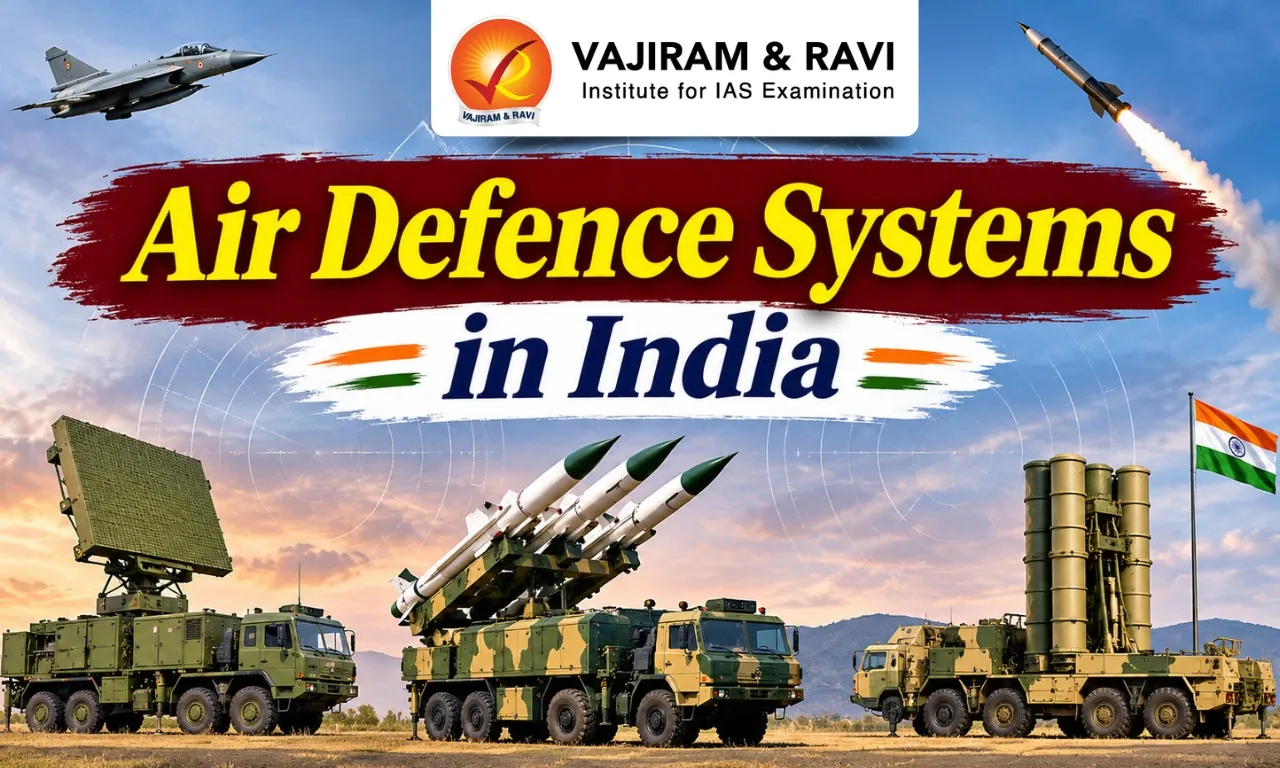
The nature of warfare is changing rapidly. Recent conflicts have shown how drones, precision-guided weapons, cruise missiles and ballistic missiles can be used alongside conventional aircraft to target military installations and critical infrastructure.
Even relatively inexpensive drones can pose significant challenges to advanced defence systems when deployed in large numbers. Similarly, missile attacks can threaten military bases, cities and other strategic assets.
In this changing security environment, air defence systems in India are essential for detecting, tracking and responding to different types of aerial threats. India's approach involves developing an integrated network of surveillance systems, command-and-control platforms and interception weapons.
What are Air Defence Systems?
Air defence systems are a combination of weapons, sensors, radars and command-and-control technologies designed to detect, track, identify and neutralise hostile aerial threats.
These systems protect a country's airspace and important assets against threats such as:
- Aircraft and helicopters: Hostile military aircraft entering or approaching national airspace.
- Unmanned Aerial Vehicles (UAVs): Drones used for surveillance, reconnaissance and attacks.
- Cruise missiles: Low-flying guided missiles designed to evade radar detection.
- Ballistic missiles: Missile threats that travel along a ballistic trajectory after being powered during the initial phase of flight.
- Loitering munitions: Weapons that can remain airborne while searching for a target before attacking it.
Air defence systems may be deployed on land, at sea or in the air, depending on their purpose and operational requirements.
How Do Air Defence Systems Work?
Air defence systems generally operate through three interconnected stages: detection, tracking and interception.
1. Detection of Aerial Threats
The first step is to identify potential threats entering or approaching protected airspace.
- Ground-based radars: Use electromagnetic waves to detect and locate aircraft, missiles and other aerial objects.
- Airborne Early Warning and Control (AEW&C) aircraft: Carry radar and surveillance equipment to detect aerial threats over a wider area, including low-flying targets that may be difficult for ground-based radars to detect.
- Other surveillance sources: Information from different sensors and intelligence systems can contribute to a wider understanding of the air situation.
2. Tracking and Identification
Once a threat is detected, the system tracks its movement, speed, direction and altitude. The information is analysed to identify whether the object is hostile, friendly or unidentified. This helps defence forces assess the level of threat and determine an appropriate response.
3. Interception and Neutralisation
After identifying a threat, the command-and-control network helps select the most suitable response. Depending on the nature and distance of the threat, different systems may be used:
- Fighter aircraft: Intercept hostile aircraft and engage aerial threats.
- Surface-to-Air Missiles (SAMs): Launched from ground-based or naval platforms to destroy incoming aerial targets.
- Anti-aircraft guns: Provide close-range protection against certain low-flying targets.
- Electronic warfare systems: Disrupt or interfere with the communication, navigation or control systems of hostile drones and other platforms.
The effectiveness of an air defence system depends on how quickly these stages are completed and how effectively different defence assets work together.


Significance of Air Defence Systems for India
For India, a strong air defence network is important for several strategic and security-related reasons.
- Protection of strategic assets: Safeguards military bases, airfields, nuclear facilities, power plants, ports and other critical infrastructure.
- Strengthening deterrence: Reduces the likelihood of successful aerial attacks and increases the potential cost of hostile action.
- Supporting military operations: Protects troops, military formations and logistical infrastructure from aerial attacks.
- Civilian security: Helps protect cities, industrial centres and essential services from aerial threats.
- Strategic autonomy: Indigenous systems such as Akash and other domestically developed programmes strengthen India's defence capabilities and reduce dependence on foreign suppliers.
Operation Sindoor demonstrated the operational importance of these capabilities by highlighting India's ability to counter coordinated drone and missile attacks through an integrated air defence network.
India's Air Defence Architecture
India's air defence architecture is based on a combination of surveillance systems, command-and-control networks and interception weapons. These components work together to provide different layers of protection against aerial threats.
1. Surveillance and Detection Systems in India's Air Defence Network
Surveillance systems provide early warning by detecting and tracking potential aerial threats.
Major components include:
- Ground-based radars: Detect and track aircraft, drones and missiles within their coverage areas. Different types of radars are used to monitor different altitudes and ranges.
- Airborne Early Warning and Control (AEW&C) systems: Provide surveillance from the air, helping overcome some limitations of ground-based radars, particularly against low-flying threats.
- Netra AEW&C System: An indigenous airborne surveillance system developed by DRDO in collaboration with the Indian Air Force and Indian industry. It improves aerial surveillance, situational awareness and battle management. Its Final Operational Clearance was handed over in June 2026.
- Satellite-based surveillance: Satellite-based sensors can contribute to the detection of certain missile launches and provide strategic early warning. They complement rather than replace conventional air defence radars.
2. Command-and-Control Systems in India's Air Defence Architecture
Command-and-control systems integrate information from different surveillance platforms and help defence forces coordinate their responses.
Important systems include:
- Integrated Air Command and Control System (IACCS): Developed for the Indian Air Force, it integrates information from different sensors and air defence assets to support real-time decision-making.
- Akashteer: An automated air defence control and reporting system developed for the Indian Army. It improves situational awareness and coordination among Army air defence units.
- Trigun: The Indian Navy's air defence command-and-control system, which supports the coordination of naval air defence operations.
These systems help create a common operational picture and enable faster responses to aerial threats.
3. Interception Systems Used in India's Air Defence Network
Once an aerial threat is detected and assessed, different weapons and platforms are used to intercept or neutralise it.
- Fighter aircraft: Used to intercept hostile aircraft and engage threats at different distances.
- Surface-to-Air Missile (SAM) systems: Designed to destroy incoming aircraft, drones and certain missile threats.
- Anti-aircraft guns: Provide close-range protection against low-flying aerial targets.
- Electronic warfare systems: Disrupt the functioning of hostile drones and other systems by interfering with their communication and navigation links.
The combination of these systems enables India to respond to aerial threats at different ranges and altitudes.
Major Air Defence Systems in India
India uses a combination of imported and indigenous air defence systems to protect its airspace and strategic assets.
1. S-400 Triumf
The S-400 Triumf is a Russian-origin long-range surface-to-air missile system designed to engage multiple types of aerial threats.
- It can intercept aircraft, cruise missiles and certain ballistic missile threats.
- It uses different interceptor missiles to engage targets at varying ranges and altitudes.
- India signed a contract with Russia in October 2018 for the procurement of five S-400 regiments.
Importance: The S-400 strengthens India's long-range air defence capabilities and provides protection against a wide range of aerial threats.
2. Indigenous Akash Missile System
The Akash is an indigenous surface-to-air missile system developed by the Defence Research and Development Organisation (DRDO).
- It is designed to protect vulnerable areas and important installations against aerial attacks.
- It can engage multiple targets simultaneously.
- It is operational with both the Indian Army and the Indian Air Force.
Akash Prime is an improved version of the system, while Akash-NG (Next Generation) is being developed to enhance its capabilities.
3. Medium and Short-Range Air Defence Systems
India also operates and develops several medium- and short-range missile systems to provide protection at different levels.
- Medium Range Surface-to-Air Missile (MRSAM): Jointly developed by DRDO and Israel Aerospace Industries (IAI), it is used by the Indian Army, Indian Air Force and Indian Navy in different configurations.
- Quick Reaction Surface-to-Air Missile (QRSAM): An indigenous system developed by DRDO for the Indian Army. It is designed to provide air defence to mobile military formations and can operate while on the move.
- Very Short Range Air Defence System (VSHORADS): An indigenous man-portable air defence system being developed by DRDO to engage low-altitude aerial threats.
- Vertical Launch Short Range Surface-to-Air Missile (VL-SRSAM): An indigenous naval missile system designed to protect warships against aerial threats, including sea-skimming missiles.
These systems provide different layers of protection and complement long-range air defence platforms.
India's Ballistic Missile Defence Programme
India's Ballistic Missile Defence (BMD) programme, developed by DRDO, aims to detect and intercept incoming ballistic missiles before they reach their targets. It is being developed in two phases.
Phase I: PAD and AAD
The first phase developed two interceptor missiles:
- Prithvi Air Defence (PAD): Designed to intercept ballistic missiles outside the atmosphere (exo-atmospheric interception).
- Advanced Air Defence (AAD): Designed to intercept ballistic missiles within the atmosphere (endo-atmospheric interception).
Phase II: AD-1 and AD-2
The second phase aims to strengthen India's capability to intercept longer-range ballistic missile threats.
- AD-1: Designed to intercept ballistic missiles both inside and outside the atmosphere.
- AD-2: An advanced interceptor being developed under Phase II.
Recent Development: In June 2026, DRDO conducted flight tests involving AD-1 and AD-2 under Phase II of the BMD programme. The Defence Ministry stated that the tests demonstrated India's ability to engage advanced ballistic missile threats, including those of the Intercontinental Ballistic Missile (ICBM) class.
Counter-Drone Capabilities in India
Modern warfare increasingly involves the use of small, low-cost drones for surveillance, reconnaissance and targeted attacks. Drone swarms can also overwhelm conventional air defence systems. This has made counter-drone capabilities an important part of India's air defence preparedness.
Counter-drone systems are designed to detect, track, identify and neutralise hostile drones that threaten military installations, troops and critical infrastructure.
Types of Counter-Drone Measures
- Soft-kill methods: Use electronic warfare techniques such as jamming and spoofing to disrupt a drone's communication or navigation systems without physically destroying it.
- Hard-kill methods: Physically destroy hostile drones using guns, missiles or laser-based weapons.
India's Counter-Drone Capabilities
- DRDO's Anti-Drone System: An indigenous system designed to detect and track drones and neutralise them through electronic jamming and laser-based interception.
- Naval Anti-Drone System (NADS): Developed by DRDO and manufactured by Bharat Electronics Limited (BEL), it combines surveillance and electronic warfare capabilities with laser-based interception.
- Akash Tarang: An Anti-UAV Electronic Warfare System intended to protect Army formations against hostile drones. In July 2026, the Defence Acquisition Council granted Acceptance of Necessity (AoN) for its procurement.
Significance: The growing use of drones in modern conflicts has made air defence more complex. India needs a combination of electronic warfare, surveillance and physical interception systems to counter individual drones as well as coordinated drone attacks.
Recent Developments in India's Air Defence
India is strengthening its air defence capabilities through indigenous programmes aimed at developing an integrated, multi-layered network of surveillance, interception and command-and-control systems. Some major initiatives supporting this effort are:
1. Integrated Air Defence Weapon System (IADWS)
The Integrated Air Defence Weapon System (IADWS) is a DRDO-developed system designed to provide multi-layered protection against different aerial threats.
It brings together three interception technologies under a centralised command-and-control system:
- Quick Reaction Surface-to-Air Missile (QRSAM): Designed to intercept aerial threats at short ranges.
- Very Short Range Air Defence System (VSHORADS): Designed to counter low-altitude threats, including drones.
- Directed Energy Weapon (DEW): Uses high-energy laser technology to destroy targets.
Importance: By combining missile-based and laser-based interception, IADWS aims to engage different types of aerial threats through a coordinated defence network. DRDO conducted its maiden flight tests of the system in August 2025.
2. Project Kusha
Project Kusha is an indigenous long-range surface-to-air missile system being developed by DRDO for the Indian Air Force.
It is designed to intercept a range of aerial threats, including fighter aircraft, missiles, unmanned aerial vehicles (UAVs) and large enemy aircraft.
Importance: Project Kusha aims to strengthen India's long-range air defence capabilities and reduce dependence on imported missile systems. DRDO successfully conducted its maiden flight test in July 2026. The system remains under development.
Also Read:- Operation Barga
3. Mission Sudarshan Chakra
Mission Sudarshan Chakra is a national initiative announced in 2025 to develop a multi-layered security shield for protecting military installations, critical infrastructure and important civilian establishments.
It envisages integrating surveillance systems, radars, command-and-control networks and interception technologies to detect, track and neutralise aerial threats.
Importance: The mission aims to extend air defence protection beyond selected military installations to a wider range of strategic assets and important locations across the country. It represents India's long-term effort to build a coordinated national air defence network.
4. Improved Low-Level Lightweight Radar (LLLR-I)
The Improved Low-Level Lightweight Radar (LLLR-I) is a radar system intended to strengthen the Indian Army's ability to detect and track low-flying aerial threats, including small drones.
Importance: It will improve surveillance against small and low-altitude targets that may be difficult to detect using conventional radar systems. In October 2026, the Ministry of Defence signed a contract with BEL for its procurement.
Challenges Facing India's Air Defence Systems
Despite significant progress, India faces several challenges in developing a comprehensive air defence network.
- Growing diversity of threats: The increasing use of drones, cruise missiles, ballistic missiles and other advanced weapons makes air defence more complex.
- Drone swarms and saturation attacks: Large numbers of low-cost drones can overwhelm conventional air defence systems and deplete expensive missile interceptors.
- Low-altitude detection: Small and low-flying targets can be difficult to detect because of terrain, radar limitations and background interference.
- Advanced technologies: Stealth aircraft, hypersonic weapons and electronic warfare capabilities create new challenges for detection and interception.
- Import dependence: India continues to rely on foreign suppliers for certain advanced air defence systems and technologies.
- High costs: Advanced missile interceptors and radar systems are expensive, making it difficult to maintain adequate stockpiles against large-scale attacks.
- Coordination and integration: Effective air defence requires seamless information-sharing and coordination among the Army, Navy and Air Force.
Way Forward
India needs to strengthen its air defence network through a combination of indigenous development, technological modernisation and better operational coordination.
- Strengthen indigenous capabilities: Accelerate the development and production of domestic missile systems, radars, sensors and counter-drone technologies.
- Improve sensor integration: Integrate information from ground-based radars, airborne platforms and other surveillance systems to improve early warning and situational awareness.
- Develop cost-effective counter-drone systems: Expand the use of electronic warfare, directed-energy weapons and other affordable technologies to counter low-cost drone threats.
- Increase production capacity: Build adequate stocks of interceptors and ensure that domestic production can meet operational requirements during prolonged conflicts.
- Enhance tri-service coordination: Strengthen interoperability among the Army's Akashteer, the Air Force's IACCS and the Navy's Trigun.
- Improve cyber and electronic resilience: Protect air defence networks from cyberattacks, electronic jamming and disruption of communication systems.
- Reduce development-to-induction timelines: Ensure that successful indigenous technologies move more quickly from testing to procurement and operational deployment.
A strong air defence network is essential for protecting India's sovereignty, strategic assets and civilian infrastructure. Developing an integrated, technologically advanced and self-reliant air defence architecture will remain a key priority as the nature of warfare continues to evolve.

 Last updated on Nov, 2026
→ UPSC 2027 Notification will be released on 13 January 2027 at upsconline.nic.in.
→ Check Nobel Prize 2026 Winners List here.
→ Check out the latest UPSC Syllabus here.
→ Download UPSC Calendar 2027 PDF Here.
Air Defence Systems in India FAQs
Q1. What are air defence systems?+
Q2. Which is India's indigenous air defence missile system?+
Q3. What is the S-400 air defence system?+
Q4. What is India's Ballistic Missile Defence Programme?+
Q5. What is Mission Sudarshan Chakra?+
Tags: air defence systems air defence systems in india