




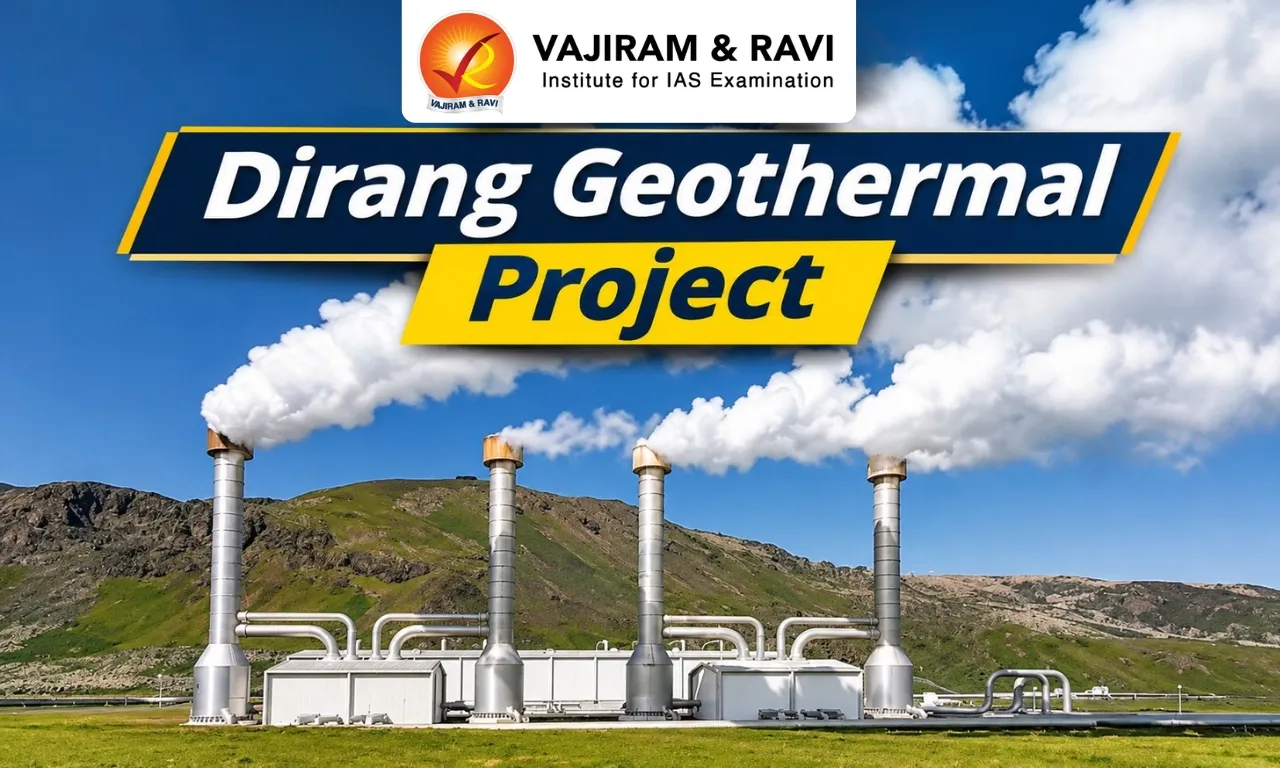
Dirang Geothermal Project in Arunachal Pradesh is an important initiative to harness geothermal energy, a renewable energy source obtained from the Earth’s internal heat. The project aims to provide clean and reliable energy for heating, agriculture and other local needs, while reducing dependence on conventional fuels in the Himalayan region.
About Dirang Geothermal Project
The Centre for Earth Sciences and Himalayan Studies (CESHS) successfully drilled Northeast India’s first geothermal production well in Dirang, Arunachal Pradesh, in 2025. The initiative has opened new opportunities for renewable energy development in the Eastern Himalayas.
- Major Achievement: The first geothermal production well in Northeast India was drilled in April 2025, marking a significant step towards using the region’s underground heat resources for sustainable development.
- Project Development: The project is led by CESHS, an autonomous organisation under the Arunachal Pradesh government’s Department of Science and Technology, with support from the state government and the Ministry of Earth Sciences.
- International Collaboration: The initiative involves technical cooperation with the Norwegian Geotechnical Institute (NGI), Iceland-based Geotropy ehf and Guwahati Boring Service.
- Recent Progress: Pumping tests began in November 2025 to assess the geothermal reservoir’s productivity and long-term sustainability before expanding practical applications.
Dirang Geothermal Project Location and Key Features
The Dirang Geothermal Project is located in West Kameng district of Arunachal Pradesh, where geological conditions provide opportunities to harness naturally occurring underground heat.
- Location: The project is situated in Dirang, a high-altitude Himalayan town in Arunachal Pradesh, identified as a promising location for geothermal energy development.
- Geothermal Potential: The area has an estimated reservoir temperature of around 115°C, making it suitable for direct-use geothermal applications such as heating and agricultural processing.
- Geological Features: The drilling site lies near a major fault zone associated with quartzite and schist rock formations, where fractures allow underground hot water to circulate.
- Scientific Exploration: Researchers conducted nearly two years of geological, structural and geochemical surveys to identify suitable drilling locations and minimise environmental disturbance.
- Technology Potential: Geothermal heat can also generate electricity through a binary Organic Rankine Cycle (ORC) system, which uses heat to vaporise a secondary fluid and drive a turbine. However, commercial electricity generation at Dirang has not yet been established.


Dirang Geothermal Project Objectives
The main objective of the Dirang Geothermal Project is to develop clean, reliable and locally available geothermal energy to support sustainable development and improve living conditions in Arunachal Pradesh.
- Promoting Renewable Energy: To harness underground geothermal heat as a sustainable energy source and reduce dependence on fossil fuels in the Himalayan region.
- Reducing Conventional Fuel Dependence: To provide alternative heating solutions that can reduce the use of diesel and firewood, particularly during extremely cold winters.
- Improving Agricultural Productivity: To support farmers through geothermal-powered drying and storage facilities that help preserve agricultural products and reduce post-harvest losses.
- Supporting Local Communities: To improve living standards by providing affordable heating, agricultural processing facilities and other energy-based services in remote mountainous areas.
- Encouraging Sustainable Development: To demonstrate how geothermal resources can support economic activities while reducing environmental damage and promoting clean energy technologies.
Dirang Geothermal Project Applications
The Dirang Geothermal Project is expected to support several practical applications, particularly in agriculture, heating and local infrastructure.
- Agricultural Product Drying: Geothermal heat can be used to dry fruits, nuts, meat and other local products, helping farmers preserve produce, reduce wastage and improve market opportunities.
- Space Heating: Underground heat can provide reliable heating for homes, public buildings and other facilities, especially in high-altitude areas experiencing severe winters.
- Controlled-Environment Storage: Geothermal energy can support temperature-controlled storage facilities, helping maintain the quality and shelf life of agricultural products.
- Heating and Cooling Systems: The project may support building-scale heating and cooling applications, offering an energy-efficient alternative to conventional systems.
- Tourism and Local Development: Geothermal resources may also support hot-spring tourism, wellness facilities and other local economic activities once the resource is fully assessed.
Dirang Geothermal Project Significance
The Dirang Geothermal Project is an important step towards expanding renewable energy development in Northeast India, while demonstrating the potential of geothermal resources in Himalayan regions.
- First in Northeast India: The project established the region’s first geothermal production well, opening new possibilities for clean energy exploration in Arunachal Pradesh and other Himalayan states.
- Reliable Renewable Energy: Unlike solar and wind energy, geothermal energy can provide continuous heat throughout the day, making it valuable for baseload energy applications where technically feasible.
- Reducing Carbon Emissions: By replacing diesel and firewood for heating and processing, the project could help reduce greenhouse gas emissions and local air pollution.
- Strengthening Rural Economy: Geothermal-powered agricultural processing and storage facilities could increase farmers’ incomes, reduce crop losses and create new livelihood opportunities.
- Supporting India’s Geothermal Potential: According to the Geothermal Atlas of India (2022), India has identified 381 thermally anomalous sites with an estimated geothermal power potential of around 10,600 MW.
- Promoting Sustainable Himalayan Development: The project provides a potential model for clean energy use in remote mountainous regions, although proper monitoring is necessary to prevent geothermal fluid leakage and protect local water resources.
Geothermal Energy in India
Geothermal energy is a renewable energy source obtained from heat stored beneath the Earth’s surface. It is generated mainly through radioactive decay and leftover heat from Earth’s formation. Unlike solar and wind energy, geothermal energy can provide continuous power throughout the day, making it a reliable source of clean energy.
- Geothermal Potential: According to the Geological Survey of India (GSI), India has 381 identified hot springs across 10 geothermal provinces, with an estimated geothermal power potential of around 10,600 MW (10.6 GW).
- Major Geothermal Regions: Important geothermal provinces include the Himalayan region, Naga-Lusai, Andaman and Nicobar Islands, Cambay Graben, Son-Narmada-Tapi (SONATA), West Coast and Godavari region.
- Puga Valley Project: In July 2026, ONGC Energy Centre commissioned two geothermal wells in Puga Valley, Ladakh, to assess underground heat resources and support a proposed 1 MW demonstration power project.
- Other Geothermal Projects: India is developing geothermal initiatives in Gujarat, Telangana and Arunachal Pradesh, focusing on electricity generation, heating, cooling and the reuse of abandoned oil and gas wells.
- National Policy on Geothermal Energy, 2025: Introduced by the Ministry of New and Renewable Energy (MNRE) to promote geothermal exploration, technology development, investment and direct-use applications.
- International Cooperation: India has established geothermal energy partnerships with countries including Iceland, Australia and Saudi Arabia to support research, technology exchange and project development.
- Significance: Geothermal energy can reduce dependence on fossil fuels, provide reliable electricity, support agriculture and heating applications, and contribute to India’s Net Zero 2070 target.

 Last updated on Nov, 2026
→ UPSC 2027 Notification will be released on 13 January 2027 at upsconline.nic.in.
→ Check Nobel Prize 2026 Winners List here.
→ Check out the latest UPSC Syllabus here.
→ Download UPSC Calendar 2027 PDF Here.
Dirang Geothermal Project FAQs
Q1. What is the Dirang Geothermal Project?+
Q2. Where is the Dirang Geothermal Project located?+
Q3. Who is leading the Dirang Geothermal Project?+
Q4. What is the main achievement of the Dirang Geothermal Project?+
Q5. What are the applications of the Dirang Geothermal Project?+
Q6. How much geothermal potential does India have?+
Q7. What are the other geothermal projects in India?+
Tags: dirang geothermal project