




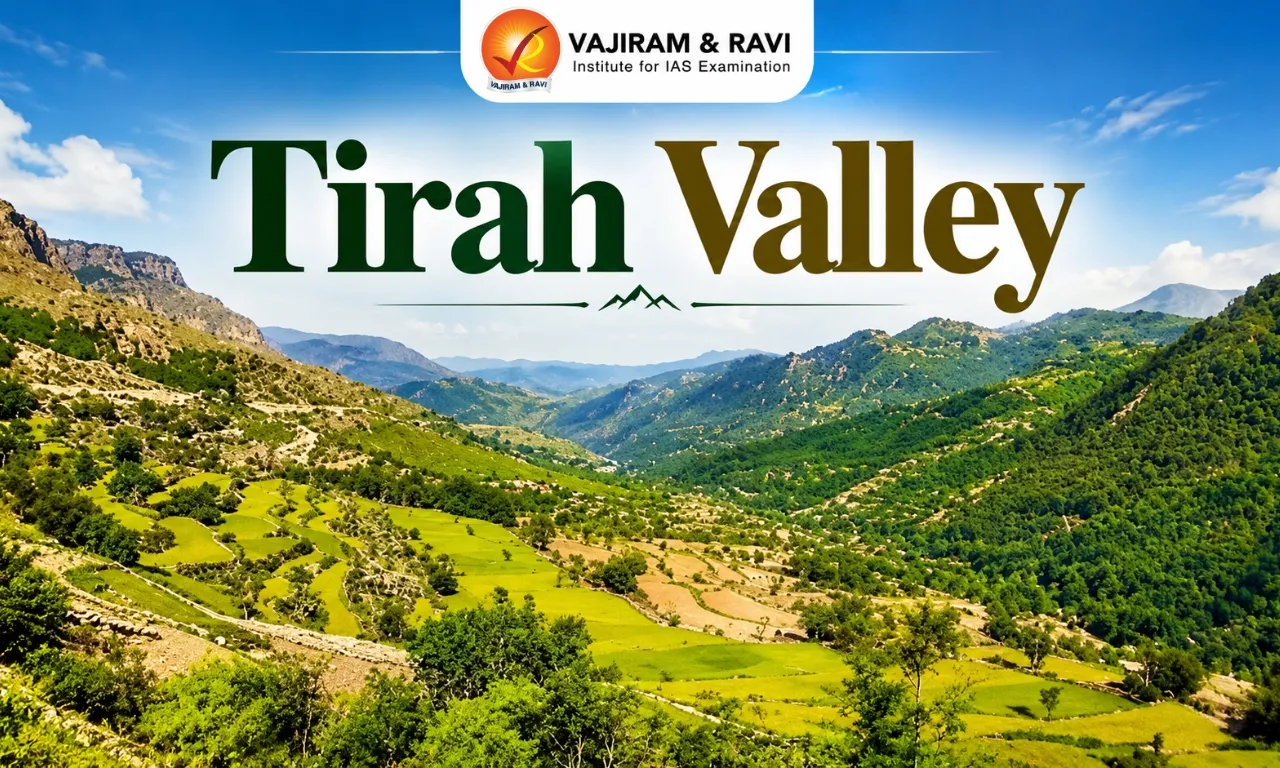
Tirah Valley is a mountainous region in the Khyber District of Khyber Pakhtunkhwa province in northwestern Pakistan. Located near the Pakistan-Afghanistan border, it is known for its rugged terrain, high mountain passes and association with the Pashtun tribes, particularly the Afridis and Orakzais. Its location near the historic Khyber Pass has contributed to its strategic and historical significance.
Location and Geographical Features of Tirah Valley
- Location: West-central Khyber Pakhtunkhwa, Pakistan, near the Pakistan-Afghanistan border.
- Extent: Historical geographical accounts describe Tirah as covering approximately 600-700 square miles, or about 1,550-1,810 square kilometres. This is a historical estimate rather than a modern administrative measurement.
- Relief: A rugged mountainous tract with enclosed valleys, steep slopes and high passes.
- Elevation: Many inhabited valley areas lie at approximately 1,500-2,100 metres, although elevations vary considerably across the region.
- Mountain ranges: The terrain is associated with the Safed Koh (Spin Ghar) mountain system and its adjoining ridges.
- Climate: Mountainous conditions produce seasonal variations in temperature and precipitation, with cooler high-altitude areas and warmer lower valleys.
Major Valleys and Mountain Passes
Historical geographical descriptions identify five principal valleys within the Tirah region.
|
Valley |
Geographical significance |
|
Maidan |
A highland valley historically associated with Afridi communities. |
|
Rajgul |
A valley whose drainage joins the Maidan stream system. |
|
Waran |
One of the principal valleys of the Tirah region. |
|
Bara |
Associated with the Bara River drainage, which descends towards the Peshawar Valley. |
|
Mastura |
A southern valley historically associated with the Orakzai communities. |
Tirah is also characterised by mountain passes that connect its valleys with surrounding areas.
- Sampagha Pass: Connects the Khanki and Mastura valley areas.
- Tseri Kandao Pass: Separates the Maidan and Waran valley areas.
- Saran Sar Pass: Provides a route between parts of Maidan and the Bara Valley.
These passes are important because the rugged relief restricts movement to a limited number of routes. Their geography has historically influenced local trade, migration and military operations.
Also Read:- Indus Valley Civilization


Rivers, Agriculture and Natural Resources
The valley’s drainage system is shaped by mountain streams and rivers flowing through narrow valleys towards the Peshawar region.
- Bara River: The principal river associated with Tirah. Streams from the Maidan and Rajgul areas combine to form the Bara River, which flows towards the Peshawar Valley.
- Mastura and Khanki streams: These drain parts of the southern and eastern mountainous region and connect with the wider river system.
- Agriculture: Historical accounts describe fertile alluvial deposits, terraced cultivation, walnut and mulberry trees, and summer pastures in parts of Tirah.
- Seasonal conditions: Snowfall and cold winters in the higher areas contrast with hotter conditions in some lower valleys. Pastoral activities have traditionally benefited from seasonal movement between highland and lowland areas.
Also Read:- Valleys in India
Strategic Importance of Tirah Valley
Tirah’s importance arises from its location near the Pakistan-Afghanistan border and its difficult mountain terrain.
- Proximity to Afghanistan: The valley lies in a sensitive border region of northwestern Pakistan. Its location connects it with adjoining tribal districts and routes leading towards Afghanistan.
- Historical and Military Significance: The wider region has historically been difficult to control because of its mountainous relief and limited routes through mountain passes. The Tirah Campaign of 1897 was a major British military expedition against Afridi and Orakzai resistance during colonial rule.
- Connection with the Khyber Pass: The nearby Khyber Pass has historically served as a major route between the Peshawar region and Afghanistan, linking South Asia with areas further west and north. Tirah’s surrounding mountain routes contributed to its regional strategic importance, although the valley itself should not be confused with the main Khyber Pass route.
- Security and Humanitarian Concerns: Tirah has experienced security operations and displacement linked to militancy. In 2026, thousands of families were reported to have been displaced amid preparations for security operations. A planned return beginning on 10 October was subsequently reported to have been postponed, with affected residents raising concerns about rehabilitation, compensation and basic services. The situation illustrates the effects of insecurity on livelihoods, education, healthcare and local infrastructure.

 Last updated on Oct, 2026
→ UPSC 2027 Notification will be released on 13 January 2027 at upsconline.nic.in.
→ Check Nobel Prize 2026 Winners List here.
→ Check out the latest UPSC Syllabus here.
→ Download UPSC Calendar 2027 PDF Here.
Tirah Valley FAQs
Q1. Where is Tirah Valley located?+
Q2. Which tribes are historically associated with Tirah Valley?+
Q3. What are the five principal valleys of Tirah?+
Q4. Why is Tirah Valley strategically important?+
Q5. What was the Tirah Campaign of 1897?+
Tags: tirah valley valley