




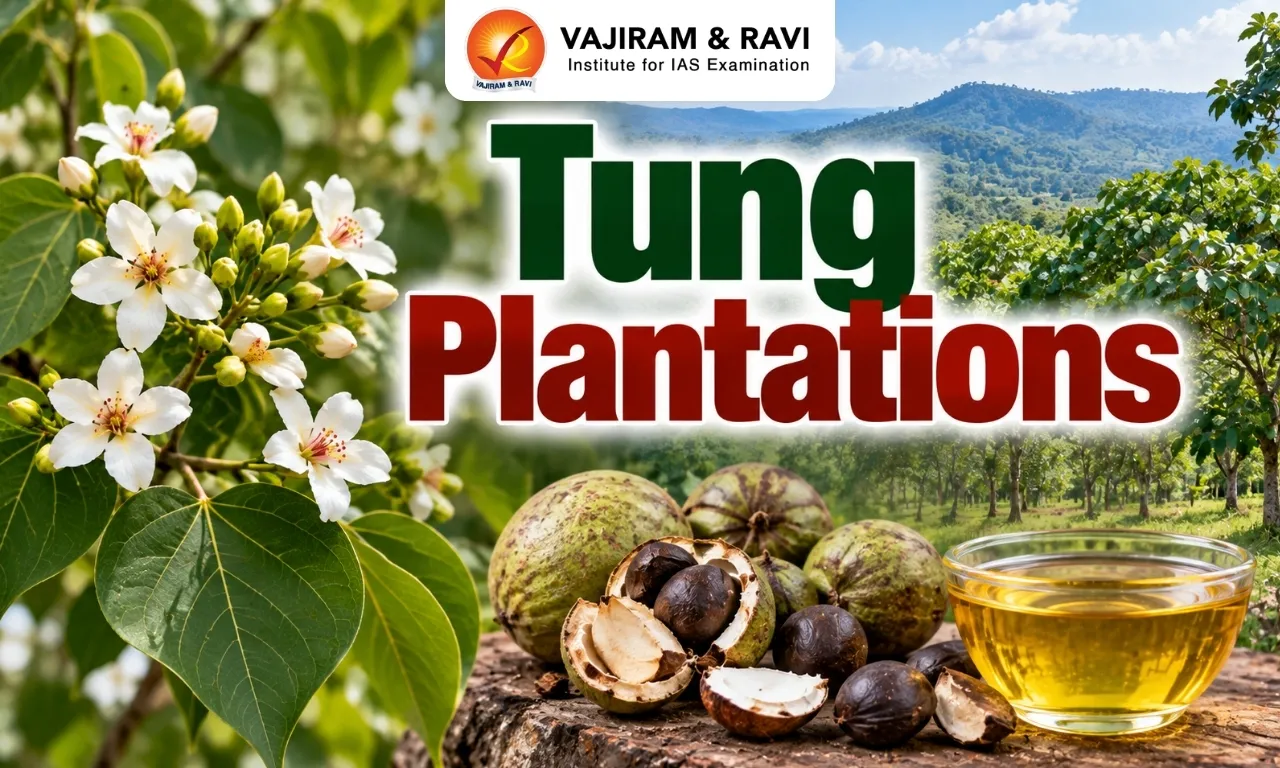
Tung Plantation refers to the cultivation of tung trees (Vernicia fordii) to obtain seeds that produce tung oil, a natural oil widely used in paints, varnishes and wood finishes. Native to parts of East and Southeast Asia, the tree is gaining attention in India, particularly in Mizoram, as farmers explore alternative sources of income from tree-borne oilseeds.
What Is a Tung Plantation?
A tung plantation is an area where tung trees are grown to obtain seeds for extracting tung oil. The tree belongs to the Euphorbiaceae family, commonly known as the spurge family.
The scientific name of the tung tree is Vernicia fordii, formerly known as Aleurites fordii. It is native to southern China, Myanmar and northern Vietnam.
Tung oil is valued for its ability to dry quickly and form a durable, water-resistant coating. Therefore, it is mainly used in industrial applications rather than as an edible oil.
Climate and Soil Requirements
Tung trees grow best under suitable subtropical or tropical conditions. Their growth and productivity depend on rainfall, temperature and soil quality.
- Rainfall: Generally requires at least 1,120 mm of annual rainfall.
- Temperature: Benefits from winter chilling, including approximately 350–400 hours below 7.2°C.
- Soil: Requires deep, well-drained and well-aerated soil with good moisture retention.
- Landform: Hilltops and slopes with proper air drainage may help reduce the risk of spring frost damage.


Major Uses of Tung Oil
Tung oil, also known as China wood oil, is mainly used in industrial products because it hardens when exposed to air and forms a durable, water-resistant surface. Its major uses include:
- Paints and varnishes: Used to produce protective coatings.
- Wood finishes: Helps protect wooden furniture, flooring and other surfaces.
- Sealants and caulk: Used in products designed to seal gaps and resist water.
- Linoleum and oilcloth: Used in certain traditional and industrial products.
- Electrical insulation: Historically used for insulating electrical wires.
- Traditional lighting and fuel: Used in earlier lighting and fuel applications.
Tung Plantation Revival in India
Mizoram has emerged as an important region for the revival of tung cultivation. Farmers and government agencies are exploring the crop as a long-term source of income and an alternative to dependence on traditional shifting cultivation, locally known as jhum.
According to a March 2026 report by Mongabay India, more than 600 farmers had joined the Saitual District Tung Grower Association to improve cultivation and marketing. Tung cultivation is also being promoted under the National Mission on Edible Oils–Oilseeds (NMEO-OS), which includes tree-borne oilseeds.
The main objectives of this initiative are to:
- Diversify farmers' income through the production of oil-rich seeds.
- Promote tree-based farming as an alternative livelihood.
- Improve oil production through better seed collection and processing.
- Develop markets for tung oil and its industrial applications.
- Encourage long-term cultivation of trees that can produce seeds for many years.
Environmental Concerns Associated with Tung Plantations
Despite its commercial potential, large-scale tung cultivation has raised environmental concerns, particularly in the hilly regions of Mizoram.
- Monoculture risks: Growing a single tree species across large areas may reduce biodiversity and weaken ecosystem resilience.
- Soil erosion: Poorly managed plantations on steep slopes may increase soil loss and surface runoff.
- Non-native species: Tung is not native to Mizoram, and its expansion requires careful assessment of its effects on local ecosystems.
- Market uncertainty: Farmers may face financial difficulties if oil extraction facilities and reliable markets are not developed.
- Toxicity: All parts of the tung tree, including its seeds, are poisonous. Contact may cause skin irritation, while ingestion can lead to serious poisoning.
Measures for Sustainable Tung Cultivation
Sustainable cultivation can help balance farmers' income with environmental protection. Instead of replacing diverse vegetation with tung trees alone, cultivation can be planned through agroforestry and soil conservation practices.
Important measures include:
- Agroforestry: Combining tung trees with compatible crops and other tree species.
- Soil conservation: Using contour planting, vegetation barriers and crop residues to reduce erosion.
- Protection of native vegetation: Retaining indigenous plants and trees to support biodiversity.
- Gradual expansion: Assessing environmental effects through pilot projects before expanding plantations.
- Market development: Establishing oil extraction facilities, storage infrastructure and dependable supply chains.
- Safe handling: Taking precautions during harvesting and processing because the tree and its seeds are poisonous.
Historical Background of Tung Cultivation
Tung cultivation has a long history in East and Southeast Asia, particularly in China, where the oil has been used for industrial purposes.
During the mid-20th century, tung plantations also expanded across the American Gulf South, a region commonly known as the Tung Belt. However, commercial cultivation in the United States declined substantially by the late 1960s.
In India, tung cultivation was introduced through earlier plantation efforts, including trials during the 1920s. Later initiatives in Mizoram faced difficulties related to marketing, processing and prices. Current efforts aim to revive cultivation while addressing these economic and environmental challenges.

 Last updated on Oct, 2026
→ UPSC 2027 Notification will be released on 13 January 2027 at upsconline.nic.in.
→ Check Nobel Prize 2026 Winners List here.
→ Check out the latest UPSC Syllabus here.
→ Download UPSC Calendar 2027 PDF Here.
Tung Plantations FAQs
Q1. What is a tung plantation?+
Q2. What is the scientific name of the tung tree?+
Q3. What is tung oil used for?+
Q4. Where is tung plantation being revived in India?+
Q5. Is tung oil edible?+
Q6. How long does a tung tree take to produce seeds?+
Tags: tung plantation tung plantations