




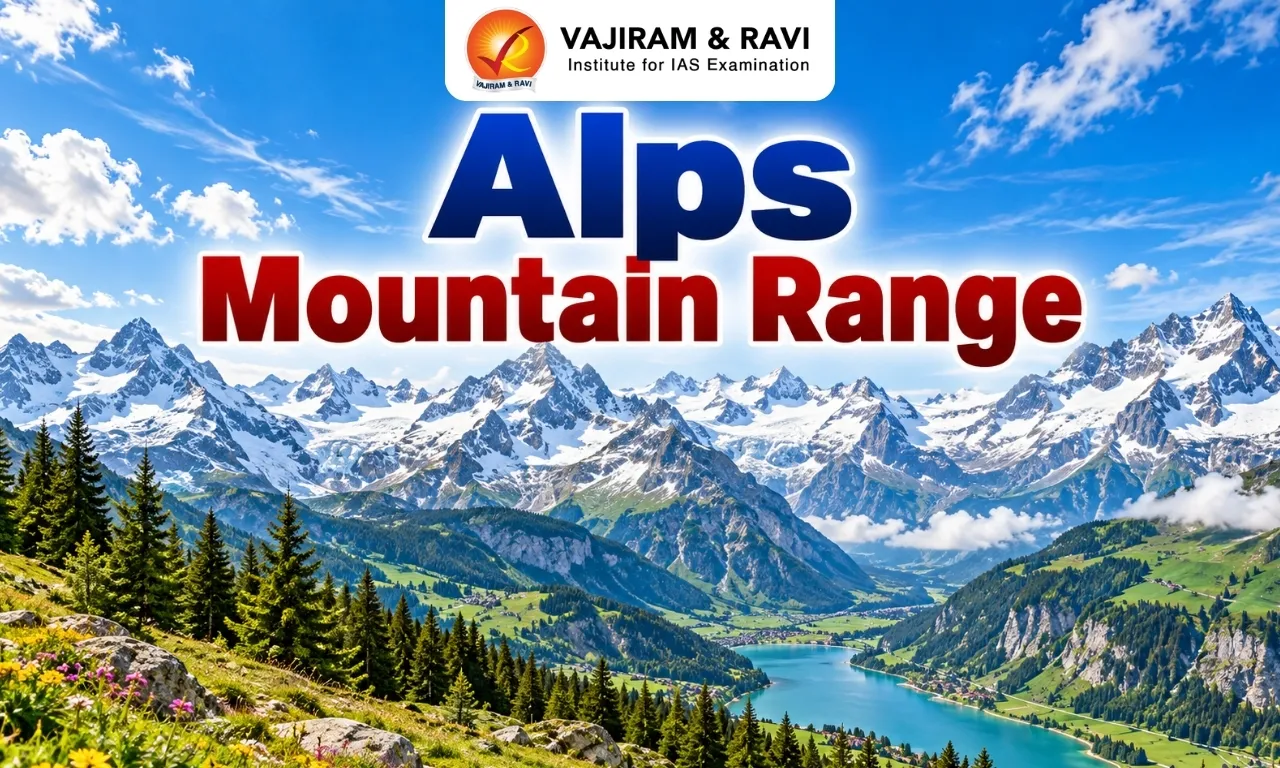
The Alps Mountain Range are a major mountain system in Europe, known for their high peaks, glaciers, deep valleys and influence on the continent’s climate, rivers and human activities.
Location and Extent of the Alps Mountain Range
The Alps mountain range extend across south-central Europe, forming a major physical barrier between the northern European plains and the Mediterranean region.
- The mountain range stretches approximately 1,200 km, from the Mediterranean coast near Nice in France to the region around Vienna in Austria.
- The Alps pass through eight countries: Austria, France, Germany, Italy, Liechtenstein, Monaco, Slovenia and Switzerland.
- The range forms a natural geographical boundary between several parts of Europe and influences transport, settlement and economic activities.
- The Alps are divided into the Western Alps and Eastern Alps, although classifications vary according to the geographical system used.
Formation of the Alps Mountain Range
The Alps mountain range are young fold mountains formed mainly through tectonic movements associated with the convergence of the African and Eurasian plates.
- The formation of the Alps began around 65 million years ago, during the Alpine orogeny.
- The convergence of tectonic plates compressed and deformed sediments deposited in the ancient Tethys Sea.
- These rocks were folded, faulted and uplifted, creating the complex mountain system seen today.
- Continued tectonic activity and erosion have shaped the present landscape.
- Glaciers played a major role in modifying the mountains during past ice ages.


Major Geographical Features of the Alps Mountain Range
The Alps mountain range are characterised by rugged relief, high peaks, deep valleys and landforms shaped by both tectonic activity and glaciation.
- High mountain peaks: The range contains numerous peaks exceeding 4,000 metres, particularly in the western and central sections.
- Glacial valleys: Moving glaciers carved broad U-shaped valleys and steep-sided mountain landscapes.
- Cirques and aretes: Glacial erosion created bowl-shaped hollows called cirques and sharp ridges known as arêtes.
- Mountain passes: Passes such as the Great St Bernard and Brenner have historically supported travel and trade across the mountains.
- Glacial lakes: Many lakes in and around the Alps formed through glacial erosion or the deposition of glacial material.
Highest Peaks of the Alps Mountain Range
The Alps mountain range contain some of Europe’s highest mountains, with several prominent peaks in the Mont Blanc massif and the Pennine Alps, including the Monte Rosa massif.
- Mont Blanc: The highest peak in the Alps, located on the France-Italy border. Its measured elevation varies with the thickness of its snow and ice cap; a measurement reported in 2026 was approximately 4,807 metres.
- Dufourspitze: At 4,634 metres, it is the highest peak in Switzerland and forms part of the Monte Rosa massif.
- Dom: A major peak in Switzerland, rising to approximately 4,545 metres.
- Weisshorn: A prominent Swiss Alpine peak with an elevation of approximately 4,506 metres.
- Matterhorn: A distinctive pyramid-shaped mountain on the Switzerland-Italy border, reaching approximately 4,478 metres.
Climate of the Alps Mountain Range
The climate of the Alps mountain range varies significantly with altitude, slope orientation and the movement of air masses.
- Temperature: Temperatures generally decrease with increasing altitude, producing colder conditions and longer periods of snow cover at higher elevations.
- Precipitation: The windward slopes often receive substantial precipitation, while leeward areas may experience rain-shadow effects.
- Regional variation: The northern and western Alps experience stronger Atlantic influences, while the southern slopes are affected by Mediterranean conditions.
- Foehn winds: These warm, dry downslope winds can cause sudden temperature increases and rapid snowmelt.
- Climate change: Rising temperatures are contributing to glacier retreat, changes in snow cover and shifts in alpine ecosystems.
Major Rivers Originating in the Alps Mountain Range
The Alps mountain range is an important water source for Europe, supplying rivers that support agriculture, settlements, industry and hydropower.
- Rhine: Flows northwards and eventually reaches the North Sea.
- Rhone: Flows through Switzerland and France before entering the Mediterranean Sea.
- Po: Drains much of northern Italy and flows into the Adriatic Sea.
- Danube tributaries: Several rivers originating in or around the Alps contribute to the Danube river system, which ultimately drains into the Black Sea.
The Alpine region is important for freshwater storage and seasonal water supply. Changes in glaciers and snow cover can affect river flow, especially during periods of drought or unusually high temperatures.
Economic Significance of the Alps Mountain Range
The Alps mountain range support a range of economic activities, although steep terrain and harsh climatic conditions limit development in many areas.
- Tourism: Skiing, mountaineering, hiking and other outdoor activities generate income and employment.
- Hydropower: Alpine rivers and differences in elevation support hydroelectric power generation.
- Agriculture: Valleys and lower slopes support dairy farming, livestock rearing, vineyards and other specialised agricultural activities.
- Transport: Tunnels, roads and railway passes connect European regions across the mountain barrier.
- Industry and settlements: Accessible valleys support towns, manufacturing and services, while mountain communities often depend on tourism and local industries.
Biodiversity of the Alps Mountain Range
The Alps mountain range contain diverse ecosystems that change with elevation, from forests and grasslands to alpine meadows and rocky habitats.
- Lower slopes support deciduous and mixed forests, while coniferous forests are common at higher elevations.
- Alpine meadows contain plant species adapted to short growing seasons and cold conditions.
- Wildlife includes ibex, chamois, marmots and golden eagles.
- Many species depend on specific altitude zones, making them sensitive to changes in temperature, land use and habitat connectivity.
Environmental Challenges in the Alps Mountain Range
The Alpine mountain range environment faces growing pressure from climate change, infrastructure development and intensive tourism.
- Glacier retreat: Rising temperatures are reducing glacier mass and altering seasonal water availability.
- Natural hazards: Avalanches, landslides, rockfalls and floods pose risks to mountain communities and infrastructure.
- Tourism pressure: Construction, transport and high visitor numbers can disturb habitats and increase waste and water demand.
- Habitat fragmentation: Roads and development can divide wildlife habitats and restrict species movement.
- Biodiversity loss: Changes in temperature and land use threaten species adapted to specific Alpine conditions.
Conservation of the Alps Mountain Range
Protecting the Alps mountain range requires cooperation among countries because the mountain ecosystem extends across national boundaries.
- The Alpine Convention is an international treaty aimed at protecting the Alpine region and promoting its sustainable development.
- Conservation measures include protecting habitats, managing tourism, reducing pollution and improving ecological connectivity.
- Climate adaptation, sustainable transport and responsible use of water resources are important for the long-term resilience of Alpine communities and ecosystems.

 Last updated on Oct, 2026
→ UPSC 2027 Notification will be released on 13 January 2027 at upsconline.nic.in.
→ Check Nobel Prize 2026 Winners List here.
→ Check out the latest UPSC Syllabus here.
→ Download UPSC Calendar 2027 PDF Here.
Alps Mountain Range FAQs
Q1. Where are the Alps located?+
Q2. Which is the highest peak in the Alps?+
Q3. How were the Alps formed?+
Q4. Which major rivers originate in the Alps?+
Q5. Why are the Alps important for Europe?+
Tags: alps mountain alps mountain range