



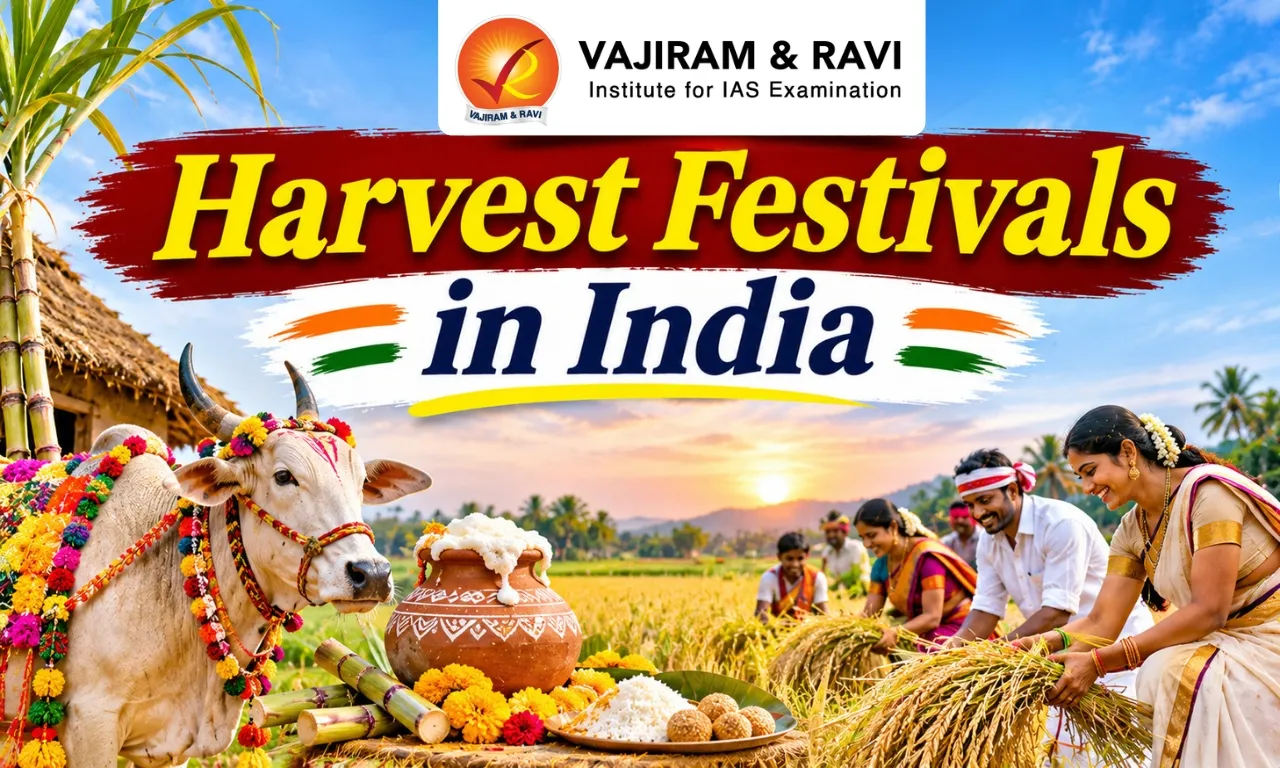
Harvest Festivals in India reflect the country's agricultural diversity, regional traditions and cultural heritage. Celebrated at different times of the year, these festivals mark the harvesting of crops, the arrival of new agricultural produce or the completion of important stages of the farming cycle.
Major harvest festivals in India include Pongal in Tamil Nadu, Bihu in Assam, Baisakhi in Punjab, Onam in Kerala, Nuakhai in Odisha and Wangala in Meghalaya. Their customs and celebrations vary according to regional agricultural practices, climatic conditions and cultural traditions.
What are Harvest Festivals?
Harvest festivals are celebrations marking the gathering of crops and the arrival of new agricultural produce. Farming communities celebrate them to give thanks for a good harvest and pray for future prosperity.
In India, these festivals reflect regional agricultural practices, seasonal cycles and cultural traditions.
Their common features include:
- Thanksgiving: Expressing gratitude for a successful harvest.
- Nature worship: Honouring the Sun, earth, rain and other natural elements.
- Community celebrations: Organising feasts, fairs, folk dances and music.
- Livestock worship: Recognising the role of cattle and other animals in farming.
- Cultural preservation: Maintaining traditional food, folk songs, dances and customs.
List of Major Harvest Festivals in India
The following table provides a list of major harvest festivals celebrated across different states and regions of India, along with their geographical associations.
|
Festival |
State/Region |
|
Makar Sankranti |
Across India |
|
Pongal |
Tamil Nadu |
|
Lohri |
Punjab, Haryana and parts of northern India |
|
Baisakhi (Vaisakhi) |
Punjab and parts of northern India |
|
Bihu |
Assam |
|
Onam |
Kerala |
|
Nuakhai |
Western Odisha |
|
Nabanna |
West Bengal |
|
Wangala |
Meghalaya (Garo tribe) |
|
Ka Pomblang Nongkrem |
Meghalaya (Khasi community) |
|
Tusu Parab |
Jharkhand and adjoining regions of West Bengal and Odisha |
|
Huthri (Puthari) |
Kodagu, Karnataka |
|
Tokhu Emong |
Nagaland (Lotha Naga tribe) |
|
Ngada |
Nagaland (Rengma Naga tribe) |
|
Ahuna |
Nagaland (Sumi Naga tribe) |
Note: Some festivals are directly associated with harvesting, while others mark seasonal transitions, agricultural stages or post-harvest thanksgiving. Their dates may vary according to regional calendars and agricultural conditions.


Major Harvest Festivals in India
India's harvest festivals vary across regions, reflecting differences in agricultural seasons, local crops and cultural traditions. The major festivals celebrated across the country are listed below.
1. Makar Sankranti
Makar Sankranti is celebrated across India, usually on 14 January, although it occasionally falls on 15 January. It is an important solar festival marking the Sun's transition into the zodiac sign of Makara (Capricorn). It is traditionally associated with Uttarayana, the Sun's northward journey.
The festival is celebrated in different forms across India:
- Uttarayan: In Gujarat, the festival is famous for kite flying and the International Kite Festival.
- Maghi: In Punjab, it is observed on the day following Lohri, with religious bathing and traditional food.
- Poush Sankranti: In West Bengal, it is associated with the preparation of traditional rice-based sweets called pitha.
- Khichdi: In Uttar Pradesh, the festival is associated with ritual bathing, charity and the preparation of khichdi.
- Maghe Sankranti: In Sikkim, it is celebrated with traditional food and community gatherings.
- Makara Sankramana: In Karnataka, the festival is marked by traditional rituals and the exchange of sesame seeds and jaggery.
Makar Sankranti is determined primarily by the solar calendar, unlike many Indian festivals that follow the lunar calendar.
2. Pongal
Pongal is a four-day harvest festival celebrated in Tamil Nadu during January, corresponding to the Tamil month of Thai. The word Pongal means 'to boil over' and refers to the traditional preparation of freshly harvested rice with milk and jaggery.
The four days of the festival are:
- Bhogi Pongal: The first day marks renewal and new beginnings. Traditionally, homes are cleaned and old belongings are discarded.
- Thai Pongal (Surya Pongal): The main day is dedicated to the Sun God. Freshly harvested rice is cooked with milk and jaggery as an offering.
- Mattu Pongal: This day is dedicated to cattle, particularly cows and bulls, for their contribution to agricultural activities. They are bathed and decorated.
- Kaanum Pongal: The final day is associated with family gatherings, social visits and community celebrations.
Pongal highlights the importance of the Sun, agricultural produce and livestock in Tamil society.
3. Lohri
Lohri is a popular winter folk festival celebrated mainly in Punjab, Haryana and parts of northern India on 13 January. It is associated with the winter solstice period, the gradual lengthening of days and the agricultural cycle.
Major traditions include:
- Lighting a bonfire and gathering around it.
- Offering sesame seeds, jaggery, popcorn and peanuts to the fire.
- Singing traditional folk songs and performing Bhangra and Gidda.
- Celebrating important family occasions, particularly the birth of a child or a newly married couple's first Lohri.
The festival is also associated with Dulla Bhatti, a folk hero remembered in traditional Lohri songs for helping people in distress.
Lohri is primarily a winter folk festival associated with Punjab's seasonal and agricultural traditions. It is celebrated on the eve of Makar Sankranti.
4. Baisakhi (Vaisakhi)
Baisakhi is celebrated in Punjab and parts of northern India on 13 or 14 April. It is an important harvest festival marking the harvesting of Rabi crops, particularly wheat. It is associated with agricultural prosperity and has major historical and religious significance for Sikhs.
Its significance includes:
- Agricultural significance: Farmers celebrate the harvesting of winter crops and express gratitude for a successful agricultural season.
- Sikh religious significance: On Baisakhi in 1699, Guru Gobind Singh, the tenth Sikh Guru, established the Khalsa Panth at Anandpur Sahib.
- Cultural celebrations: Fairs, processions and traditional folk dances such as Bhangra and Gidda are organised.
Baisakhi is both an agricultural festival and an important event in Sikh history.
5. Bihu
Bihu is the most important festival of Assam and is closely connected with its agricultural calendar. It is celebrated three times a year, with each form representing a different stage of the farming cycle.
- Rongali Bihu (Bohag Bihu): Celebrated in mid-April, it marks the Assamese New Year and the beginning of the agricultural season. It is associated with spring, sowing activities, traditional Bihu dance and music.
- Kongali Bihu (Kati Bihu): Celebrated in October, it corresponds to the growing stage of crops, when granaries are traditionally relatively empty. Farmers light earthen lamps near Tulsi plants and in paddy fields and pray for a good harvest.
- Bhogali Bihu (Magh Bihu): Celebrated in mid-January, it marks the harvesting season and the abundance of food. Community feasts are an important feature.
Some important traditions associated with Magh Bihu include:
- Uruka: The eve of Magh Bihu, when people gather for community feasts.
- Meji: A traditional structure made of bamboo, wood and thatch, which is burnt the following morning.
- Pitha and Laru: Traditional rice-based cakes and sweets prepared during the festival.
The three Bihus represent different stages of the agricultural cycle: the beginning of the agricultural season, crop growth and harvesting.
6. Onam
Onam is Kerala's major annual cultural festival and is also celebrated as a harvest festival. It takes place during August–September, in the Malayalam month of Chingam. The festival is associated with prosperity, abundance and the legend of King Mahabali, whose annual visit to Kerala is celebrated by the people.
Major traditions include:
- Pookkalam: Floral carpets arranged outside homes.
- Onasadya: A traditional vegetarian feast served on banana leaves.
- Vallam Kali: Traditional snake boat races.
- Pulikali: A folk performance in which participants paint their bodies like tigers.
- Traditional dances and games: Community performances and celebrations.
Onam is generally celebrated over ten days, beginning with Atham and culminating on Thiruvonam. It combines harvest-related traditions with the legend of King Mahabali and Kerala's cultural heritage.
7. Nuakhai
Nuakhai is one of the most important agrarian festivals of Western Odisha. Celebrated generally in August–September during the Bhadraba month of the Odia calendar, it marks the arrival of the new harvest.
The word is derived from two Odia words: Nua, meaning new, and Khai, meaning food.
Major traditions include:
- Offering the first grains of the new harvest to the presiding deity.
- Worshipping Maa Samaleswari, particularly in Sambalpur.
- Sharing newly harvested rice among family and community members.
- Organising traditional dances, music and community feasts.
Nuakhai is particularly important in the Sambalpur region of Western Odisha.
8. Nabanna
Nabanna is a traditional harvest celebration of West Bengal, generally observed in November–December, depending on the paddy harvest. The term comes from two Bengali words: Naba, meaning new, and Anna, meaning food or rice.
It is associated with the arrival of newly harvested paddy and the preparation of traditional rice-based dishes.
Major traditions include preparing food using newly harvested rice, observing household customs and sharing delicacies such as pitha among family members and communities.
Nabanna reflects Bengal's traditional paddy-based agricultural economy and the cultural importance of rice.
9. Wangala
Wangala is an important post-harvest festival of the Garo tribe of Meghalaya, generally celebrated in November. Popularly known as the 100 Drums Festival, it is observed to express gratitude to Misi Saljong, the Sun God, for a successful harvest and agricultural prosperity.
Major traditions include:
- Traditional dances accompanied by the beating of drums.
- Community feasts and celebrations.
- Colourful traditional costumes and folk music.
- Rituals expressing gratitude for the harvest.
Wangala is one of the major cultural festivals of the Garo community.
10. Ka Pomblang Nongkrem
Ka Pomblang Nongkrem, commonly known as the Nongkrem Dance Festival, is an important festival of the Khasi community in Meghalaya. It is generally celebrated in November at Smit, near Shillong.
The festival is associated with thanksgiving for a good harvest, prosperity and the well-being of the community.
Major traditions include:
- Traditional Khasi dances performed by men and women.
- Rituals conducted under the guidance of the Syiem, the traditional chief.
- Religious ceremonies and offerings associated with Khasi traditions.
Nongkrem is a major cultural festival of the Khasi community, combining thanksgiving, religious rituals and traditional dance.
11. Tusu Parab
Tusu Parab is a traditional folk and harvest festival celebrated in parts of Jharkhand and adjoining regions of West Bengal and Odisha. It is generally observed around Poush Sankranti in January and is associated with the post-harvest period.
Major traditions include:
- Singing traditional Tusu folk songs.
- Preparing and decorating structures known as Tusu figures.
- Organising fairs and community gatherings.
- Immersing decorated structures in rivers as part of local traditions.
Tusu Parab reflects the folk traditions of the Chotanagpur and adjoining regions.
12. Huthri (Puthari)
Huthri, also known as Puthari, is the traditional harvest festival of the Kodava community in Karnataka's Kodagu district. It is generally celebrated in November–December and marks the harvesting of the new paddy crop.
Major traditions include:
- The head of the family ceremonially cutting the first sheaf of newly harvested paddy.
- Offering prayers for a prosperous harvest.
- Gathering with family members and participating in traditional celebrations.
- Chanting 'Poli, Poli, Deva', seeking blessings for an abundant harvest.
Huthri reflects the agrarian traditions of the Kodava community and the importance of paddy cultivation in Kodagu.
13. Tokhu Emong
Tokhu Emong is a major post-harvest festival of the Lotha Naga tribe of Nagaland, generally celebrated in November. It marks the completion of the agricultural harvest and is observed through community feasts, traditional songs, dances and social gatherings.
The festival also provides an occasion for strengthening social relationships, sharing food and resolving disputes.
14. Ngada
Ngada is a post-harvest festival of the Rengma Naga tribe of Nagaland, generally celebrated in November. It marks the completion of the harvest season and is observed through traditional rituals, songs, dances and community feasts.
The festival provides an opportunity for thanksgiving, social gatherings and the strengthening of community bonds.
15. Ahuna
Ahuna is the traditional post-harvest festival of the Sumi Naga tribe of Nagaland, generally celebrated in November. It marks the completion of the harvest and the preparation of the first meal using newly harvested rice.
Major traditions include preparing and sharing rice-based food, offering prayers for prosperity and organising community feasts.
Harvest Festivals and India's Agricultural Seasons
India has three major cropping seasons. The timing of harvest festivals is influenced by the crops cultivated and harvested in different regions.
|
Cropping Season |
Sowing Period |
Harvesting Period |
Major Crops |
|
Kharif |
June-July, with the onset of the monsoon |
September-October or later |
Rice, maize, cotton and millets |
|
Rabi |
October-December |
March-April |
Wheat, barley, gram and mustard |
|
Zaid |
March-June |
Generally before the onset of the monsoon |
Watermelon, muskmelon, cucumber and vegetables |
The relationship between agricultural seasons and festivals can be understood through examples such as Magh Bihu and Pongal, which are associated with the paddy harvest, and Baisakhi, which is associated with the Rabi harvest, particularly wheat. Nuakhai celebrates the new rice harvest in Western Odisha, while Wangala marks post-harvest thanksgiving among the Garo community.
The timing of harvest festivals is not uniform across India because agricultural seasons vary according to regional climate, rainfall and cropping patterns.
Significance of Harvest Festivals in India
Harvest festivals have agricultural, cultural, social and economic significance.
- Preservation of agricultural heritage: They reflect India's dependence on agriculture and preserve traditional practices associated with farming and food production.
- Relationship with nature: Rituals associated with the Sun, earth and rain reflect the importance of natural resources in agricultural life.
- Social cohesion: Community feasts, fairs and folk performances strengthen relationships among families and villages.
- Preservation of folk culture: These festivals help sustain regional languages, folk songs, dances, traditional food, crafts and customs.
- Recognition of farmers and livestock: They acknowledge the contribution of farmers and domestic animals to agricultural production.
- Rural economy and tourism: Fairs, local markets, handicrafts and cultural events create opportunities for rural artisans and small businesses.

 Last updated on Nov, 2026
→ UPSC 2027 Notification will be released on 13 January 2027 at upsconline.nic.in.
→ Check Nobel Prize 2026 Winners List here.
→ Check out the latest UPSC Syllabus here.
→ Download UPSC Calendar 2027 PDF Here.
Harvest Festivals in India FAQs
Q1. What are the major harvest festivals in India?+
Q2. Which harvest festival is known as the 100 Drums Festival?+
Q3. Which harvest festivals are celebrated by Naga tribes?+
Q4. What is the difference between Bihu and Pongal?+
Q5. Which harvest festival is associated with the new rice harvest in Odisha?+
Tags: harvest festivals harvest festivals in india