



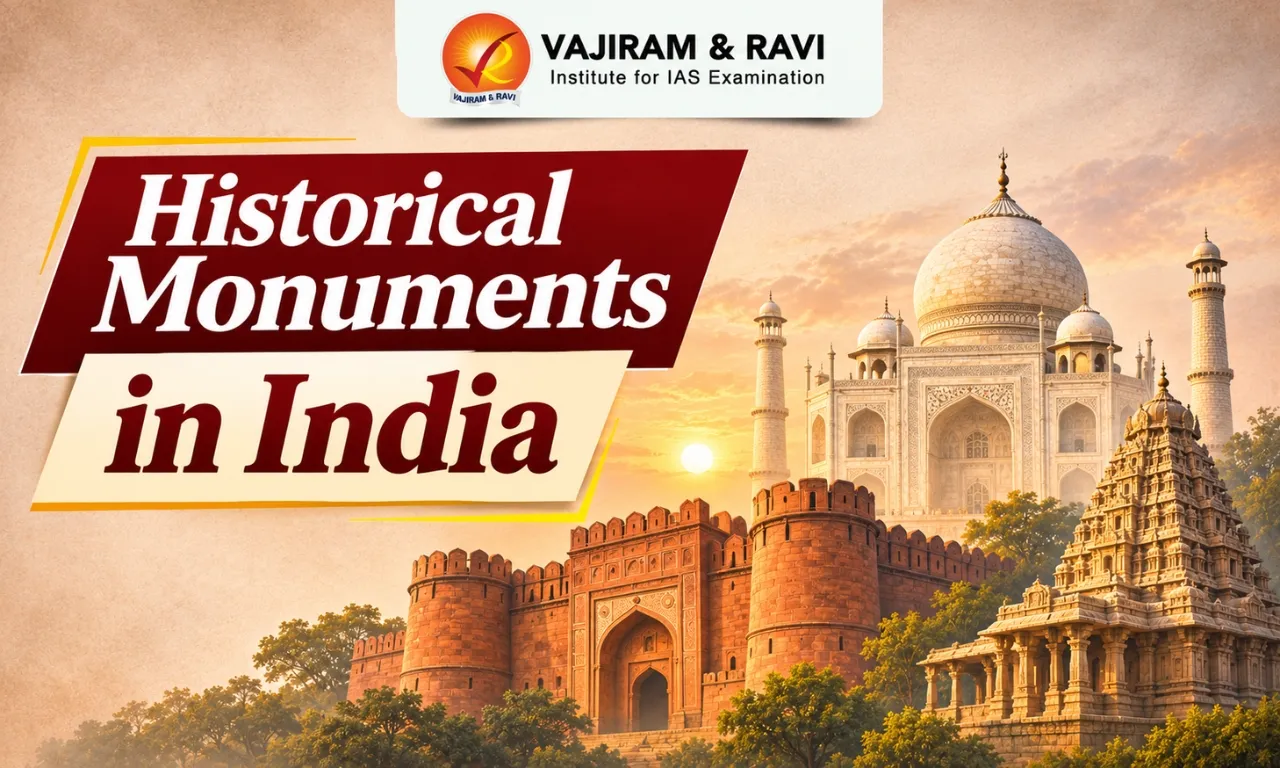
Historical monuments in India are important sources of information about the country's history, religion, art and architecture. They help us understand the rule of different dynasties, religious traditions, social life and the development of towns and cities.
Inscriptions on monuments provide information about kings, land grants, donations and administration. Paintings and sculptures tell us about religious beliefs, clothing, ornaments and daily life. For example, the paintings at Ajanta show scenes from the life of Buddha and the society of that period, while inscriptions at Chola temples provide details about land grants and temple administration.
Ancient Historical Monuments in India
The ancient period saw the growth of Buddhist, Jain and Hindu religious architecture in different parts of India. Stupas, rock-cut caves and temples from this period reflect the religious beliefs, artistic skills and building techniques of their time.
Buddhist Monuments
Buddhist architecture developed in India through the construction of stupas, monasteries and prayer halls. Many of these monuments were built with the support of rulers, traders and Buddhist followers.
Great Stupa at Sanchi, Madhya Pradesh
- The Great Stupa was originally built by Emperor Ashoka in the 3rd century BCE and was enlarged during the Shunga and Satavahana periods.
- Its dome, known as the anda, contains a central relic chamber. The structure also has a harmika and a chhatra at the top.
- Four gateways, called toranas, are decorated with carvings showing Jataka stories and events from Buddha's life.
- Early Buddhist art often showed Buddha through symbols such as the Bodhi Tree, the empty throne and the Wheel of Dharma.
- Sanchi is an important site for studying the early development of Buddhist art and architecture.
Mahabodhi Temple, Bodh Gaya, Bihar
- The temple marks the place where Gautama Buddha attained enlightenment under the Bodhi Tree.
- Emperor Ashoka is associated with the construction of an early shrine at the site. The present temple was developed and restored over several periods.
- Its main tower has a tall pyramidal shape and is decorated with carved niches and smaller stupas.
- The Mahabodhi Temple Complex is an important Buddhist pilgrimage site and was included in the UNESCO World Heritage List in 2002.
Dhamek Stupa, Sarnath, Uttar Pradesh
- The Dhamek Stupa marks the place where Buddha is believed to have delivered his first sermon to five disciples. This event is known as Dharmachakra Pravartana.
- It is a large cylindrical structure made of brick and stone.
- Its lower portion has detailed floral and geometric designs.
- Sarnath later developed into an important centre of Buddhist learning and pilgrimage. The Ancient Buddhist Site of Sarnath was added to the UNESCO World Heritage List in 2026.
Rock-Cut Monuments and Caves
Rock-cut architecture involves carving structures directly into natural rock formations. India has several important cave complexes that served as Buddhist monasteries, Jain centres and Hindu places of worship.
Ajanta Caves, Maharashtra
- The Ajanta Caves were developed in two main phases, beginning around the 2nd century BCE. Major additions were made during the Vakataka period in the 5th and 6th centuries CE.
- The caves include Buddhist chaityagrihas (prayer halls) and viharas (monasteries).
- Their paintings show Jataka stories, events from Buddha's life, royal courts, merchants and scenes from daily life.
The paintings are important sources for understanding ancient Indian art, clothing, ornaments and society.
Ellora Caves, Maharashtra
- The Ellora Caves were excavated between the 6th and 10th centuries CE.
- The complex has 34 major caves: Caves 1-12 are Buddhist, 13-29 are Hindu and 30-34 are Jain.
- The Kailasa Temple (Cave 16) is the most famous structure at Ellora. It is a monolithic temple carved from a single rock and is generally associated with Rashtrakuta ruler Krishna I.
- The caves show the development of Buddhist, Hindu and Jain architecture at the same site.
Elephanta Caves, Maharashtra
- Located on Elephanta Island in Mumbai Harbour, these caves are mainly dedicated to Lord Shiva.
- The main cave contains the famous three-headed Shiva sculpture, known as Trimurti or Maheshmurti.
- Other important sculptures show Shiva as Nataraja and Ardhanarishvara.
- The caves are known for their large rock-cut sculptures and are important examples of Shaivite art in western India.
Udayagiri and Khandagiri Caves, Odisha
- These Jain caves were mainly excavated during the 2nd and 1st centuries BCE.
- They are associated with Kharavela, a ruler of the Mahameghavahana dynasty.
- Rani Gumpha at Udayagiri is known for its two-storeyed structure and carved panels.
- The Hathigumpha inscription provides information about Kharavela's rule, military campaigns and public works.
- These caves are important sources for the history of ancient Kalinga and Jainism.
Important Hindu Temples
Temple architecture developed in different regions of India under the patronage of various dynasties. These temples are known for their distinct designs, stone carvings, sculptures and inscriptions.
Group of Monuments at Mahabalipuram, Tamil Nadu
- These monuments were built under the Pallava rulers during the 7th and 8th centuries CE.
- The complex includes rock-cut halls, monolithic temples, large open-air carvings and structural temples.
- The Five Rathas are monolithic structures carved from single rock formations.
- The large rock relief known as Descent of the Ganges, also called Arjuna's Penance, is one of the site's main attractions.
- The Shore Temple, built during the reign of Pallava ruler Narasimhavarman II, is another major monument in the complex. It is an important example of early structural stone temple architecture.
Brihadisvara Temple, Thanjavur, Tamil Nadu
- The temple was built by Chola ruler Rajaraja I and completed around 1010 CE. It is dedicated to Lord Shiva.
- Its tall pyramidal vimana above the main shrine is a major feature of Dravidian architecture.
- The temple complex has a large Nandi sculpture, pillared halls and smaller shrines.
- Its inscriptions provide information about land grants, donations, temple administration, dancers and musicians.
- It forms part of the UNESCO-listed Great Living Chola Temples, along with the Brihadisvara Temple at Gangaikondacholapuram and the Airavatesvara Temple at Darasuram.
Kandariya Mahadeva Temple, Khajuraho, Madhya Pradesh
- Built during the Chandela period in the 11th century, the temple is dedicated to Lord Shiva.
- It has a tall, curved shikhara surrounded by smaller towers.
- Its outer walls are covered with sculptures of gods, goddesses, dancers and scenes from everyday life.
- It is an important example of the Nagara style of temple architecture and forms part of the UNESCO-listed Khajuraho Group of Monuments.
Sun Temple, Konark, Odisha
- The temple was built by Eastern Ganga ruler Narasimhadeva I in the 13th century and is dedicated to Surya, the Sun God.
- It was designed in the shape of a huge stone chariot with 24 carved wheels and seven horses.
- Its walls contain sculptures of gods, musicians, dancers, animals and scenes from daily life.
- It is an important example of Kalinga architecture and is popularly known as the Black Pagoda.
Hoysaleswara Temple, Halebidu, Karnataka
- Built during the 12th century under the Hoysala dynasty, the temple is dedicated to Lord Shiva.
- It stands on a star-shaped platform and is made mainly of soapstone.
- Its outer walls have detailed carvings showing scenes from the Ramayana, Mahabharata and Puranas.
- The temple is known for its carved pillars, sculptures and fine stonework.
- Along with the Chennakesava Temple at Belur, it represents the temple-building tradition of the Hoysalas.
Ramappa Temple, Telangana
- Also known as the Rudreshwara Temple, it was built in the 13th century during the rule of Kakatiya king Ganapati Deva.
- The temple is dedicated to Lord Shiva and is named after its chief sculptor, Ramappa.
- Its main features include a star-shaped platform, carved pillars, bracket figures and a lightweight brick roof.
- Sculptures of dancers and musicians provide information about the art and culture of the Kakatiya period.
- It was included in the UNESCO World Heritage List in 2021.
Medieval Historical Monuments in India
The medieval period witnessed the construction of large forts, palaces, temples, tombs and mosques. These structures reflect the political power, religious traditions and architectural styles of the kingdoms and empires that ruled different parts of India.
Forts, Palaces and Water Structures
Forts and palaces served as centres of administration, defence and royal residence. Stepwells and other water structures also played an important role in meeting the water needs of towns and settlements.
Chittorgarh Fort, Rajasthan
- Chittorgarh Fort was an important centre of the Mewar kingdom and served as its capital for several centuries.
- The fort complex contains palaces, temples, water reservoirs and towers. Two notable structures are Vijay Stambha, built by Rana Kumbha to commemorate his victory over the Sultan of Malwa, and Kirti Stambha, a Jain tower dedicated to Adinath, the first Jain Tirthankara.
- The fort witnessed three major sieges: by Alauddin Khalji in 1303, Bahadur Shah of Gujarat in 1535 and Akbar in 1567–68. These events are closely associated with the history of Mewar.
- Chittorgarh Fort is one of the six forts included in the Hill Forts of Rajasthan, inscribed on the UNESCO World Heritage List in 2013.
Kumbhalgarh Fort, Rajasthan
- Built by Rana Kumbha in the 15th century, Kumbhalgarh was an important defensive fort of the Mewar kingdom.
- Its long walls follow the shape of the surrounding Aravalli hills and include several gateways and watchtowers.
- The fort complex contains palaces, temples and water reservoirs.
- It is also part of the UNESCO-listed Hill Forts of Rajasthan.
Hampi Monuments, Karnataka
- Hampi was the capital of the Vijayanagara Empire, founded in 1336 by Harihara and Bukka.
- Important monuments include the Virupaksha Temple, Vittala Temple, Lotus Mahal, Hazara Rama Temple and Royal Enclosure.
- The Vittala Temple is famous for its stone chariot and beautifully carved pillars.
- The Royal Enclosure contains remains of audience halls, ceremonial platforms and water structures.
- The remains of temples, markets, tanks and water channels provide information about the empire's administration, trade and city planning.
Rani-ki-Vav, Patan, Gujarat
- Rani-ki-Vav was built in the 11th century by Queen Udayamati in memory of her husband, Bhima I of the Chaulukya dynasty.
- It is a stepwell with several levels of stairs, pillared halls and a deep well shaft.
- Its walls have hundreds of sculptures, including images of Vishnu and other Hindu deities.
- The stepwell shows how water storage, engineering and religious art were combined in medieval Gujarat.
- It was included in the UNESCO World Heritage List in 2014.
Golconda Fort, Telangana
Golconda was an important stronghold in the Deccan and later became the capital of the Qutb Shahi kingdom.
- It was originally built by the Kakatiya rulers in the 13th century and later expanded by the Bahmani and Qutb Shahi rulers.
- The Qutb Shahi rulers developed it into a fortified capital with massive granite walls, gateways, bastions and palaces.
- The fort is known for its acoustic design. A clap at the Fateh Darwaza can be heard at the Bala Hisar pavilion, which helped communicate warnings within the fort.
- Golconda was also famous for its diamond trade. The Koh-i-Noor is among the famous diamonds associated with the region.
Delhi Sultanate Monuments
The Delhi Sultanate introduced and developed new architectural features, including arches, domes, minarets and decorative calligraphy. Its monuments also show the use of local building materials and Indian craftsmanship.
Qutb Minar Complex, Delhi
- Construction of the Qutb Minar was started by Qutb-ud-din Aibak in the late 12th century and continued by Iltutmish.
- It is about 72.5 metres high and has five storeys with projecting balconies and inscriptions in Arabic.
- The complex also includes the Quwwat-ul-Islam Mosque, the Iron Pillar and Alai Darwaza.
- Alai Darwaza, built by Alauddin Khalji in 1311 CE, is known for its true arches, dome and geometric designs.
- The complex is an important example of early Indo-Islamic architecture in India.
Tughlaqabad Fort and Firoz Shah Kotla, Delhi
- Tughlaqabad Fort was built by Ghiyas-ud-din Tughlaq in the 14th century. It has massive sloping walls, bastions and fortified gateways.
- Its strong walls and defensive design reflect the military needs of the early Tughlaq rulers.
- Firoz Shah Kotla was built by Firoz Shah Tughlaq as part of the city of Firozabad.
- Its remains include a mosque, palace structures and an Ashokan pillar brought from Topra in present-day Haryana.
- These monuments provide information about the military architecture and city-building activities of the Delhi Sultanate.
Mughal Monuments
Mughal architecture developed through the combination of Persian, Central Asian and Indian influences. It is known for its domes, gardens, arches, marble decoration and carefully planned buildings.
Humayun's Tomb, Delhi
- The tomb was commissioned by Empress Bega Begum after Humayun's death and was completed around 1570 during Akbar's reign.
- It was designed by Persian architect Mirak Mirza Ghiyas.
- The building stands on a raised platform and has a double dome, red sandstone walls and white marble decoration.
- It is surrounded by a symmetrical charbagh garden divided into four parts.
- Its design influenced later Mughal tombs, including the Taj Mahal.
Fatehpur Sikri, Uttar Pradesh
- Fatehpur Sikri was developed by Emperor Akbar in the 16th century and served as the Mughal capital for a short period.
- Important buildings include Buland Darwaza, Jama Masjid, Panch Mahal, Diwan-i-Khas, Jodha Bai's Palace and the Tomb of Salim Chishti.
- Buland Darwaza was built to mark Akbar's victory in Gujarat.
- The buildings combine Persian, Central Asian and Indian architectural features.
Agra Fort and Taj Mahal, Uttar Pradesh
- Agra Fort was rebuilt on a large scale by Akbar in the 16th century, mainly using red sandstone. It was later modified by Jahangir and Shah Jahan.
- It served as a military centre, royal residence and administrative headquarters of the Mughal Empire.
- Important structures inside the fort include Jahangiri Mahal, Diwan-i-Aam, Diwan-i-Khas and Khas Mahal.
- Taj Mahal was commissioned by Shah Jahan in memory of his wife Mumtaz Mahal. Its construction began in 1632.
- The main mausoleum is made of white marble and has a double dome and four minarets.
- Its main features include Quranic inscriptions, symmetrical gardens and pietra dura work, in which coloured stones are set into marble.
Red Fort, Delhi
- The Red Fort was built by Shah Jahan in the 17th century as the palace-fortress of Shahjahanabad, his new capital.
- Its red sandstone walls enclose royal buildings, gardens and audience halls.
- Important structures include Diwan-i-Aam, Diwan-i-Khas and Rang Mahal.
- The fort later became associated with the Revolt of 1857.
- Every year, the Prime Minister of India addresses the nation from its ramparts on Independence Day.
Gol Gumbaz, Vijayapura, Karnataka
- Gol Gumbaz was built as the tomb of Mohammed Adil Shah of the Adil Shahi dynasty in the 17th century.
- Its most striking feature is its huge central dome.
- The building has a whispering gallery where even a faint sound can travel across the dome.
- It is an important example of Deccan Sultanate architecture.


European and Colonial-Era Monuments
European powers introduced new architectural styles during the colonial period. Churches, railway stations, memorials and administrative buildings from this period reflect European designs along with Indian architectural elements.
Churches and Convents of Goa
- These buildings represent the religious and architectural influence of Portuguese rule in Goa, mainly during the 16th and 17th centuries.
- Important structures include the Basilica of Bom Jesus, Se Cathedral and Church of St. Francis of Assisi.
- The Basilica of Bom Jesus was completed in the early 17th century and houses the mortal remains of St. Francis Xavier.
- These churches show European architectural styles such as Baroque and Renaissance, adapted to local materials and building methods.
Chhatrapati Shivaji Maharaj Terminus, Mumbai
- Earlier known as Victoria Terminus, the railway station was designed by Frederick William Stevens and completed in 1887.
- It is an example of Victorian Gothic Revival architecture with Indian features.
- Its main features include a central dome, pointed arches, turrets, stained-glass windows and detailed stone carvings.
- The building reflects the growth of railway networks and Mumbai's importance as a commercial centre during British rule.
Victoria Memorial, Kolkata
- The Victoria Memorial was built in memory of Queen Victoria and opened to the public in 1921.
- It was designed by William Emerson and constructed mainly using white marble.
- Its design combines British classical architecture with Indian and Mughal features.
- It now functions as a museum and houses paintings, manuscripts and historical objects.
Protection and Conservation of Historical Monuments in India
Historical monuments are important parts of India's cultural heritage. Their protection requires legal safeguards, regular conservation, responsible tourism and public participation.
- Archaeological Survey of India (ASI): Established in 1861, the ASI works under the Ministry of Culture. It carries out archaeological surveys, excavations and conservation of centrally protected monuments.
- Ancient Monuments and Archaeological Sites and Remains Act, 1958: Provides the legal framework for protecting ancient monuments and archaeological sites declared to be of national importance.
- National Monuments Authority (NMA): Established under the AMASR Amendment and Validation Act, 2010. It regulates construction and other activities in prohibited and regulated areas around centrally protected monuments.
- Article 49: Directs the State to protect monuments and places or objects of artistic or historic interest declared to be of national importance.
- Article 51A(f): Makes it a Fundamental Duty of citizens to value and preserve India's rich heritage of composite culture.
- Antiquities and Art Treasures Act, 1972: Regulates the export and trade of antiquities and art treasures and aims to prevent their illegal trade.

 Last updated on Nov, 2026
→ UPSC 2027 Notification will be released on 13 January 2027 at upsconline.nic.in.
→ Check Nobel Prize 2026 Winners List here.
→ Check out the latest UPSC Syllabus here.
→ Download UPSC Calendar 2027 PDF Here.
Historical Monuments in India FAQs
Q1. Which monument is associated with Buddha's first sermon?+
Q2. Which Indian monument is an example of monolithic rock-cut architecture?+
Q3. Which three temples form the Great Living Chola Temples?+
Q4. Which monument is popularly known as the Black Pagoda?+
Q5. Which law protects ancient monuments of national importance in India?+
Tags: historical monuments historical monuments in india