Why in news?
A dramatic image posted by the US Secretary of War showing the maritime control tower at Iran's Chabahar port collapsing after US military strikes has sparked fresh concern in India.
This comes even as New Delhi already grapples with the impact of US sanctions on the strategically vital port project, in which it has invested billions.
What’s in Today’s Article?
- Was the Indian Terminal Damaged?
- India's Stakes in Chabahar
- History of US Sanctions on Chabahar
- Strategic Importance for India and Iran
- India's Investment So Far
Was the Indian Terminal Damaged?
- The Ministry of External Affairs (MEA) clarified that the terminal India operates at Chabahar Port, Shahid Beheshti, was not damaged in the US strikes.
- It stated that while there were reports of damage, the terminal itself remained unaffected.
- India reiterated its position that civilian infrastructure should not be targeted during conflicts.
India's Stakes in Chabahar
- Chabahar port has two main terminals, Shahid Beheshti and Shahid Kalantari, with India managing the former.
- It is operated by India Ports Global Ltd (IPGL), a wholly owned subsidiary of India Ports Global Chabahar Free Zone (IPGCFZ), under a 10-year renewable agreement with Iran's Ports and Maritime Organisation.
- Strategic rationale
- Chabahar offers India an alternative trade route to Afghanistan, bypassing Pakistan, which does not permit Indian goods transit through its territory.
- For Iran, Chabahar is its only oceanic port with direct access to the Indian Ocean, bypassing the congested Strait of Hormuz.
- The 2024 contract
- India and Iran signed a landmark 10-year contract in May 2024, replacing earlier short-term arrangements, to equip and operate the Shahid Beheshti terminal.
- To avoid financial penalties from US sanctions, India prepaid its $120 million investment and transferred its operational stake at Shahid Beheshti to local entities.
History of US Sanctions on Chabahar
- American sanctions on Chabahar stem from Washington's broader economic and military measures against Tehran:
- The Trump administration withdrew the US from the Iran nuclear deal in 2018 and imposed sanctions on dealing with Iran.
- However, it simultaneously granted a targeted sanctions waiver for Chabahar to support humanitarian and economic efforts in Afghanistan, given the port's role in delivering Indian wheat and medical supplies there.
- In September 2025, the US withdrew this waiver, then reinstated it through a six-month waiver in October, which officially expired on April 26.
- Following the waiver's expiry, India has been in discussions with "relevant stakeholders" on how to proceed, but is effectively losing direct operational control over the Chabahar project as a result.
Strategic Importance for India and Iran
- For India:
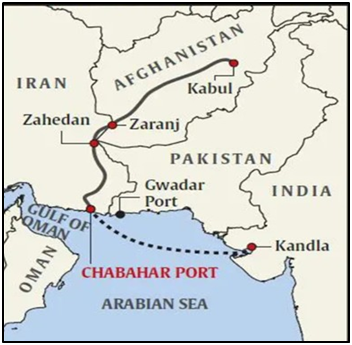
- Chabahar provides secure, direct access to Afghanistan and Central Asia.
- It serves as a counterweight to China's Gwadar Port in Pakistan, located just 140 km away.
- It forms part of the International North-South Transport Corridor (INSTC), a multi-modal transport network connecting India with Iran, Russia, Europe, and Central Asia.
- For Iran:
- Chabahar is a crucial economic hub for the Sistan-Baluchistan province, serving as a gateway connecting Iran to landlocked Central Asian states, Afghanistan, and Russia.
India's Investment So Far
- In 2021, External Affairs Minister S Jaishankar informed Parliament that:
- Grant assistance for equipment supply to Chabahar had been enhanced to $120 million.
- India committed a Line of Credit of $250 million (in rupee equivalent) for the port's development.
- Since 2018, the port had handled over 450 vessels, 1,34,082 TEUs of containerised cargo, and more than 8.7 million tonnes of bulk and general cargo.
- India had already supplied port equipment worth about $24 million, with procurement of remaining equipment underway.
Future Hangs in the Balance
- Chabahar received an allocation of ₹400 crore in the previous financial year, but the Union Budget for 2026-27 made no allocation for the port, raising questions about the future of this strategic trade route to Afghanistan and Central Asia.
- Why this matters?
- Without Chabahar, India loses its primary non-Pakistani corridor to landlocked markets, undoing decades of connectivity planning.
- The port had reduced transit times by 40% and costs by nearly a third.
- The situation raises strategic concerns for India if China, via the China-Pakistan Economic Corridor and Gwadar, expands its geopolitical footprint in Iran.
- The lapse of the Chabahar waiver by default tilts the regional balance toward China and Pakistan.
Conclusion
Chabahar embodies India's long-term vision of connectivity beyond Pakistan, but its fate remains entangled in the broader US-Iran standoff.
With sanctions waivers lapsed and budgetary support withdrawn, India risks losing not just an infrastructure investment, but strategic ground to China and Pakistan in a critical geopolitical space.

