Context
- The transition from MGNREGA to the VB-G RAM G was presented as an effort to strengthen rural employment and livelihood security.
- However, its initial implementation has produced a sharp decline in employment generation.
- The crisis raises serious concerns about policy preparedness, administrative capacity, implementation mechanisms, and livelihood security.
- Instead of expanding employment as anticipated, the new system has begun with an unprecedented contraction in work opportunities.
The Scale of the Employment Crisis
- Sharp Decline in July Employment
- Employment generation under VB-G RAM G in July 2026 was initially estimated to have fallen by around 50% compared with July 2025.
- Even revised estimates suggest a decline of more than 40%, making the setback exceptionally severe.
- Collapse During the First Four Months
- The crisis is not limited to July. During April-July, MGNREGA traditionally generated nearly half of its annual employment.
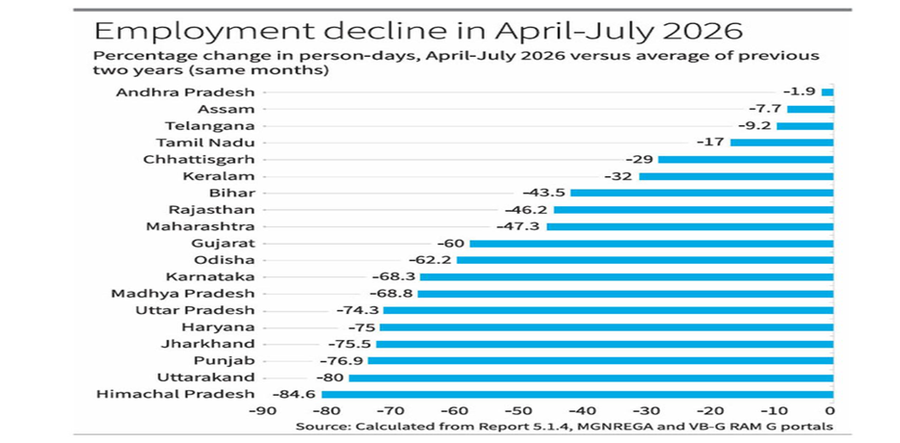
- While the corresponding periods of 2024-25 and 2025-26 produced 128 crore and 119 crore person-days, respectively, only 70 crore person-days were generated under MGNREGA and VB-G RAM G in 2026-27.
- This represents a decline of approximately 43%, demonstrating that the problem is structural rather than a temporary monthly fluctuation.
Why the Official Explanation Falls Short?
- The State Suspension Argument
- The Ministry of Rural Development attributed part of the July decline to temporary suspension of VB-G RAM G in some States under Section 6 of the Act.
- However, these States account for only a limited share of overall employment.
- A Deeper and Earlier Crisis
- The decline remains substantial even when these States are excluded. More importantly, employment had already fallen sharply during April-June.
- The July figures therefore represent a continuation of an existing crisis rather than an isolated consequence of State-level suspensions.
Administrative Problems in the Transition
- A Delayed Implementation
- The replacement of MGNREGA was announced for April 1, 2026, but the new system was not ready.
- The necessary Rules had not been finalised, forcing MGNREGA to continue amid considerable uncertainty.
- Last-Minute Rule-Making
- Draft VB-G RAM G Rules were released only on May 22, while final Rules began emerging at the end of June.
- Wage rates were notified on June 30, just one day before the programme was officially scheduled to replace MGNREGA.
- This sequence reveals a serious gap between policy announcement and administrative preparedness.
Ground-Level Impact on Rural Workers
- Disruption of Public Employment
- The April-June period is especially important because it coincides with a slack agricultural season in many parts of India.
- Yet, in several districts, officials reportedly hesitated to open new works, while employment opportunities disappeared altogether in some areas.
- Uneven but Severe State-Level Decline
- Although employment declined across all major States, the intensity varied.
- In ten of nineteen major States, the decline ranged between 60% and 85%.
- Madhya Pradesh, Uttar Pradesh and Jharkhand witnessed particularly severe disruptions.
- For poor rural households, the disappearance of employment can directly undermine income security, consumption and food security.
The Paradox of Higher Funding and Lower Employment
- Increased Financial Allocation
- The Union Budget allocated ₹95,692 crore to VB-G RAM G for 2026-27.
- Including State contributions, the total resources were expected to reach approximately ₹1.5 lakh crore, around 70% higher than MGNREGA expenditure in 2025-26.
- Why Has Employment Fallen?
- A larger budget should ordinarily have supported greater employment generation, particularly when real wages remained broadly unchanged.
- The opposite outcome points towards weaknesses in institutional capacity, programme administration and implementation.
- Financial allocation alone cannot guarantee employment unless funds are effectively converted into actual public works and timely wage payments.
Emerging Challenges
- Digital and Technological Barriers
- The proposed use of facial recognition at worksites could create difficulties for workers in areas affected by poor connectivity, technological limitations or inadequate digital infrastructure.
- Centre-State Cost Sharing
- The requirement of Centre-State cost sharing may also create financial and administrative complications.
- Differences in State capacity could lead to uneven implementation and further restrict employment opportunities in poorer regions.
The Road Ahead
- It is still too early to make a definitive judgement on VB-G RAM G.
- Administrative systems may stabilise and employment generation may recover in the coming months. However, the initial performance is deeply concerning.
- The immediate priorities should be to ensure uninterrupted availability of work, strengthen administrative preparedness, simplify implementation, protect timely wage payments and remove technological barriers that could exclude vulnerable workers.
Conclusion
- The transition from MGNREGA to VB-G RAM G demonstrates the dangers of undertaking a major policy transformation without adequate administrative preparation.
- Despite higher budgetary allocations, rural employment has experienced a dramatic decline during the programme’s initial months.
- The success of VB-G RAM G should not be measured merely by its budget or institutional design.
- Its real test is whether rural workers can obtain employment when they need it and receive their wages on time.
- Restoring this basic employment guarantee is essential for protecting rural livelihoods, income security and social protection in India.

