Why in news?
The Union government has proposed inserting a new Article 371K in the Constitution to give special safeguards to Ladakh.
The proposal follows an "in-principle understanding" between the Ministry of Home Affairs (MHA) and representatives of the Apex Body, Leh (ABL) and the Kargil Democratic Alliance (KDA).
It envisages a directly elected Union Territory-level body with legislative, executive, financial and planning powers.
What’s in Today’s Article?
- What Article 371 Originally Was?
- The 1956 Turning Point
- How 371 Became a Family of Provisions?
- What Ladakh Is Seeking?
- What Would Make 371K Strong or Weak
What Article 371 Originally Was?
- Article 371 is now associated with special protections for the Northeast and tribal regions. But that was not its original purpose.
- At Independence, India comprised not just British-administered provinces but also hundreds of princely states that had acceded under very different circumstances.
- The Constitution classified these — Hyderabad, Mysore, Jammu and Kashmir, Rajasthan and others — as Part B States.
- The original Article 371, adopted in 1950, was a transitional provision.
- It placed Part B State governments under the general control of the President for 10 years, or a period Parliament could adjust.
- Its purpose was Central supervision during integration, not cultural protection.
The 1956 Turning Point
- Six years later, the States Reorganisation Act and the Seventh Constitutional Amendment of 1956 abolished the Part A, B and C classification, creating a uniform structure of states and Union Territories.
- The original Article 371 disappeared. Parliament replaced it with a new version — the one that exists today — providing special arrangements for Maharashtra and Gujarat, focused on equitable development of regions like Vidarbha, Marathwada, Saurashtra and Kutch.
How 371 Became a Family of Provisions?
- From here, India's Constitutional system showed its flexibility.
- Parliament repeatedly built bespoke arrangements for regions whose history, social structure or political demands differed from the rest of the country. This is often called asymmetric federalism.
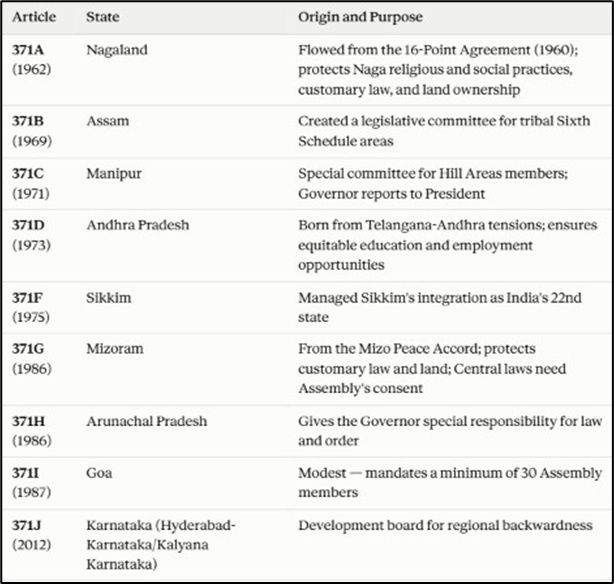
- Each provision, notably, emerged from a distinct political settlement — an insurgency, a peace accord, a regional grievance, or an integration process. There is no single template.
What Ladakh Is Seeking
- Ladakh's demand does not fit neatly into any existing 371 model, for a key reason: it would apply to a Union Territory without a legislature — something unprecedented.
- The emerging proposal includes:
- A directly elected UT-level body with legislative, executive, budgetary, planning and financial powers.
- Legislative powers over land, culture, language, forests, environment and natural resources, and other subjects reserved for the UT under Article 240.
- Control over civil servants, including their APARs (performance appraisals), for subjects under the elected body's jurisdiction.
- Control over law and order — notably the opposite of Article 371H, which gives Arunachal Pradesh's Governor special responsibility over law and order.
- Land protection resembling the philosophy of 371A and 371G, where certain Parliamentary laws don't apply automatically.
What Would Make 371K Strong or Weak?
- The final strength of 371K depends entirely on its drafting.
- If it merely creates an elected body and lists subjects it can legislate on, protection would be relatively limited. Manipur is a cautionary example — hill tribes argue Article 371C has failed to deliver meaningful autonomy.
- If it constitutionally protects the elected body's control over land, natural resources, recruitment and administration, it would be considerably stronger.
- If it specifies that certain Central laws won't apply to Ladakh without the elected body's approval, it would resemble the stronger protections under 371A and 371G.
- If law and order and the bureaucracy come under the elected executive, Ladakh's head of government would be more powerful than the J&K Chief Minister.
- This is precisely why the promised draft matters, and why Ladakh's leaders have been pressing for it.
Conclusion
Article 371 was never one idea — it is a constitutional habit of bespoke bargains. Each version answered a specific political demand of its time.
Ladakh's 371K would be the first attempt to give a Union Territory without legislature real legislative teeth. Its ultimate strength lies not in the number 371K, but in the words finally written into it.

