Context:
- India imports nearly 90% of its crude oil, making it acutely vulnerable to global price shocks, currency fluctuations, and geopolitical disruptions.
- Despite decades of reforms, the country's fuel pricing mechanism remains caught between market logic and political compulsion.
- This is a grey zone that breeds opacity, distorts incentives, and periodically destabilises public finances and oil marketing companies (OMCs) alike.
From APM to 'Managed Deregulation':
- Pre-2010 - The Administered Pricing Mechanism (APM):
- Before 2010, India operated under the APM, where the government directly fixed petrol and diesel prices — largely insulated from global crude markets.
- State-owned OMCs like Indian Oil Corporation (IOC), Bharat Petroleum (BPCL), and Hindustan Petroleum (HPCL) sold fuel below cost, with losses compensated through:
- Direct subsidies
- Upstream support (from ONGC and Oil India)
- Oil bonds — deferred liabilities passed on to future governments
- While consumers benefited from stable prices, the system severely distorted price signals and strained government finances.
- The reform trajectory:
- 2010: Petrol deregulated, based on the Kirit Parikh Committee recommendations.
- 2014: Diesel deregulated.
- 2017: Daily price revision mechanism introduced.
- On paper, India embraced market-based pricing. In practice, it never truly let go.
The Grey Zone - What 'Managed Deregulation' Really Means:
- Structural asymmetry: Prices are nominally linked to global crude rates and the rupee-dollar exchange rate, but government tax policy decisively shapes the consumer outcome.
- Who benefits when crude prices fall?
- Central and state governments raise taxes silently.
- OMCs accumulate windfall profits.
- Consumers pay broadly unchanged pump prices.
- The numbers:
- Between 2022 and 2025, crude oil prices dropped from $99 to $68 per barrel, but combined tax collections of central and state governments from petrol and diesel increased from Rs 5.24 lakh crore to Rs 6.31 lakh crore.
- At the same time, oil marketing company profits surged — Rs 83,000 crore in 2024 and Rs 50,000 crore in 2025. However, consumers saw no benefit.
- Who bears the loss when crude prices rise?
- The current Strait of Hormuz crisis and broader geopolitical tensions are pushing crude prices higher.
- OMCs are now reporting losses of ~₹20/litre on petrol, and losses of up to ₹100/litre on diesel.
- Yet retail petrol in Delhi remains around ₹95/litre — held artificially low under political pressure.
- The system that quietly captured gains during the downcycle is now ill-equipped to absorb losses in the upcycle. An inevitable price hike looms.
Key Challenge - Structural Opacity and Asymmetric Risk:
- The core problem is the absence of a rule-based, transparent pricing architecture.
- This creates -
- Consumer mistrust: No visible logic behind pump prices.
- Fiscal distortion: Taxes used as a silent revenue lever rather than a policy instrument.
- OMC vulnerability: Companies forced to absorb losses that should be passed through.
- Investment uncertainty: No predictable margin framework discourages private sector participation.
- Macroeconomic risk: Sudden large price corrections are more destabilising than gradual adjustments.
Way Forward - The Fuel Price Transparency Framework (FPTF):
- The core architecture:
- The proposed FPTF would make every component of the pump price visible and rule-bound.
- For example, pump prices should be linked directly to oil prices, exchange rates, ethanol blending, refining and marketing costs, company margin and government taxes.
- Step-by-step calculation:
- If crude is at $100 per barrel and the exchange rate is Rs 93 per dollar, one barrel/ 159 litres costs Rs 9,300/ Rs 58.5 per litre.
- Petrol in India is blended with about 20% ethanol. With petrol at Rs 58.5 per litre and ethanol at Rs 60 per litre, the blended cost comes to around Rs 58.8 per litre.
- Add 15% to cover refining, transport, marketing, dealer commissions, and company margins, bringing the cost to roughly Rs 67.6 per litre.
- With combined central and state taxes currently around Rs 28.9 per litre, the final pump price comes to about Rs 96.5 per litre — very close to prevailing prices.
- Managing a price hike under FPTF: (Different scenarios)
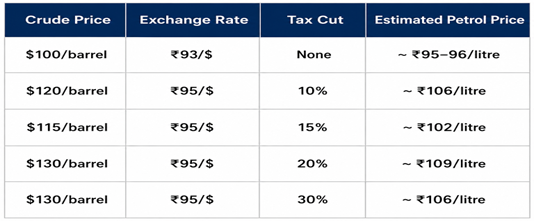
- Key insight: The FPTF does not eliminate price increases — it makes them understandable, calibrated, and accountable. Tax cuts become a policy lever, not a political surprise.
India's 3-Pillar Energy Security Strategy:
- Adopt FPTF: A rule-based, formula-driven pricing system.
- Secure long-term crude contracts: Deepen supply partnerships with Russia and other reliable suppliers, independent of external geopolitical pressure. Supply diversification reduces vulnerability to single-source disruptions.
- Accelerate domestic exploration: Invest aggressively in India's sedimentary basins to reduce the 90% import dependence over the long term. This is as much a strategic imperative as an economic one.
Conclusion:
- India's fuel pricing story is one of reforms half-taken and accountability deferred.
- A FPTF is not merely a technical fix — it is a governance reform. It restores consumer trust, shields OMCs from politically-induced losses, gives governments a calibrated fiscal tool, and sends credible signals to investors in India's energy sector.
- For an economy that runs on imported oil, transparent pricing, diversified supply, and domestic exploration are not policy options — they are macroeconomic necessities.

