Why in News?
- The Indian rupee has witnessed a sharp depreciation against the U.S. dollar, with the exchange rate crossing ₹96 per dollar in May 2026 compared to around ₹85 a year earlier.
- The decline has revived debates over the strength of India’s economy, the sustainability of external balances, and the appropriate role of the Reserve Bank of India (RBI) in managing exchange rate volatility.
What’s in Today’s Article?
- Understanding Exchange Rate Dynamics
- Trade Deficit and Current Account Pressure
- Role of Capital Flows
- Historical Episodes of Sharp Rupee Depreciation
- Economic Impact of Rupee Depreciation
- RBI’s Role in Managing the Rupee
- Debate: Defend the Rupee or Let It Adjust?
Understanding Exchange Rate Dynamics:
- Exchange rate: It refers to the value of one currency relative to another. In a market-driven system, the rupee’s value depends on the demand and supply of rupees vis-à-vis foreign currencies, especially the U.S. dollar.
- Factors increasing demand for Rupee:
- Exports of goods and services: Foreign buyers exchange dollars for rupees to pay Indian exporters.
- Remittances: From Indians working abroad.
- Foreign investments: Into Indian markets and businesses.
- Factors reducing demand for Rupee: Imports, especially crude oil. Foreign travel and education expenses. Capital outflows, where investors convert rupees into dollars and move funds abroad.
Trade Deficit and Current Account Pressure:
- India consistently runs a merchandise trade deficit because imports exceed exports, particularly due to dependence on crude oil, electronics, gold, and industrial inputs.
- Although India earns substantial foreign exchange through IT and software services, remittances from migrant workers, and other invisibles, these inflows only partially offset the merchandise trade deficit.
- Consequently, India often faces a Current Account Deficit (CAD). A persistent CAD means more rupees are exchanged for dollars than vice versa, and as a result demand for dollars rises, and rupee depreciates.
Role of Capital Flows:
- India finances its CAD through the Capital Account, mainly via: Foreign Direct Investment (FDI), Foreign Portfolio Investment (FPI), and external borrowings.
- Difference between FDI and FPI:
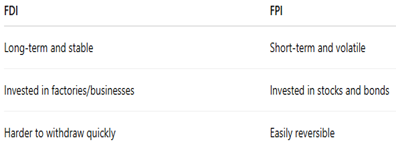
- Why do capital outflows hurt the Rupee?
- When foreign investors withdraw investments, they sell rupee assets, convert rupees into dollars, increase dollar demand, and trigger rupee depreciation.
- Recent rupee weakness has been linked to rising U.S. interest rates, global geopolitical tensions, and flight of capital toward safer assets.
Historical Episodes of Sharp Rupee Depreciation:
- Major periods of rupee decline include: 2013 “Taper Tantrum”, 2018 emerging market stress, COVID-19 shock in 2020, 2022 global monetary tightening, and 2024-26 geopolitical and oil price shocks.
- A common feature across these episodes has been trade account deterioration, FPI outflows, and global uncertainty.
Economic Impact of Rupee Depreciation:
- Negative effects:
- Costlier imports: As India imports most of its crude oil, a weaker rupee increases fuel prices, inflationary pressures, and input costs for industries.
- Example: A $100 barrel of oil costs: ₹8,500 at ₹85/$, ₹9,600 at ₹96/$.
- Imported inflation: Higher import costs raise prices of fertilisers, electronics, industrial machinery, and edible oils.
- Investment concerns: Depreciation reduces returns for foreign investors in dollar terms, discouraging future capital inflows.
- Can a weak rupee boost exports?
- Economic theory suggests depreciation improves export competitiveness because Indian goods become cheaper abroad.
- However, India faces structural limitations.
- High import content in exports: Many exports depend on imported inputs. Costlier imports offset export gains.
- Price-taking nature of exports: India competes with countries like Bangladesh and Vietnam. Foreign buyers may force Indian exporters to lower dollar prices.
- Supply-side bottlenecks: Logistics costs, infrastructure gaps, and limited manufacturing depth.
- Hence, depreciation alone may not significantly improve export earnings.
RBI’s Role in Managing the Rupee:
- The RBI intervenes in forex markets to prevent excessive volatility, not to defend any fixed exchange rate.
- Mechanism of intervention: When the rupee falls sharply RBI sells dollars from forex reserves, purchases rupees, raises rupee demand, and moderates depreciation.
- Forex reserves as strategic buffer:
- India’s forex reserves stood at about $691 billion in March 2026, providing around 10.8 months of import cover.
- These reserves ensure payment for essential imports, provide confidence to markets, and help resist speculative attacks.
- Limits of RBI intervention:
- Finite forex reserves: Continuous intervention can deplete reserves below safe import-cover levels.
- Nature of India’s forex: Unlike China’s export-driven reserves, much of India’s forex comes from volatile capital inflows rather than trade surpluses.
- Delayed adjustment risk: Artificially stabilising the rupee for long periods may postpone necessary corrections, leading to sharper future depreciation.
Debate: Defend the Rupee or Let It Adjust?
- Arguments for allowing depreciation: Conserves forex reserves, improves export competitiveness, discourages excessive imports, and allows market-based adjustment.
- Arguments for RBI defence: Prevents panic and speculation, ensures orderly currency movement, protects financial stability, and reduces inflationary shocks.
- Risks of free fall: Unchecked depreciation may trigger further speculation, encourage importers to hoard dollars, reduce foreign investment confidence, create a vicious cycle of depreciation, etc.

