Why in news?
Recently, the Karnataka Legislature unanimously passed a resolution rejecting the K. Kasturirangan Committee report on the Western Ghats in its current form.
This came in response to the seventh draft, published in July 2026, by the Ministry of Environment, Ecology and Climate Change, proposing to declare parts of the Western Ghats as an Ecologically Sensitive Area (ESA). The draft gave states a 60-day window to file objections.
This marks the seventh time Karnataka has rejected the draft since it was first published in 2014.
Successive governments have acknowledged the ecological importance of the Western Ghats but have repeatedly flagged the ESA's impact on lives and livelihoods. Of the six Western Ghats states, Karnataka has the largest area proposed for ESA notification, spread across 10 districts.
What’s in Today’s Article?
- Background: Kasturirangan Report
- How Much Area Is Involved, State-Wise?
- Key Recommendations of the Report
- Kasturirangan vs Gadgil: The Key Difference
Background: Kasturirangan Report
- Space scientist K. Kasturirangan chaired the High Level Working Group (HLWG), tasked with reviewing the earlier Western Ghats Ecology Expert Panel (WGEEP) report by Prof. Madhav Gadgil.
- WGEEP (Gadgil Committee): Submitted its report in 2011.
- It was also tasked to recommend fresh protective measures for the Western Ghats — recognised by UNESCO as one of the world's ecological hotspots.
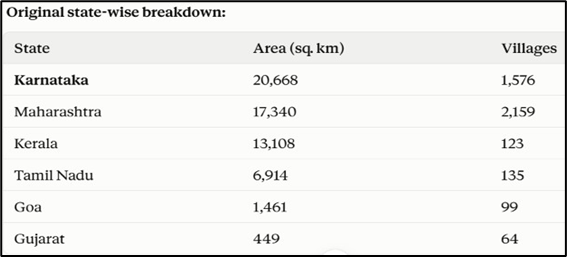
- Set up in 2012, HLWG submitted recommendations in 2013. Of the 1.64 lakh sq. km Western Ghats area, the Kasturirangan Committee recommended declaring 59,940 sq. km — covering 4,156 villages across six states — as ESA.
How Much Area Is Involved, State-Wise?
- The committee identified natural landscape covering about 41% of the Western Ghats, of which 37% (≈59,940 sq. km) was biologically rich, with low fragmentation, low population density, and containing protected areas, World Heritage Sites, and tiger/elephant corridors.
- Current Status
- The area proposed for notification has reduced to 56,825 sq. km, mainly because Kerala conducted a ground survey and brought its area down to 9,993 sq. km.
- Meanwhile, the number of villages has increased in Maharashtra and Goa, but decreased in Karnataka.
- The latest draft covers 4,402 villages in total. Final area demarcation depends on state government recommendations, stakeholder views, and the ESA Expert Committee.
Key Recommendations of the Report
- The Kasturirangan Committee proposes a mix of outright bans and regulated activities:
- Banned entirely:
- Mining, quarrying, and sand extraction
- Setting up red-category industries
- Thermal power plants
- Construction of buildings beyond 20,000 sq. metres
- Township and area development projects
- Regulated (not banned):
- Infrastructure and development projects — subject to environmental clearances
- Hydroelectricity projects — allowed with conditions
- Any project within 10 km of the ESA requiring clearance — regulated under the EIA Notification, 2006
- The report also recommends financial incentives for "Green Growth" in the region and a decision-support and monitoring centre.
Kasturirangan vs Gadgil: The Key Difference
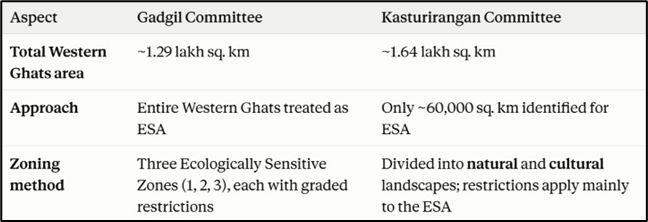
- The Gadgil approach was broader and more stringent; the Kasturirangan approach is narrower but still contentious in the areas it does cover.
Karnataka's Specific Objections
- Scope should be narrower: ESA should cover only notified forest areas and other forest areas — not plantations, agriculture/horticulture fields, or residential and public areas.
- Methodology flaw: Areas were demarcated using satellite data, not a joint physical survey.
- Land classification gap: No accurate bifurcation exists between revenue and forest land.
- No livelihood alternatives: The draft provides no reference to alternative livelihood arrangements for affected people.
- Unaddressed legal categories: Issues like Bagair Hukum (unauthorised cultivation claims), forest rights, deemed forest status, land grants, and pending legal appeals need examination.
- Village-level objection: Karnataka opposes including entire villages under ESA merely because one-fifth of the village area might be forest.
Karnataka's Way Forward
- Both Houses of the Karnataka Legislature have:
- Sought one year to conduct a physical survey of the area.
- Demanded that Karnataka's portion of the ESA not be finalised until this survey is complete.
- Announced a high-level committee headed by a retired judge, comprising all stakeholders, to review the report's shortcomings and recommend modifications.
- Cutting across party lines, legislators have urged the government to follow the "Keralam model" — where physical verification was conducted on the ground and submitted to the Centre, resulting in a reduced ESA footprint for that state.

