Why in news?
The India government has sharply raised import duties on gold, silver, and platinum to curb precious metal imports and protect foreign exchange reserves amid economic pressure from the West Asia crisis.
Effective customs duty on gold and silver has increased from 6% to 15%, alongside higher duties on related products such as doré, coins, and jewellery components.
The move aligns with PM Modi’s call for austerity measures, including postponing gold purchases, reducing fuel consumption, limiting non-essential foreign travel, and promoting public transport and electric mobility to ease pressure on India’s import bill and the weakening rupee.
What’s in Today’s Article?
- Why India Raised Import Duty on Precious Metals?
- Rupee Under Pressure from Rising Import Costs
- Declining Forex Reserves Raise Economic Concerns
- Gold Imports Increasing India’s External Economic Pressure
- Oil Shock and Strait of Hormuz Disruption
Why India Raised Import Duty on Precious Metals?
- The government increased import duties on gold and silver to conserve foreign exchange reserves as economic pressures intensify due to the ongoing West Asia crisis.
- The decision is linked to: soaring crude oil prices, disruption in the Strait of Hormuz, and rising pressure on India’s external economic stability.
- Gold and silver are viewed as discretionary imports, and the duty hike aims to discourage their purchase so foreign exchange can be preserved for more critical needs.
- The government intends to channel foreign exchange toward essential imports such as:
- crude oil,
- fertilisers,
- industrial raw materials,
- defence equipment, and
- capital goods supporting economic activity and food security.
- The move is part of a precautionary strategy to reduce India’s vulnerability to external shocks and prevent further strain on the current account during an uncertain global economic environment.
Rupee Under Pressure from Rising Import Costs
- The Indian rupee has weakened sharply due to escalating import costs and geopolitical tensions linked to the West Asia crisis.
- As crude oil prices surged amid supply disruption fears, the rupee fell to a record low against the US dollar.
- Higher import bills increase dollar demand, worsening the current account deficit and further weakening the currency.
- The government has described the situation as a real-time balance of payments stress test with implications for inflation and economic stability.
Declining Forex Reserves Raise Economic Concerns
- India’s foreign exchange reserves have fallen significantly since the West Asia conflict began, reflecting growing external economic pressure.
- The decline in reserves, especially foreign currency assets, has increased concerns about India’s ability to manage rising import costs.
- In response, the government is prioritising foreign exchange for essential imports such as energy, fertilisers, defence equipment, critical technologies, and industrial inputs, while seeking to curb non-essential imports to protect macroeconomic stability.
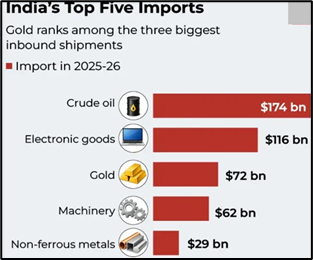
Gold Imports Increasing India’s External Economic Pressure
- Heavy Dependence on Imported Gold - India is the world’s second-largest gold consumer and relies heavily on imports to meet domestic demand.
- Pressure on Foreign Exchange - Since gold imports are paid for in U.S. dollars, they increase demand for foreign currency, put pressure on forex reserves, and widen the trade deficit.
- Sharp Rise in Import Bill - India’s gold import bill surged significantly in 2025–26, despite lower import volumes, mainly because of a steep rise in global gold prices.
- Discretionary Nature of Gold Imports - Officials view precious metal imports as largely consumption- and investment-driven rather than essential economic imports, making them a target for moderation during periods of external economic stress.
- Macro-Economic Rationale - Reducing discretionary gold imports can help: conserve foreign exchange, ease pressure on the external account, and support broader macroeconomic stability during global uncertainty.
Oil Shock and Strait of Hormuz Disruption
- India’s import duty hike comes amid a sharp increase in the oil import bill caused by the ongoing West Asia conflict.
- Brent crude prices have risen steeply from pre-conflict levels, significantly increasing India’s energy import costs and external economic pressure.
- India imports the vast majority of its crude oil needs, making it highly vulnerable to global supply disruptions and price shocks.
- A large share of India’s crude oil shipments passes through or near the Strait of Hormuz, making disruptions in this route a major threat to energy security.
- India also depends heavily on LPG imports, with most supplies sourced through the Gulf region, further increasing exposure to geopolitical instability in West Asia.
Impact of the Duty Hike on Gold Prices
- Higher Import Costs - The increase in import duty will raise the landed cost of gold and silver, since India depends heavily on imported precious metals.
- Cost Passed to Consumers - Jewellers are expected to transfer the higher import burden to buyers, making jewellery, bullion, and silver products more expensive in the domestic market.
- Immediate Market Reaction - Following the announcement, gold and silver prices surged sharply in commodity markets, reflecting expectations of higher domestic prices.
- Reversal of Earlier Policy - The move effectively reverses the government’s earlier customs duty reduction aimed at supporting the gems and jewellery industry, lowering prices, and discouraging smuggling.
- Historical Precedent - India had adopted a similar import duty hike during the Russia-Ukraine crisis, when rising oil prices and rupee weakness created comparable external economic pressures.

