





The 8th Pay Commission has been constituted to review the salary, allowances, pension and service conditions of Central Government employees and pensioners. The Union Cabinet approved its formation in January 2025, and its recommendations are expected to take effect from January 1, 2026. The Commission is expected to submit its recommendations within 18 months. Its proposed revisions will consider factors such as inflation, cost of living, economic conditions, fiscal capacity and the welfare of government employees and pensioners.
What is the 8th Pay Commission?
- The Pay Commission is set up by the Central Government to review the existing pay structure, allowances, pension and retirement benefits of government employees.
- It examines factors such as inflation, cost of living, economic conditions and prevailing market salary levels before making recommendations.
- The Pay Commission is an advisory body, which means that the government is not legally bound to accept all its recommendations.
- Pay Commissions are generally constituted at intervals of around 10 years. The First Pay Commission was established in 1946.
- The Commission functions under the Department of Expenditure, Ministry of Finance, and includes experts who examine different aspects of government employees' compensation and service conditions.
- The 7th Pay Commission, headed by Justice A.K. Mathur, increased the minimum basic salary to ₹18,000 and the minimum pension to ₹9,000. Its implementation added around ₹1 lakh crore to government expenditure during 2016-17.
8th Pay Commission History
- The Government announced the formation of the 8th Pay Commission in January 2025, and the Commission was formally constituted on November 3, 2025, with Justice Ranjana Prakash Desai as its Chairperson.
- The Commission is expected to cover more than 49 lakh Central Government employees and around 65-68 lakh pensioners, including defence personnel.
- Like previous Pay Commissions, the 8th CPC is being considered against the changing inflation, economic conditions, cost of living and welfare requirements of government employees.
- Its recommendations are expected to be implemented retrospectively from January 1, 2026, after the completion of the 7th Pay Commission's period on December 31, 2025.
- The revision is expected to include a new fitment factor, which would be used to calculate revised basic salaries and pensions.
- After its formal constitution in November 2025, the Commission began seeking inputs from stakeholders, employee organisations and government departments.
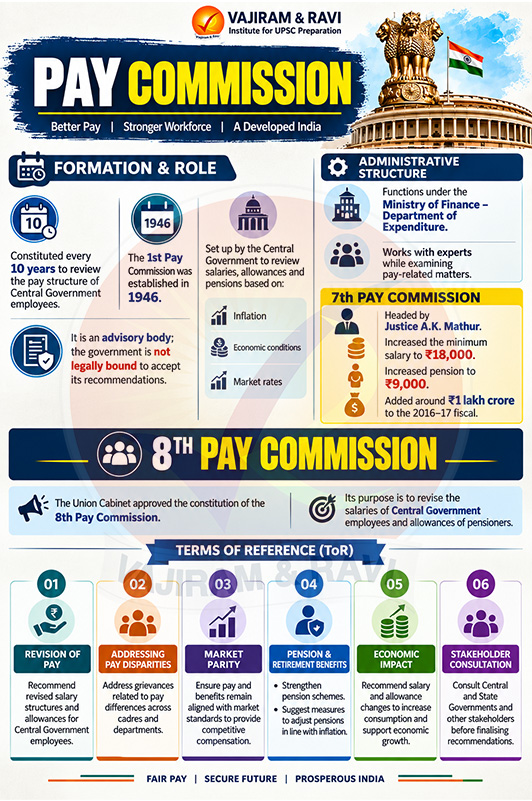


Terms of Reference of the 8th Pay Commission
The Terms of Reference (ToR) define the broad areas that the 8th Pay Commission will examine.
- Pension and retirement benefits: The Commission will review the existing pension and retirement benefits of serving and retired government employees.
- Fiscal prudence: Pay revisions will have to take into account the government's fiscal capacity and overall macroeconomic stability.
- Development priorities: The Commission will need to balance salary revisions with the government's spending requirements for welfare, infrastructure and other development programmes.
- Legacy pension liabilities: It will examine the financial burden arising from unfunded pension liabilities, particularly those linked with employees covered by the pre-NPS pension system.
- Pay parity: The Commission will consider the pay structures of State Governments, Central Public Sector Enterprises (CPSEs) and the private sector while examining appropriate compensation.
- Impact on States: It will also assess the possible financial implications for State Governments that choose to adopt the recommendations of the Central Pay Commission.
8th Pay Commission Fitment Factor
- Meaning of Fitment Factor: The fitment factor is a multiplier used to calculate the revised basic salary of Central Government employees under a new Pay Commission. It determines how the existing basic pay may change under the revised pay structure.
- How It Is Calculated: The revised basic pay can be estimated by multiplying the employee's current basic salary by the applicable fitment factor. The formula is: Revised Basic Pay = Current Basic Pay × Fitment Factor.
- Example of 2.86 Fitment Factor: If an employee currently receives a basic salary of ₹18,000 and a fitment factor of 2.86 is assumed, the estimated revised basic pay would be ₹18,000 × 2.86 = ₹51,480.
- Final Fitment Factor: The 8th Pay Commission fitment factor has not been finalised yet. The actual factor will be known only after the Commission submits its recommendations and the Government of India takes a final decision on the revised pay structure.
Proposed Fitment Factors by Different Organisations
Different employee and pensioner organisations have proposed varying fitment factors for the 8th Pay Commission, depending on their expectations regarding salary and pension revisions.
| Organisation | Proposed Minimum Pay | Proposed Fitment Factor |
|
National Council of Joint Consultative Machinery (NC-JCM) |
₹69,000 |
3.833 |
|
All India Defence Employees' Federation (AIDEF) |
₹69,000 |
3.833 |
|
Federation of National Postal Organisations (FNPO) |
₹69,000 |
3.833 |
|
All India New Pension Scheme Employees Federation (AINPSEF) |
₹69,000 |
3.833 |
|
Indian Railways' Technical Supervisors' Association (IRTSA) |
Multiple levels; minimum ₹52,560 |
2.92, 3.50, 3.80, 4.09, 4.38 |
|
Delhi Government School Teachers |
₹47,210 |
2.62 |
|
Chennai GPO Pensioners |
₹68,000 |
3.77 |
|
Bharat Pensioners Samaj (BPS) |
₹69,000 |
3.833 |
- The NC-JCM and several employee organisations have recommended a fitment factor of 3.833, which would increase the ₹18,000 minimum salary under the 7th CPC to around ₹69,000.
- The IRTSA has proposed different fitment factors for different employee levels, ranging from 2.92 to 4.38.
- The fitment factors under the 6th and 7th Pay Commissions were 1.86 and 2.57, respectively.
- According to one employee representative, a fitment factor around 2.1 could be a possibility based on current dearness allowance and pay-related factors. However, the final figure will depend on the Commission's recommendations and the government's decision.
8th Pay Commission Salary Calculator
The 8th Pay Commission Salary Calculator can be used to estimate the revised salary based on the expected fitment factor. The calculation below uses an assumed fitment factor of 2.86 to explain how the revised basic pay, DA, HRA and TA can be calculated.
Steps to Calculate Gross Salary
- Step 1: Check Current Basic Pay: First, identify your current basic pay under the 7th Pay Commission pay matrix. This amount will be used as the starting point for calculating the revised salary.
- Step 2: Calculate Revised Basic Pay: Multiply your current basic pay by the assumed fitment factor of 2.86. The formula is:
Revised Basic Pay = Current Basic Pay × Fitment Factor (2.86) - Step 3: Calculate Dearness Allowance (DA): DA is calculated as a percentage of the revised basic pay. Assuming DA is 50%, it can be calculated using:
DA = Revised Basic Pay × 0.50 - Step 4: Calculate House Rent Allowance (HRA): HRA is also calculated as a percentage of the revised basic pay. The applicable rate depends on the category of the city where the employee is posted:
- Metro cities: 27%
- Tier-2 cities: 20%
- Tier-3 cities: 10%
- Step 5: Add Travel Allowance (TA): Travel Allowance (TA) is added to the salary based on the employee's pay level and the classification of the city. The applicable TA may therefore vary from one employee to another.
- Step 6: Calculate Gross Salary: Finally, add the revised basic pay, DA, HRA and applicable TA, and then account for the standard deduction. The formula is:
Gross Salary = Revised Basic Pay + DA + HRA + TA − Standard Deduction - For example, under a fitment factor of 2.86:
|
Current Basic Pay |
Revised Basic Pay at 2.86 |
|
₹18,000 |
₹51,480 |
|
₹22,400 |
₹64,064 |
|
₹25,000 |
₹71,500 |
|
₹30,000 |
₹85,800 |
|
₹35,400 |
₹1,01,244 |
|
₹44,900 |
₹1,28,414 |
|
₹56,100 |
₹1,60,446 |
Important Note: These calculations are only salary estimates based on the assumed fitment factor. The actual 8th Pay Commission salary structure and fitment factor will depend on the Commission's recommendations and the final decision of the government.
8th Pay Commission Salary Structure
The expected salary structure will include several major components:
- Basic Pay: The revised basic salary will be calculated by applying the approved fitment factor to the existing basic pay.
- Dearness Allowance (DA): DA is linked to the basic salary and is expected to be recalculated under the revised pay structure.
- House Rent Allowance (HRA): HRA will depend on the applicable city category and the revised basic pay.
- Travel Allowance (TA): TA will vary according to the employee's pay level and applicable city classification.
- Gross Salary: The gross salary will be determined by adding the basic pay and applicable allowances.
- A simplified calculation can be represented as:
Gross Salary = Basic Pay + DA + HRA + TA – applicable deductions
8th Pay Commission Pay Matrix
The following table presents an expected pay matrix based on an assumed fitment factor of 2.86:
|
Pay Matrix Level |
7th CPC Basic Salary |
Expected 8th CPC Basic Salary |
|
Level 1 |
₹18,000 |
₹51,480 |
|
Level 2 |
₹19,900 |
₹56,914 |
|
Level 3 |
₹21,700 |
₹62,062 |
|
Level 4 |
₹25,500 |
₹72,930 |
|
Level 5 |
₹29,200 |
₹83,512 |
|
Level 6 |
₹35,400 |
₹1,01,244 |
|
Level 7 |
₹44,900 |
₹1,28,414 |
|
Level 8 |
₹47,600 |
₹1,36,136 |
|
Level 9 |
₹53,100 |
₹1,51,866 |
|
Level 10 |
₹56,100 |
₹1,60,446 |
|
Level 11 |
₹67,700 |
₹1,93,622 |
|
Level 12 |
₹78,800 |
₹2,25,368 |
|
Level 13 |
₹1,23,100 |
₹3,52,066 |
|
Level 13A |
₹1,31,100 |
₹3,74,946 |
|
Level 14 |
₹1,44,200 |
₹4,12,412 |
|
Level 15 |
₹1,82,200 |
₹5,20,092 |
|
Level 16 |
₹2,05,400 |
₹5,87,444 |
|
Level 17 |
₹2.25 lakh |
₹6,43,500 |
|
Level 18 |
₹2.50 lakh |
₹7,15,000 |
The figures in this table are projections based on an assumed fitment factor of 2.86 and should not be treated as final pay scales.
8th Pay Commission and 7th Pay Commission Comparison
|
Feature |
7th Pay Commission |
8th Pay Commission - Projected |
|
Implementation |
January 1, 2016 |
January 1, 2026 |
|
Minimum Basic Pay |
₹18,000 |
₹41,000-₹51,480, depending on estimates |
|
Fitment Factor |
2.57 |
Around 2.86-3.00 in some estimates |
|
Expected Pay Hike |
14.29% |
Around 34%-40% in some estimates |
|
Pay Matrix |
Levels 1-18 |
Similar structure with higher base values |
|
DA |
Reset at revision |
Expected to be reset under revised structure |
|
Allowances |
Rationalised |
HRA, TA and other allowances likely to be recalculated |
|
Beneficiaries |
Around 50 lakh employees and 60 lakh pensioners |
Around 49 lakh employees and 68 lakh pensioners |
The figures for the 8th Pay Commission are projections and may change after the final recommendations are accepted by the government.
8th Pay Commission for Pensioners
The 8th Pay Commission is also expected to review the pension structure and retirement benefits of Central Government pensioners.
- The minimum pension under the 7th Pay Commission was ₹9,000.
- Applying an assumed fitment factor of 2.28 would take the minimum pension to around ₹20,500.
- Other estimates place the revised minimum pension in the range of ₹20,500-₹25,740, depending on the final fitment factor.
- Dearness Relief (DR) may be reset when the revised pension structure comes into effect.
- Changes may also be considered for pension-related schemes such as NPS and UPS, including proposals for a minimum pension of ₹10,000 for employees with more than 10 years of service.
- Higher revised salaries could also increase NPS contributions, as contributions are linked to salary.
Significance of the 8th Pay Commission
- Massive Coverage: The 8th Pay Commission is expected to benefit around 12 million people, including about 50 lakh Central Government employees and 69 lakh pensioners, by revising their pay and pension structures.
- Higher Purchasing Power: An increase in salaries and pensions can improve the disposable income and purchasing power of employees and pensioners, helping them cope with rising living costs.
- Consumption Stimulus: Higher disposable income can increase demand for goods and services. The 7th CPC's approximately ₹1 lakh crore payout in 2016-17 was associated with higher middle-class demand and around 0.4% contribution to GDP growth.
- Employee Morale: Better salaries and allowances can improve employee motivation, job satisfaction and morale, particularly in large departments such as Defence and Railways.
- Fiscal Balance: The Commission will have to consider the government's fiscal capacity and macroeconomic stability so that higher salary and pension expenditure does not affect welfare, infrastructure and other development spending.
- Social Equity: A revised and standardised pay structure can promote greater consistency in salaries and pensions across government services and help reduce disparities between different groups of employees.
Advantages of the 8th Pay Commission
- Higher purchasing power: An increase in basic pay can improve the purchasing power of employees and help them manage rising living costs.
- Better employee morale: Improved salaries and allowances can increase job satisfaction and motivation among government employees.
- Attracting skilled professionals: Competitive compensation can help government organisations attract and retain qualified personnel.
- Rationalisation of pay: The Commission can review existing pay scales and allowances and make them more consistent with current economic conditions.
- Improved pension security: Pension revisions can provide greater financial support to retired employees.
- Economic demand: Higher disposable income among government employees and pensioners can increase consumption and support economic activity.
Challenges of the 8th Pay Commission
- High Fiscal Burden: The 8th Pay Commission may increase government expenditure by around ₹1.5-2 lakh crore annually, creating additional pressure on public finances.
- Inflationary Pressure: Higher salaries can increase disposable income and demand, which may create demand-pull inflation if the supply of goods and services does not rise at a similar pace.
- State-Level Fiscal Stress: States adopting Central Pay Commission recommendations may face higher salary and pension expenditure, putting additional pressure on their fiscal position.
- Employee Demands: Demands relating to the Old Pension Scheme, cashless medical facilities and children's education allowance may remain areas of concern if they are not covered adequately under the Commission's mandate.
- Productivity-Pay Mismatch: Higher salaries without a corresponding improvement in productivity, efficiency and public service delivery could increase government expenditure without similar gains in administrative performance.
- Private Sector Gap: Repeated increases in government salaries may widen the pay gap between the public and private sectors, potentially affecting labour mobility and competitiveness.
Way Forward for the 8th Pay Commission
- Performance-Linked Pay: Salary increases and increments can be linked with measurable productivity and service-delivery outcomes to ensure that higher pay is accompanied by better administrative performance.
- Digital Performance Assessment: Platforms such as iGOT Karmayogi can be used to track training, capacity building and performance, supporting a more data-driven approach to pay rationalisation.
- Fiscal Sustainability: Pay revisions should be aligned with the government's long-term fiscal capacity, ensuring that salary and pension expenditure remains manageable without affecting essential development spending.
- Centre-State Coordination: A suitable Pay Coordination Council can help States assess the financial impact of adopting CPC recommendations and reduce uneven fiscal pressures.
- Gender and Inclusion Lens: Equity audits and pay-equity principles can be incorporated into pay revision to promote fair and inclusive compensation across different categories of employees.
- Phased Implementation: If the financial impact is substantial, a staggered implementation can distribute the additional expenditure over several years while allowing employees to benefit from the revised pay structure.

 Last updated on Oct, 2026
→ UPSC 2027 Notification will be released on 13 January 2027 at upsconline.nic.in.
→ Check Nobel Prize 2026 Winners List here.
→ Check out the latest UPSC Syllabus here.
→ Download UPSC Calendar 2027 PDF Here.
8th Pay Commission FAQs
Q1. What is the 8th Pay Commission?+
Q2. When will the 8th Pay Commission be implemented?+
Q3. What is the expected fitment factor for the 8th Pay Commission?+
Q4. How is the 8th Pay Commission salary calculated?+
Q5. What will be the minimum salary under the 8th Pay Commission?+
Q6. How will the 8th Pay Commission affect pensioners?+
Q7. What is the difference between the 7th and 8th Pay Commissions?+
Q8. Who will benefit from the 8th Pay Commission?+
Tags: 8th pay commission 8th pay commission calculator 8th pay commission fitment factor current affairs