



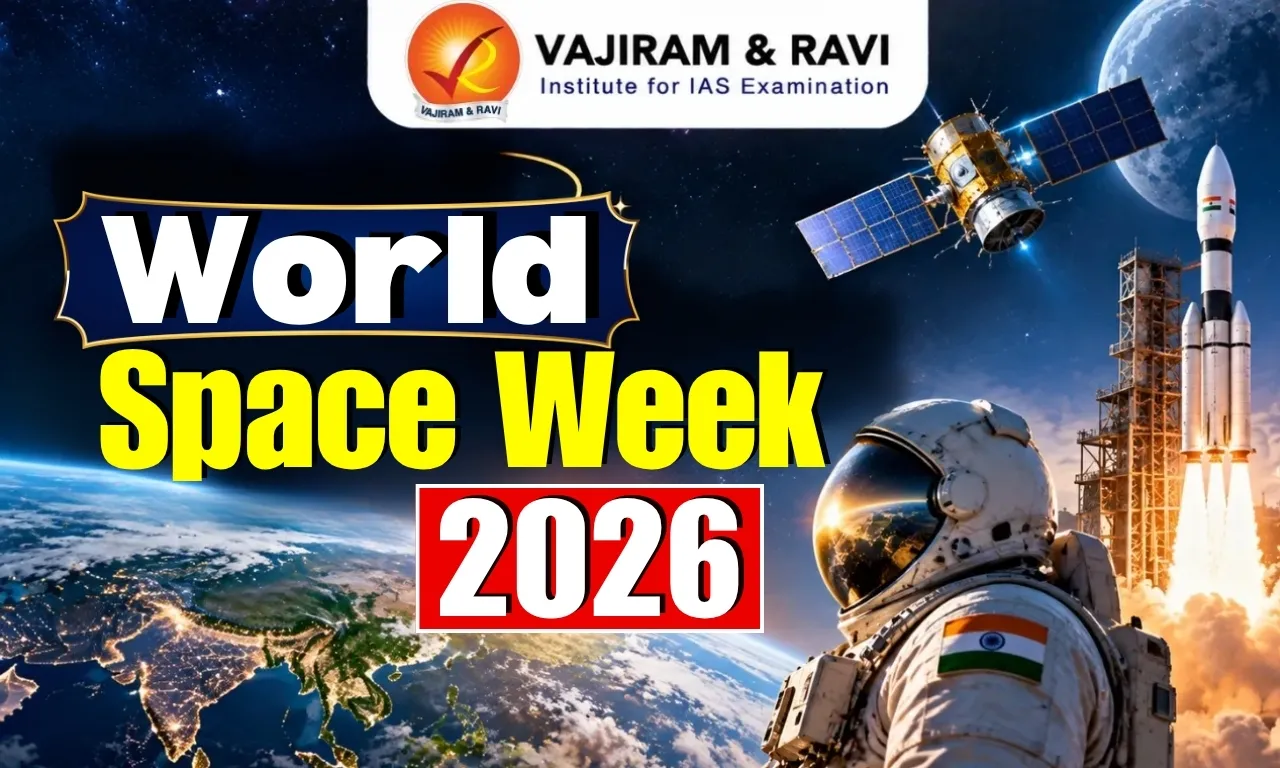
World Space Week 2026 is an annual international observance that highlights the role of space science and technology in improving human life. It promotes awareness of space activities and encourages interest in space science.
When is World Space Week 2026?
World Space Week 2026 will be observed from 4 to 10 October 2026. World Space Week is observed from 4 to 10 October to commemorate two important milestones in the history of space exploration.
- 4 October 1957: The Soviet Union launched Sputnik 1, the first artificial satellite to orbit the Earth. Its launch marked the beginning of the Space Age.
- 10 October 1967: The Outer Space Treaty entered into force. It laid down the basic principles for the peaceful exploration and use of outer space.
World Space Week 2026 Theme
The theme of World Space Week 2026 is “Rocket Revolution.” It highlights how advances in launch technology are changing access to space.
The shift from traditional government-led launches to reusable rockets, private launch companies, startups and new launch systems is making space activities more diverse. These developments can support lower launch costs, more frequent missions and wider access to orbit, opening new opportunities for space exploration and commercial activities.


World Space Week History
The history of World Space Week is linked to the United Nations’ efforts to promote the peaceful use of outer space. As space exploration developed, the UN began encouraging countries to cooperate in space activities.
- In 1958, the United Nations General Assembly adopted Resolution 1348 (XIII) on the peaceful uses of outer space. This was one of the early steps towards international cooperation in space.
- In 1999, the UN General Assembly adopted Resolution 54/68, officially declaring 4 to 10 October as World Space Week.
- The first World Space Week was observed in 2000. Since then, it has been observed every year through programmes and activities that help people learn about space science and technology.
- The United Nations Office for Outer Space Affairs (UNOOSA) supports World Space Week, while the World Space Week Association (WSWA) coordinates activities around the world.
World Space Week Objectives
World Space Week aims to:
- Increase awareness about the benefits of space science and technology.
- Educate people about space activities and their applications.
- Encourage young people to take an interest in science and technology.
- Promote international cooperation in space education and outreach.
- Encourage the use of space technology for sustainable development.
How is World Space Week Celebrated?
World Space Week is celebrated through educational and public activities that help people learn more about space science, technology and exploration.
- Schools and universities organise lectures, quizzes, science projects and workshops on space-related topics.
- Space agencies and research institutions conduct public talks, exhibitions and educational programmes.
- Museums and planetariums organise space shows, exhibitions and interactive activities.
- Astronomy clubs and science groups conduct stargazing sessions and astronomy-related events.
- Private organisations and startups hold demonstrations and activities to explain new space technologies.
- In 2026, many activities are focused on the “Rocket Revolution” theme, including rockets, launch technology and reusable launch systems.
World Space Week and India
India's participation in World Space Week is closely linked to its space programme and the outreach work of ISRO. The observance provides an opportunity to connect India's space achievements with wider public understanding of space science and technology.
- ISRO-led programmes: ISRO centres such as Satish Dhawan Space Centre (SDSC-SHAR) have been organising World Space Week programmes to familiarise students and the public with India’s space programme.
- Student engagement: The programmes introduce students to India’s satellites, launch vehicles, space missions and applications of space technology, while encouraging interest in space science.
World Space Week also provides an opportunity to highlight India’s progress in launch technology, human spaceflight and reusable launch systems, along with the growing participation of private companies.
The “Rocket Revolution” theme has particular relevance for India as the country works to develop reusable launch technology and a more diverse launch ecosystem involving private space companies.
World Space Week Significance
World Space Week is significant because it connects developments in space science with their wider impact on society, the economy and international cooperation.
- Highlights the growing role of space technology in communication, navigation, weather forecasting, agriculture, disaster management and Earth observation.
- Promotes peaceful use of outer space and creates awareness about international principles governing the exploration and use of outer space.
- Encourages international cooperation by bringing attention to joint efforts in space exploration, research, education and the sharing of space-based data and applications.
- Supports innovation and the growth of the space economy by highlighting developments in areas such as reusable rockets, commercial launches, satellites and private space companies.
- Builds scientific capacity by encouraging students and young people to take an interest in science, technology, engineering and mathematics (STEM).
- Raises awareness of emerging space challenges such as space debris, increasing congestion in orbit and the need for responsible and sustainable use of outer space.
- For India, it highlights the changing space sector, including the growing role of private companies, new launch technologies and India's efforts to expand its capabilities in space exploration and applications.
Role of Space Science and Technology in Improving Human Life
Space science and technology have applications across everyday life and contribute to social, economic, environmental and scientific development.
- Communication: Satellites enable telecommunications, television broadcasting and internet connectivity. For example, INSAT satellites support communication and broadcasting services in India.
- Weather Forecasting: Meteorological satellites help track cyclones, rainfall and other weather conditions. For example, INSAT-3D and INSAT-3DR provide meteorological observations.
- Disaster Management: Satellite imagery supports early warning, damage assessment and relief operations. For example, ISRO’s satellite data is used to monitor floods, cyclones, landslides and forest fires.
- Navigation: Satellite navigation supports transport, aviation, shipping and location-based services. For example, NavIC provides regional navigation services over India and the surrounding region.
- Agriculture: Remote sensing helps monitor crops, soil, water resources and agricultural conditions. For example, ISRO’s remote-sensing satellites provide data used for crop assessment and agricultural planning.
- Environmental Monitoring: Satellites help monitor forests, glaciers, oceans and changes in land use. For example, satellite data is used to monitor forest cover and glacial changes.
- Healthcare: Satellite communication can support telemedicine and connect specialised healthcare services with remote areas. ISRO’s telemedicine initiatives have helped link healthcare institutions with distant locations.
- Scientific Research: Space missions expand knowledge about Earth and the universe. For example, Chandrayaan-3 helped study the lunar surface and demonstrated a soft landing near the Moon’s south polar region.
- Economic Development: Space-based services support sectors such as telecommunications, navigation, weather services and remote sensing, creating applications for both public services and businesses.

 Last updated on Oct, 2026
→ UPSC 2027 Notification will be released on 13 January 2027 at upsconline.nic.in.
→ Check Nobel Prize 2026 Winners List here.
→ Check out the latest UPSC Syllabus here.
→ Download UPSC Calendar 2027 PDF Here.
World Space Week 2026 FAQs
Q1. What is World Space Week 2026?+
Q2. When is World Space Week 2026 observed?+
Q3. What is the theme of World Space Week 2026?+
Q4. Who declared World Space Week?+
Q5. How does India participate in World Space Week 2026?+
Tags: current affairs world space week 2026 world space week 2026 objectives world space week 2026 theme