




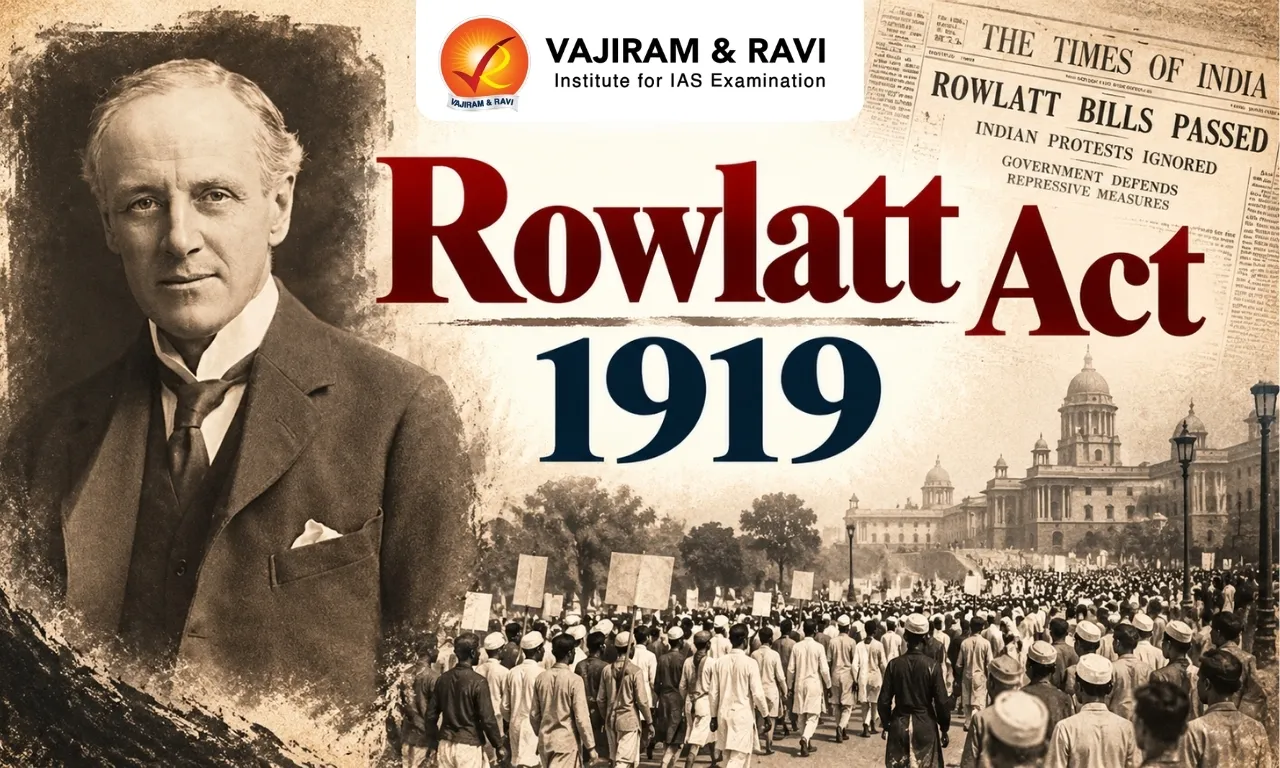
The Rowlatt Act 1919 was a controversial law introduced by the British colonial government to suppress revolutionary activities and nationalist movements in India. Officially known as the Anarchical and Revolutionary Crimes Act 1919, it permitted arrests without warrants, detention without trial and restrictions on civil liberties. Passed despite strong opposition from Indian representatives, the Act triggered nationwide protests under Mahatma Gandhi's leadership. The resulting Rowlatt Satyagraha became a turning point in India's freedom struggle and intensified opposition to British rule.
What is Rowlatt Act 1919?
The Rowlatt Act 1919 was a repressive legislative measure passed by the Imperial Legislative Council on 18 March 1919. It empowered the colonial administration to detain individuals suspected of revolutionary or seditious activities for up to two years without a regular trial. The legislation extended emergency powers introduced during the First World War into peacetime, weakening judicial safeguards and civil liberties. Its harsh provisions generated widespread public anger and became the basis of a nationwide movement against colonial repression.
Rowlatt Act 1919 Provisions
The Rowlatt Act 1919 expanded British administrative powers and restricted legal protections available to individuals suspected of political offences.
- Arrest Without Warrant: The government could arrest and search individuals suspected of revolutionary or seditious activities without obtaining a warrant, allowing authorities to act on suspicion rather than following ordinary legal procedures.
- Detention Without Trial: Suspected individuals could be imprisoned for up to two years without a regular trial. This provision weakened personal liberty and enabled the colonial government to suppress political opposition.
- Suspension of Habeas Corpus: The Act weakened the protection provided by habeas corpus, which allows individuals to challenge unlawful detention before a court. Consequently, detainees faced fewer effective safeguards against arbitrary imprisonment.
- Secret Trials: Special tribunals consisting of three High Court judges could conduct proceedings behind closed doors. Trials could take place without a jury, limiting public scrutiny of judicial decisions.
- No Right to Appeal: Individuals tried by special tribunals could not appeal against their verdicts. This removed an important judicial safeguard and made it difficult for accused persons to challenge potentially unjust decisions.
- Restrictions on Press and Public Activities: The government could restrict publications considered seditious, control public gatherings and impose conditions on released convicts. These measures limited freedom of expression and political participation.
- Slogan: The Act became associated with the slogan “No Dalil, No Vakil, No Appeal”, meaning no argument, no lawyer and no appeal. It expressed public anger over the denial of basic legal protections.


Rowlatt Act 1919 Historical Background
The historical background of the Rowlatt Act 1919 lies in British concerns about revolutionary nationalism during and after the First World War.
- First World War and Emergency Laws: During the war, the British government introduced the Defence of India Act 1915, to control revolutionary activities, restrict the press and detain suspected individuals. These powers were originally intended as temporary wartime measures.
- Formation of the Sedition Committee: In December 1917, a committee headed by British judge Sir Sidney Rowlatt was established to examine revolutionary activities in India. Its recommendations supported continuing exceptional powers after the war.
- Continuation of Wartime Restrictions: The committee recommended extending repressive provisions beyond the wartime period. The resulting legislation allowed the colonial administration to retain extraordinary powers over political dissent even after the emergency had ended.
- Betrayal of Political Expectations: Indians expected greater political freedom following their support for Britain during the war. Instead, the Act imposed further restrictions, creating widespread disappointment and strengthening nationalist opposition.
- Enactment Despite Opposition: The Imperial Legislative Council passed the legislation on 18 March 1919 despite strong objections from Indian members. The decision intensified criticism of British rule and encouraged resistance across the country.
Rowlatt Act 1919 Opposition
Opposition to the Rowlatt Act 1919 emerged across political groups and among ordinary Indians because the law threatened civil liberties and constitutional rights.
- Muhammad Ali Jinnah's Resignation: Muhammad Ali Jinnah opposed the legislation and resigned from the Imperial Legislative Council in protest. He described the law as a Black Act, highlighting its unjust restrictions on individual freedom.
- Resignation of Indian Members: Madan Mohan Malaviya and Mazharul Haque also opposed the legislation and resigned. Their actions demonstrated the seriousness of Indian representatives' objections to the government's decision.
- Public Anger: The Act provoked widespread resentment because it allowed detention without trial and restricted political activity. Many Indians considered the legislation inconsistent with the political reforms and greater freedom they expected after the war.
- Opposition to Colonial Repression: Nationalist leaders argued that the government was using exceptional powers to suppress legitimate political demands. The controversy strengthened public opposition to colonial policies and encouraged collective resistance.
Rowlatt Satyagraha
The Rowlatt Satyagraha was a nationwide movement led by Mahatma Gandhi in 1919 to oppose the Rowlatt Act through non violent resistance and civil disobedience.
- Formation of Satyagraha Sabha: Mahatma Gandhi established the Satyagraha Sabha in Bombay in February 1919 to organise resistance. Members pledged to oppose the legislation peacefully and spread awareness through meetings, pamphlets and public mobilisation.
- Nationwide Hartal on 6 April 1919: Gandhi called for a countrywide hartal on 6 April 1919. People closed shops, suspended business activities, observed fasting and prayers and participated in demonstrations to express opposition to the Act.
- Participation of Nationalist Leaders: Leaders including Vallabhbhai Patel, Jawaharlal Nehru, Rajendra Prasad, C. Rajagopalachari, Hakim Ajmal Khan and Dr. Saifuddin Kitchlew supported the wider agitation, helping extend opposition beyond individual political circles.
- Arrest of Local Leaders: The arrest and removal of Dr. Saifuddin Kitchlew and Dr. Satyapal from Amritsar intensified public anger in Punjab. Protests escalated as people demanded their release and challenged colonial restrictions.
- Escalation of Violence: Although Gandhi advocated non violence, disturbances and clashes occurred in several places. Violence deeply concerned Gandhi, who believed that the movement lacked sufficient discipline and that participants were not fully prepared for mass civil disobedience.
- Withdrawal of the Movement: Gandhi suspended the Rowlatt Satyagraha in April 1919 after violence spread. He later described the premature launch of mass civil disobedience as a Himalayan miscalculation, recognising the need for stronger non violent discipline.
Rowlatt Act 1919 Impacts and Aftermath
The Rowlatt Act 1919 transformed political opposition into mass resistance and intensified public awareness of colonial repression across different regions and communities.
- Rise of Gandhi as a National Leader: The Rowlatt Satyagraha brought Gandhi into the centre of national politics. His approach of non violent resistance demonstrated the potential to mobilise people across religious, social and regional boundaries.
- Jallianwala Bagh Massacre: The arrest of local leaders and growing tensions in Punjab formed the immediate political background to the Jallianwala Bagh Massacre on 13 April 1919. Troops under Brigadier General Reginald Dyer fired on a gathering in Amritsar, causing extensive casualties.
- Appointment of the Hunter Commission: The British government appointed the Disorders Inquiry Committee, popularly known as the Hunter Commission, on 14 October 1919 to investigate disturbances and official actions in Punjab, Delhi and Bombay. Its report criticised Dyer's actions as unjustified.
- Strengthening of Nationalist Unity: The protests brought together people from different communities and political backgrounds. The repressive response strengthened opposition to British rule and increased support for the demand for self government.
- Foundation for the Non Cooperation Movement: The experience of 1919 convinced Gandhi that a broader campaign was needed against colonial rule. The agitation and its aftermath helped prepare the ground for the Non Cooperation Movement launched in 1920.
- International Attention: Reports of the protests and the Jallianwala Bagh tragedy drew international attention to British repression. The events damaged the colonial government's credibility and encouraged sympathy for India's struggle for political freedom.
Rowlatt Act 1919 Revocation
The Rowlatt Act 1919 faced sustained opposition because its provisions undermined civil liberties and enabled arbitrary detention. The nationwide agitation, public criticism and growing nationalist mobilisation weakened the legitimacy of the legislation. The British government formally repealed the Act in March 1922, alongside several other repressive laws and regulations. Although its repeal came after prolonged resistance, the development demonstrated the political consequences of ignoring public demands. The controversy had already strengthened the national movement and contributed to the growing rejection of colonial rule.
Rowlatt Act 1919 Significance
The Rowlatt Act 1919 holds historical importance because it exposed the conflict between colonial authority and Indian demands for civil liberties and political freedom.
- Turning Point in the Freedom Struggle: The Act intensified opposition to British rule and transformed political dissatisfaction into widespread public protest. It marked an important stage in the development of mass nationalism in India.
- Expansion of Mass Politics: The Rowlatt Satyagraha demonstrated how hartals, peaceful demonstrations and civil disobedience could mobilise people across different regions. It helped establish mass participation as a major feature of the national movement.
- Importance of Civil Liberties: The controversy highlighted the dangers of detention without trial, restrictions on expression and denial of judicial remedies. It reinforced the importance of individual freedom and legal safeguards against arbitrary state power.
- Emergence of Gandhian Methods: The agitation brought non violent resistance to the national political stage. Despite its premature suspension, it provided important experience for later campaigns based on mass mobilisation and civil disobedience.
- Background to Future Movements: The events of 1919 strengthened the demand for self government and contributed to the political atmosphere preceding the Non Cooperation Movement. They also changed public perceptions of British intentions regarding Indian political reforms.
Rowlatt Act 1919 PYQs
The question asked in UPSC CSE PYQs related to Rowlatt Act 1919 has been listed below:
Question. With reference to Rowlatt Satyagraha, which of the following statements is/are correct? [UPSC CSE Prelims 2015]
The Rowlatt Act was based on the recommendations of the 'Sedition Committee'.
In Rowlatt Satyagraha, Gandhiji tried to utilize the Home Rule League.
Demonstrations against the arrival of Simon Commission coincided with Rowlatt Satyagraha.
Select the correct answer using the codes given below.
(a) 1 only
(b) 1 and 2 only
(c) 2 and 3 only
(d) 1, 2 and 3
Ans: (b)

 Last updated on Oct, 2026
→ UPSC 2027 Notification will be released on 13 January 2027 at upsconline.nic.in.
→ Check Nobel Prize 2026 Winners List here.
→ Check out the latest UPSC Syllabus here.
→ Download UPSC Calendar 2027 PDF Here.
Rowlatt Act 1919 FAQs
Q1. Who was the governor general when the Rowlatt Act passed in 1919?+
Q2. Which movement was launched by Mahatma Gandhi in 1919 against the Rowlatt Act?+
Q3. Who passed the Rowlatt Act in India?+
Q4. Why was the Rowlatt Act called the Black Act?+
Q5. What was the Rowlatt Act 1919 also known as?+
Q6. What were the main provisions of the Rowlatt Act 1919?+
Q7. What was the main objective of the Rowlatt Act 1919?+
Q8. How was the Rowlatt Act connected to the Jallianwala Bagh Massacre?+
Q9. What was the role of the Hunter Commission after the Jallianwala Bagh Massacre?+
Q10. Why was the Rowlatt Act 1919 repealed?+
Tags: rowlatt act rowlatt act 1919