


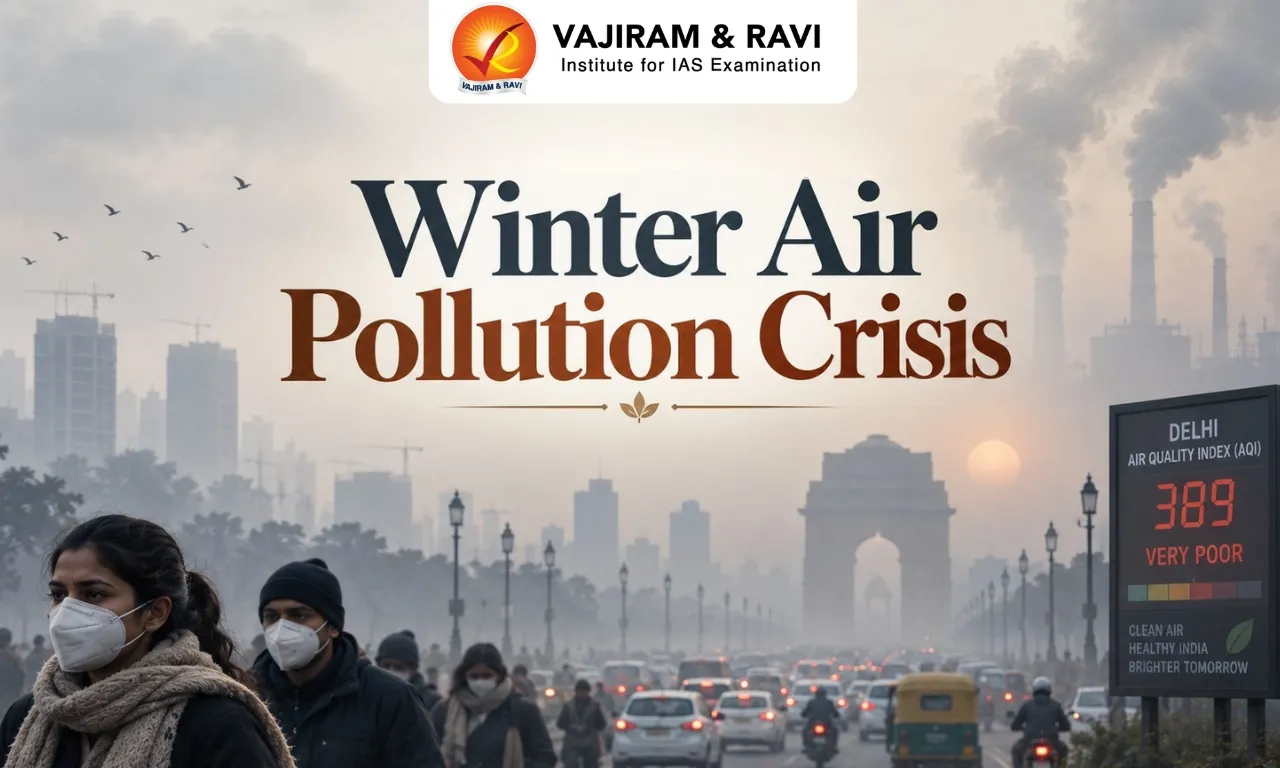
Winter air pollution is a recurring environmental and public health challenge in India, particularly across the Indo-Gangetic Plain and major urban centres. Emissions from vehicles, industries, power plants, construction activities and waste burning contribute to poor air quality, affecting public health and everyday life.
The crisis requires sustained action to reduce emissions, improve waste management, strengthen pollution-control measures and coordinate efforts across states. While Delhi-NCR remains a major example, addressing winter air pollution requires a wider, region-wide approach across India.
Why Does Air Pollution Worsen During Winter?
Winter weather conditions make it harder for pollutants to disperse, allowing them to accumulate close to the ground.
- Low wind speeds: Slow-moving air reduces the dispersion of pollutants.
- Temperature inversion: When warmer air lies above cooler air near the surface, vertical mixing is restricted and pollutants remain trapped close to the ground.
- Shallow atmospheric boundary layer: The lower layer of the atmosphere in which surface emissions mix becomes relatively shallow, concentrating pollutants in a smaller volume of air.
- Seasonal emissions: Crop-residue burning, firecrackers and other combustion activities can add to the pollution load during this period.
- Regional transport: Winds can carry pollution from surrounding areas into Delhi-NCR, making the problem regional rather than exclusively local.
These conditions do not generate all the pollution themselves; they make emissions from human activities more difficult to disperse.
Major Sources of Winter Air Pollution
Winter air pollution in India results from a combination of local emissions, regional pollution and particles formed through chemical reactions in the atmosphere. The relative contribution of these sources varies across locations and over time.
- Vehicular and Industrial Emissions: Vehicles release particulate matter and gases such as nitrogen oxides, while industries contribute particulate matter, sulphur dioxide and other pollutants. These emissions also supply gases that react in the atmosphere to form secondary particles.
- Secondary Aerosols: Not all PM2.5 enters the air directly. Secondary organic aerosols form when volatile organic compounds (VOCs) from vehicles, industries, solvents and vegetation react in the atmosphere. Secondary inorganic aerosols form through reactions involving sulphur dioxide, nitrogen oxides and ammonia, producing sulphates and nitrates. In Delhi, these particles have accounted for substantial shares of PM2.5 in recent observations.
- Crop-Residue Burning: Burning agricultural residue after harvest releases smoke and fine particles. Winds can carry emissions from Punjab and Haryana towards Delhi-NCR, adding to pollution from local sources. Its contribution varies with the timing of fires and prevailing weather conditions.
- Road Dust and Construction: Dust generated by road traffic, construction, demolition and poorly maintained roads adds to particulate pollution. In Delhi, road dust accounted for 10.9% of PM2.5 in one reported observation, although its contribution varies over time.
- Waste Burning: Open burning of municipal and other waste releases fine particles and harmful gases. In one Delhi observation, waste burning accounted for 5% of PM2.5.
- Firecrackers: Fireworks release particulate matter and other pollutants, increasing the pollution load during festivals. Their impact can be especially significant when emissions coincide with unfavourable weather conditions.


What Do Recent PM2.5 Findings Reveal?
Data reported from the Indian Institute of Tropical Meteorology’s (IITM) Integrated Atmospheric Chemistry and Aerosol Toxicity Analysis Laboratory (AATAL) highlighted the contribution of several sources to Delhi’s fine particulate matter, or PM2.5.
For one reported observation, the estimated contributions were:
|
Pollution source |
Reported contribution to PM2.5 |
|
Vehicles |
25% |
|
Secondary organic aerosols |
18.4% |
|
Secondary inorganic aerosols |
16.5% |
|
Road dust |
10.9% |
|
Waste burning |
5% |
The reported findings also showed that the relative contribution of sources changed from day to day. On another reported day, secondary organic aerosols accounted for 24.6%, while vehicles and secondary inorganic aerosols each contributed 20.7%.
These figures are observations from a specific period, not fixed annual shares of Delhi’s pollution. They illustrate why source-apportionment studies and real-time monitoring are important for designing targeted interventions.
The inauguration of AATAL also highlights the growing role of scientific monitoring in understanding the chemical composition and sources of particulate pollution.
Health and Economic Impacts
Fine particulate matter is a major concern because small particles can penetrate deep into the respiratory system. Exposure to polluted air can affect both short-term health and the risk of longer-term disease.
- Respiratory health: Pollution can aggravate asthma, bronchitis and other respiratory conditions.
- Cardiovascular health: Fine particulate matter is associated with increased cardiovascular risks.
- Vulnerable groups: Children, older people, outdoor workers and individuals with existing health conditions face particular risks.
- Education and work: Poor air quality can disrupt outdoor activities, affect attendance and reduce productivity.
- Economic costs: Healthcare expenditure, lost working days and reduced quality of life impose costs on households and the wider economy.
Air pollution is therefore not simply a seasonal inconvenience. It is a public health and governance challenge requiring preventive action throughout the year.
Delhi-NCR and the Graded Response Action Plan
The Graded Response Action Plan (GRAP), implemented by the Commission for Air Quality Management (CAQM), prescribes progressively stricter measures as air pollution worsens in Delhi-NCR.
|
GRAP stage |
AQI category |
AQI range |
|
Stage I |
Poor |
201–300 |
|
Stage II |
Very Poor |
301–400 |
|
Stage III |
Severe |
401–450 |
|
Stage IV |
Severe+ |
Above 450 |
Measures include dust control, restrictions on construction activities, vehicle-related curbs and controls on diesel generator sets, depending on the stage and applicable directions.
On 28 September 2026, CAQM approved a revised GRAP schedule. Key changes included moving restrictions on certain buses and measures concerning diesel generator sets from Stage II to Stage I, consolidating repeated provisions on dust, municipal solid waste and transport, and extending certain vehicle restrictions to Sonipat. The revised schedule is intended to enable earlier action against pollution.
Government Measures and Delhi’s Winter Action Plan
Delhi’s Winter Action Plan for 2026–27 includes measures to control road dust and strengthen scientific monitoring of air pollution.
- Mechanised Road Cleaning: The Delhi Cabinet approved 30 electric vehicle-based mechanical road-sweeping machines for smaller roads. The initiative covers 854 roads across 250 municipal wards, spanning approximately 609 km, with a right of way below 10 metres. The Municipal Corporation of Delhi will deploy and operate the machines.
- Real-Time Pollution Monitoring: A five-year collaboration with IIT Delhi will support continuous, real-time analysis of PM2.5 and PM10 sources, including vehicular emissions, road dust and biomass burning. The project also includes plans to restart an existing monitoring site and mobile laboratory.
- Enforcement Measures: Other pollution-control actions include inspections of construction sites, enforcement of vehicle pollution-under-control requirements, traffic management and action against open waste burning and polluting industrial activities.
The road-sweeping initiative and IIT Delhi collaboration were approved by the Delhi Cabinet on 29 September 2026. Together, they combine ground-level dust control with scientific monitoring to help identify pollution sources and guide targeted action.
Also Read:- Delhi Air Pollution 2026
Beyond Delhi: The Need for Regional Action
While GRAP and Delhi’s Winter Action Plan address pollution within the capital, some sources lie beyond its administrative boundaries. Crop-residue burning in neighbouring states and the movement of pollutants across regions make coordination essential for effective air-pollution control.
Regional coordination should focus on:
- Crop-Residue Management: Monitoring stubble burning and supporting practical, affordable alternatives for farmers.
- Coordinated Enforcement: Aligning pollution-control measures across Delhi, Punjab, Haryana, Uttar Pradesh and relevant central agencies.
- Data Sharing: Sharing air-quality and source-apportionment data to identify changing pollution sources and guide action.
- Regional Emission Control: Enforcing regulations on industrial emissions, transport, waste management and other sources across state boundaries.
The focus must shift from isolated state-level interventions to an airshed-based approach, which considers the wider geographical area through which pollutants travel. This would help align local measures with regional emission reduction and make pollution-control efforts more effective.
Way Forward
A lasting response to the Winter Air Pollution Crisis requires a shift from seasonal emergency action towards year-round pollution prevention.
- Use scientific evidence: Expand real-time monitoring and source-apportionment studies to identify changing pollution sources.
- Reduce vehicle emissions: Improve public transport, manage congestion and enforce vehicle-emission standards.
- Control dust: Strengthen road maintenance, mechanical sweeping, construction-site inspections and dust suppression.
- Improve waste management: Prevent open burning and expand reliable collection, segregation and processing systems.
- Address crop-residue burning: Provide farmers with affordable alternatives, machinery and viable uses for agricultural residue.
- Enforce industrial standards: Improve inspections and ensure that emission-control systems operate effectively.
- Regulate firecrackers: Ensure compliance with applicable restrictions and verify the standards of products sold as green crackers.
- Strengthen regional cooperation: Coordinate policies and share data across Delhi-NCR and neighbouring states.
- Measure outcomes: Assess policies through transparent indicators rather than relying only on announcements or the number of measures introduced.

 Last updated on Oct, 2026
→ UPSC 2027 Notification will be released on 13 January 2027 at upsconline.nic.in.
→ Check Nobel Prize 2026 Winners List here.
→ Check out the latest UPSC Syllabus here.
→ Download UPSC Calendar 2027 PDF Here.
Winter Air Pollution Crisis FAQs
Q1. Why does air pollution worsen during winter?+
Q2. What are the major sources of Delhi’s winter air pollution?+
Q3. What is PM2.5?+
Q4. What is the Graded Response Action Plan?+
Q5. Why is regional coordination important for controlling Delhi’s air pollution?+
Tags: winter air pollution winter air pollution crisis